Averroes: Córdoba's Philosopher Who Saved Aristotle
Born in Córdoba in 1126, Averroes wrote the commentaries that returned Aristotle to Christian Europe. Thomas Aquinas read him. Paris called him the Commentator.
Art history background with eight years writing interpretive content on Córdoba's Caliphal heritage.
Published
Updated
The most thorough interpreter of Aristotle in medieval history was a Muslim judge from Córdoba who died in exile and whose books were preserved not in any Arabic city, but in Hebrew and Latin translation. Ibn Rushd (Averroes) wrote three tiers of commentary on virtually the whole Aristotelian corpus, and when Michael Scot translated them into Latin at Toledo in 1217, he handed the universities of Paris and Oxford a complete Aristotle, with a sophisticated guide already attached. Christian scholars gave him a title no Muslim thinker had ever received: the Commentator.
In this article
The philosopher who became "the Commentator"
Aristotle's full philosophical corpus had largely vanished from Latin Europe after the fall of the Western Roman Empire. By the 12th century, scholars in Paris and Oxford knew fragments (some logic, a little natural philosophy), but the Metaphysics, the De Anima, the Nicomachean Ethics were gone. Not destroyed, simply untranslated, sitting in Arabic in the libraries of cities they had never visited.
38
The number of commentaries Averroes produced on Aristotle: a body so thorough that Latin medieval scholars referred to him simply as "the Commentator", as though the task had been completed once and needed no successor.
Averroes changed that. Working in Córdoba and Seville through the 1170s and 1180s, he produced the most systematic exposition of Aristotle's thought the world had yet seen. When Michael Scot began translating those commentaries from Arabic into Latin at Toledo in 1217, he handed medieval Europe a complete Aristotle, with a sophisticated guide already attached.
Within a generation, Averroes was standard reading at the University of Paris. Thomas Aquinas, writing his Summa Theologiae in the 1260s, cited him on nearly every major question in natural philosophy. When Aquinas needed to disagree, on the eternity of the world and the unity of the intellect, he still had to go through Averroes to do it. The name he used was simply the Commentator, just as Aristotle was always the Philosopher.
The paradox is sharp. In his own lifetime, Averroes was condemned by the Almohad court that had once employed him, his books burned in public squares across Andalusia. He died in Marrakech, rehabilitated but spent, in December 1198. The works that would shape the European university system for two centuries were kept alive not in any Arabic city, but in Hebrew and Latin translation.
To understand how that happened, you need to go back to Córdoba at its height under the Almohads, and to the family that produced him.
A qadi's son, born to argue
His full name was Abu al-Walid Muhammad ibn Ahmad ibn Muhammad ibn Rushd. Three generations of the ibn Rushd family had served as chief judges (qadis, Islamic magistrates who applied sharia law) of Córdoba. His grandfather, also named Abu al-Walid Muhammad, had been imam of the Great Mosque under the Almoravid dynasty and one of the most respected Maliki jurists in Andalusia. His father taught him the Muwatta of Imam Malik, the canonical text of Maliki jurisprudence, before he was a teenager.
Born on 14 April 1126[1], Averroes grew up in a household where legal disputation was professional duty, not eccentricity. He trained in hadith, Islamic law, theology, and medicine. His medical teacher, Abu Jafar Jarim al-Tajail, may also have introduced him to philosophy, falsafa (from the Greek philosophia), the tradition of rational inquiry that Arab scholars had been translating and developing since the 8th century. Córdoba had its own precedent here: Ibn Hazm, born in the city in 994, had combined Zahiri legal rigour with philosophical ambition a century before Averroes, leaving a model of Córdoban systematic inquiry that Averroes inherited alongside the law books.
The commission that shaped his life came through the Almohad caliph Abu Yaqub Yusuf, who summoned Averroes to Marrakech around 1169. The caliph wanted someone to explain Aristotle's texts: the existing Arabic paraphrases were too obscure for non-specialists. Averroes got the job. He was also appointed qadi of Seville that same year, then chief judge of Córdoba in 1171.
This created a double life: jurist by appointment, philosopher by vocation. Such dual roles were not unusual in Andalusian court circles. What was unusual was his scope. Most scholars of his generation wrote on one domain. Averroes wrote on all of them: law, medicine, astronomy, theology, and above all, Aristotle. His medical encyclopaedia, the Kitab al-Kulliyat (known in Latin as the Colliget), remained a primary text in Jewish, Christian, and Muslim medical institutions well into the 16th century[2]. He also critiqued Ptolemaic astronomy, a bold move in an era when Ptolemy's geometric models were the accepted framework. Moorish Córdoba at its intellectual height produced polymaths reliably, but Averroes was exceptional even by those standards.
Saving Aristotle: the translation chain
To grasp what Averroes did, you need the longer timeline. Aristotle wrote in Greek in Athens in the 4th century BC. His works moved into Syriac in the 5th and 6th centuries, then into Arabic at the House of Wisdom in Baghdad during the 8th and 9th centuries — one of the most consequential translation projects in intellectual history. By the time Averroes was born, Arabic was the primary language of Aristotelian philosophy.
Averroes wrote three levels of commentary on the major works, following a system he inherited from earlier commentators but executed at unprecedented scale:
- The jami' (short summary): concise paraphrases for general readers, covering the main argument without technical detail
- The talkhis (middle commentary): intermediate analysis for educated students, balancing clarity with philosophical depth
- The tafsir (long commentary): line-by-line exegesis for scholars, the format that would become the scholastic standard in Latin Europe
He applied this across six major Aristotelian works:
Timeline
4th c. BC
Aristotle writes in Athens
Original Greek philosophical corpus completed.
5th–6th c.
Greek → Syriac
Nestorian Christian scholars translate Aristotle into Syriac.
8th–9th c.
Syriac → Arabic
House of Wisdom in Baghdad produces Arabic translations and commentaries.
1170s–1180s
Averroes' commentaries
Ibn Rushd writes three tiers of commentary on the major Aristotelian works in Córdoba.
1217+
Arabic → Latin
Michael Scot translates Averroes at Toledo; the long commentaries reach Paris and Oxford.
1230s+
The university standard
Paris and Oxford arts faculties adopt Averroes as the authoritative guide to Aristotle.
- Metaphysics
- Physics
- De Anima (On the Soul)
- Nicomachean Ethics
- Posterior Analytics
- On the Heavens
Not all three commentary levels exist for every text, but the coverage is extraordinary for one person working without institutional support in the modern sense.
Michael Scot's Latin translations from Toledo, beginning around 1217[3], brought the long commentaries to the University of Paris. Hermannus Alemannus translated further texts in the same decades. By the 1230s, the arts faculties at Paris and Oxford were building curricula around Aristotle as explained by Averroes. When the Bishop of Paris condemned 13 Averroist propositions in 1270, and 219 more in 1277[4], he was responding to something already embedded in the university. Siger of Brabant and the Latin Averroists at Paris were drawing consequences from Averroes that even Averroes hadn't endorsed.
The irony the Latin scholars probably did not dwell on: many of Averroes' original Arabic works were lost or suppressed in the Islamic world. They survive today primarily in Hebrew and Latin translation.
The Incoherence of the Incoherence — and Maimonides next door
Averroes was a combatant as much as a commentator.
In 1095, the Asharite theologian Abu Hamid al-Ghazali published Tahafut al-Falasifa — The Incoherence of the Philosophers. His thesis: philosophy is incompatible with Islam on three specific points. Philosophers claim the world is eternal (requiring no creator); that God knows only universals, not individual humans; and that bodily resurrection is impossible. Al-Ghazali did not just disagree with these positions; he argued the philosophers' own logic was incoherent.
Averroes answered him in the 1180s with Tahafut al-Tahafut (The Incoherence of the Incoherence). The format was deliberate: he quoted al-Ghazali verbatim, then dismantled each argument point by point. His core position came in the Fasl al-Maqal (The Decisive Treatise): the Quran commands the study of philosophy; demonstrative truth cannot contradict divine truth; apparent conflicts require allegorical interpretation of scripture. "Truth does not contradict truth" is his most quoted line, and it was not a diplomatic retreat. It was a philosophical claim about the unity of knowledge.
Latin readers later attributed to Averroes a "doctrine of double truth": that something can be true in philosophy but false in theology. Averroes never held this view. He argued for a single, harmonious truth; the confusion originated with later followers, particularly Siger of Brabant, who pushed his ideas further than he had.
Meanwhile, a few streets away in Córdoba's Jewish quarter, another thinker was working through the same set of problems from a different tradition. Maimonides (Moses ben Maimon) was born in Córdoba in 1138, twelve years after Averroes. Both were formed by the same city, the same Andalusian culture of Arabic-language philosophy, and the same challenge of reconciling rational thought with revealed religion. In a 1199 letter to Samuel ibn Tibbon, Maimonides explicitly recommended studying Averroes' commentaries on Aristotle. That recommendation drove the Hebrew translation movement that preserved many of Averroes' works.
Neither man, as far as we know, ever met. But they are neighbours in the deepest sense: both Córdoba-born philosophers who became authorities for medieval Jewish and Christian thought, and whose arguments about reason and faith Córdoba's three-cultures heritage has been trying to explain to visitors ever since.
1195 — when Córdoba turned on him
The disgrace came at the height of his reputation. By 1195, Averroes was physician to the caliph, chief judge, and the man Andalusian scholars turned to when they needed Aristotle explained. Then the fuqaha (Islamic legal scholars) of Córdoba moved against him.
The political circumstances were specific. The Almohad caliph Abu Yusuf Yaqub al-Mansur needed conservative theologians on his side for ongoing military campaigns. The fuqaha argued that Averroes' defence of philosophy, particularly his claim in the Fasl al-Maqal that philosophical study was obligatory for qualified elites, contradicted literal interpretation of scripture and diminished God's direct intervention in the world. Al-Mansur, calculating the political cost, sacrificed him.
Averroes was exiled to Lucena, a largely Jewish town near Córdoba. His books were banned and burned in public squares across Andalusia. The man who had spent decades arguing that reason and revelation were compatible found himself condemned by the institution that should have been his natural constituency.
The exile lasted only a few years. Al-Mansur pardoned him, likely recognising that he was too useful to waste. But the rehabilitation was brief. Averroes died in Marrakech on 11 December 1198, aged 72. His remains were transported back to Córdoba some three months later.
The young Ibn al-Arabi (Abu Abdullah Muhammad ibn Ali ibn Muhammad, then about 33, not yet the Sufi mystic he would become) was among those who watched the funeral cortège arrive at Córdoba's gates. He had met Averroes years earlier, when the philosopher sought out the young man whose spiritual gifts were already being talked about. Ibn al-Arabi later described the body loaded onto one side of a beast of burden, Averroes' written works counterbalancing the corpse on the other side. His reflection on the sight became one of the most quoted lines in medieval biography:
Better known in Paris than in Córdoba for three centuries
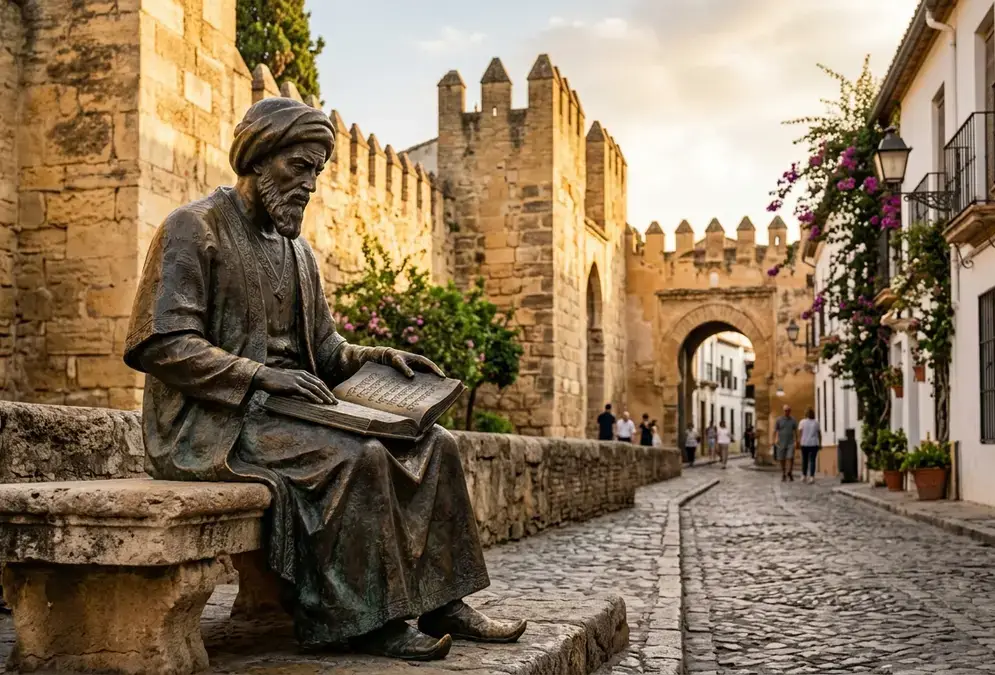
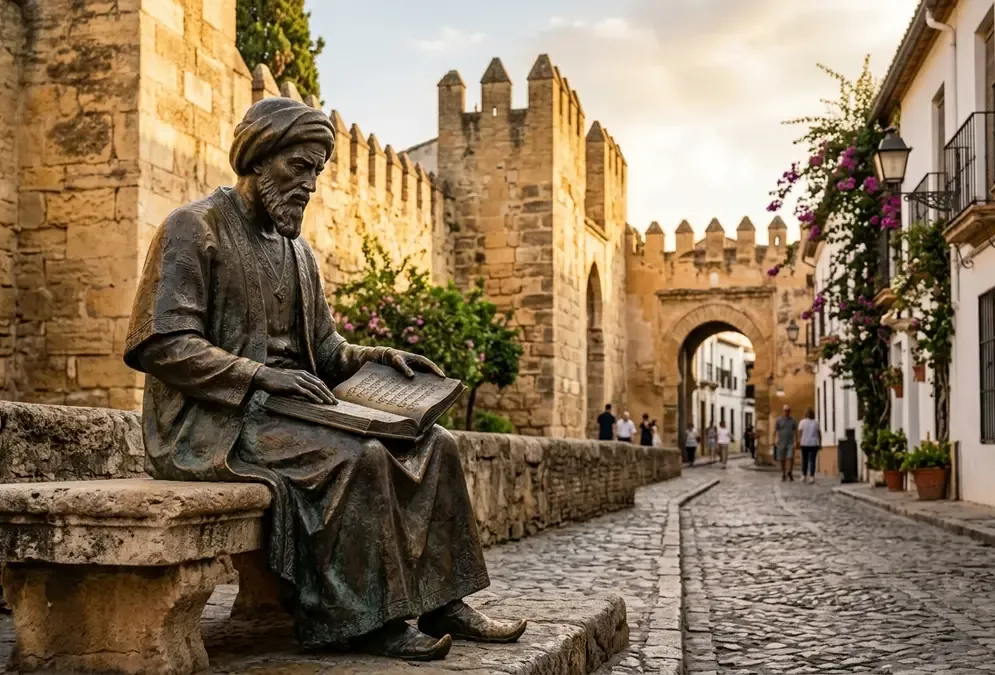
The bronze statue on Calle Cairuán is easy to miss if you are moving quickly through the Judería. Pablo Yusti Conejo cast it in 1967, and it sits on a stone plinth beside the medieval wall, not far from the Almodóvar Gate. Averroes is seated, a book open on his knee, his gaze level. The location is deliberate: the statue stands at the edge of the medieval Moorish quarter and the ancient Judería wall, which is roughly where Averroes himself stood intellectually.
The Casa de Sefarad, a short walk away, contextualises the medieval neighbourhood where Jewish and Muslim scholars worked in proximity. It is one of the few places in the city where you can read about Maimonides and understand why Córdoba keeps insisting on its three-cultures identity: not a myth of perfect harmony, but a fact of dense intellectual cohabitation.
Ernest Renan's 1852 essay Averroès et l'averroïsme introduced the philosopher to 19th-century French readers as a symbol of rational philosophy defending itself against religious literalism. That framing (useful, slightly anachronistic) stuck. The 20th-century Moroccan philosopher Mohammed Abed al-Jabri named Averroes the founder of modern rationalism in the Arab tradition, positioning him as an icon of Arab intellectual modernity and the defence of scientific reason against orthodoxy.
Pablo Yusti Conejo's 1967 bronze of Averroes, on Calle Cairuán beside the medieval Judería wall: the philosopher's only monumental honour in the city of his birth.
Both readings simplify him. Averroes was not a secular philosopher avant la lettre. He was arguing for philosophy within Islam, not against it. The "Truth does not contradict truth" principle was a theological position as much as a philosophical one.
What you see if you stand by the statue on a quiet afternoon (before the tour groups arrive from the Mezquita) is a man sitting with his book in a narrow street that once belonged to a city that was, at its Caliphate-era height, among the largest in western Europe. A Muslim judge condemned by his own government, whose works were preserved by Jews and Christians, better known in Paris than in any Arabic capital for the next three centuries: that is the real Córdoba paradox, and this single bronze on a side street is its only monument in the city of his birth.
FAQ about averroes córdoba
Who was Averroes and why does Córdoba claim him?
Averroes (Ibn Rushd, 1126–1198) was born in Córdoba to a family of chief judges and became the most influential commentator on Aristotle in medieval history. His works, translated into Latin at Toledo in the early 13th century, formed the basis of university philosophy at Paris and Oxford. Córdoba claims him as its greatest medieval intellectual, alongside Maimonides, born in the city twelve years later.
What did Averroes actually do with Aristotle's writings?
He wrote three levels of commentary: short (jami'), middle (talkhis), and long (tafsir), applied to virtually the whole Aristotelian corpus, including the Metaphysics, De Anima, Nicomachean Ethics, and Physics. The long commentaries, translated into Latin by Michael Scot from 1217 onwards, became the standard guide to Aristotle at European universities, filling a gap that had existed since the fall of Rome.
Why was Averroes exiled in 1195?
The Almohad caliph Abu Yusuf Yaqub al-Mansur exiled him to Lucena, near Córdoba, under pressure from conservative theologians who objected to his defence of philosophy as an Islamic duty. His books were burned in public squares across Andalusia. The exile lasted only a few years; he was pardoned before his death in Marrakech in 1198. The political calculation was simple: the caliph needed the fuqaha's support for military campaigns more than he needed his court philosopher.
How did Averroes influence Thomas Aquinas and Christian Europe?
When Latin translations of Averroes' long commentaries reached Paris and Oxford in the 1220s and 1230s, arts faculties built their Aristotle curricula around them. Thomas Aquinas, writing the Summa Theologiae in the 1260s, used Averroes as his principal interpretive guide to Aristotle (citing him as 'the Commentator'), even while disagreeing with his conclusions on the eternity of the world and the unity of the intellect. The Bishop of Paris condemned 219 Averroist theses in 1277, which suggests how deeply embedded in university culture they had become.
Did Averroes believe philosophy contradicts Islam?
No. His core argument was the opposite: that the Quran commands the study of philosophy, and that demonstrative truth cannot contradict divine truth. 'Truth does not contradict truth' is his most-quoted line. When conflicts appear between reason and revelation, he argued they require allegorical reading of scripture. Latin readers later attributed to him a 'double truth' doctrine (that something can be true in philosophy but false in theology), but Averroes never held this position.
What happened to Averroes' body after he died in Marrakech?
He died on 11 December 1198. His remains were transported back to Córdoba some three months later. The young Ibn al-Arabi, later the great Sufi mystic, watched the funeral cortège arrive at the city's gates and described the body loaded on one side of a mule, his books counterbalancing the corpse on the other side. He recorded the image in one of medieval biography's most striking lines: 'On one side the Master, on the other his books.'
Was Maimonides influenced by Averroes?
Maimonides (1138–1204) was born in Córdoba twelve years after Averroes, in the same neighbourhood. In a 1199 letter to Samuel ibn Tibbon, who was translating Maimonides' own Guide for the Perplexed into Hebrew, Maimonides explicitly recommended studying Averroes' commentaries on Aristotle. That recommendation drove the Hebrew translation movement that preserved many of Averroes' works after the Arabic originals were lost or suppressed.
Where can I find Averroes' statue in Córdoba?
The bronze statue, cast by Pablo Yusti Conejo in 1967, stands on Calle Cairuán beside the medieval Judería wall, a short walk from the Almodóvar Gate. It shows Averroes seated with a book on his knee. There is no dedicated museum, but the Casa de Sefarad nearby provides context for the medieval neighbourhood where Jewish and Muslim scholars worked in proximity. The statue is on most walking routes through the Jewish quarter and is easily combined with a visit to the Almodóvar Gate itself.