
Bishop Alonso de Manrique and the 1523 petition
The decision to insert a cathedral into the Mezquita did not originate with Charles V. It originated with Bishop Alonso de Manrique, who had held the see of Córdoba since 1516 and spent years frustrated by what he saw as an inadequate liturgical space inside the converted mosque.
The Mezquita had been consecrated as a Christian cathedral in 1236, when Ferdinand III of Castile took Córdoba from the Almohad rulers[1]. The conversion changed its function but not its fabric: a main altar was set up under the mihrab dome, chapels were carved into the outer walls, and the congregation worshipped under the forest of 856 marble and jasper columns[2] that Abd al-Rahman I had built in 784. For nearly three centuries, the building remained substantially intact. The Mezquita-Cathedral that visitors see today owes its hybrid character to that long period of restraint as much as to what came after.
By the early 16th century, the cathedral chapter wanted something different. They wanted a proper cruciform nave with choir stalls, a raised presbytery, and a vaulted ceiling — a building that looked like a cathedral rather than a mosque with Christian furniture arranged inside it. Manrique led the petition to the crown, arguing that the existing space was liturgically unsatisfactory. The chapter sent their request to Charles V in 1523.
Charles V, then 23 years old and two years into his reign as Holy Roman Emperor, granted the permission[1]. He may not have known what the project would require in physical terms. He was administering an empire that stretched from Spain to the Americas, and an architectural petition from a bishop in Andalusia was not the most pressing item on his desk.
The death threat from Córdoba's city council
The cathedral chapter had anticipated resistance and gone to the king precisely because local opposition was too strong to overcome otherwise. What they had not quite anticipated was how formal that opposition would become.
In 1523, Córdoba's city council issued a formal protest against the project, reportedly going so far as to declare that anyone who dared alter the mosque-cathedral would face severe penalties[1]. The cited sources describe the opposition as vigorous and official; the specific terms of the council's proclamation vary across historical accounts. What is not in doubt is that the opposition was recorded and formal: the council was asserting that the building belonged to the city in a way that no royal decree could override.
Explore nearby · Monument
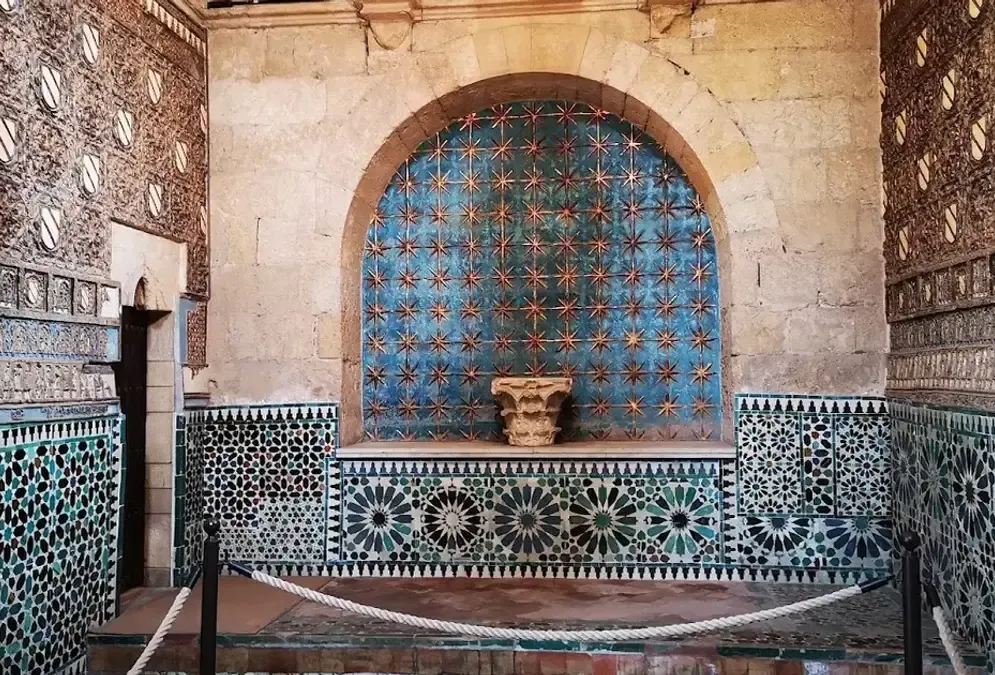
Capilla de San Bartolomé
A late 14th-century Gothic-Mudéjar chapel in Córdoba with exquisite plasterwork, blending Christian and Islamic artistic traditions over 600 years old.
The position was not sentimental. Córdoba in 1523 was a city built around the Mezquita in a physical sense: the old quarter's streets, markets, and social life organized themselves around the mosque's perimeter. The building was also understood, even by the Christian population that had worshipped in it for nearly three centuries, as something irreplaceable. It had no parallel in Spain or in Europe.
The cathedral chapter's strategy was legally correct: by obtaining royal permission first, they placed the city council in the position of defying the crown rather than simply defending a local monument. The proclamation was never enforced. Construction began in 1523 despite it, under the direction of architect Hernán Ruiz I[2]. The council's threat became a historical footnote rather than a legal obstacle, but it preserved, in the administrative record, the fact that Córdoba itself did not want this.
This detail matters for how visitors read the building today. The hybrid structure is sometimes presented as a natural evolution, two traditions coexisting in the same walls. The death-threat proclamation makes clear that the coexistence was imposed, and that the people who knew the building best voted against it.
84 years of construction: Hernán Ruiz I to Juan de Ochoa
The project that Charles V authorized in 1523 was not completed until 1607 — eighty-four years later, spanning three architects and three generations of builders[2]. The gap between authorization and completion tells you something about the scale of the intervention.
Hernán Ruiz I began work immediately after the royal permission arrived. His task was to remove a section of the mosque's central forest of columns and replace them with a cruciform nave and transept in the Renaissance style then fashionable in Castile. He got the choir walls up to window height and completed the Gothic vaults on the south side before he died in 1547, with the main vault still unfinished.
84 years
His son, Hernán Ruiz II, inherited the project and the problem. He completed the central vault and added the dome above the crossing, then died in 1569 with the decorative programme still incomplete. Juan de Ochoa took over and finished the construction in 1607, adding the choir stalls and the final decorative elements that made the nave usable as a full liturgical space.
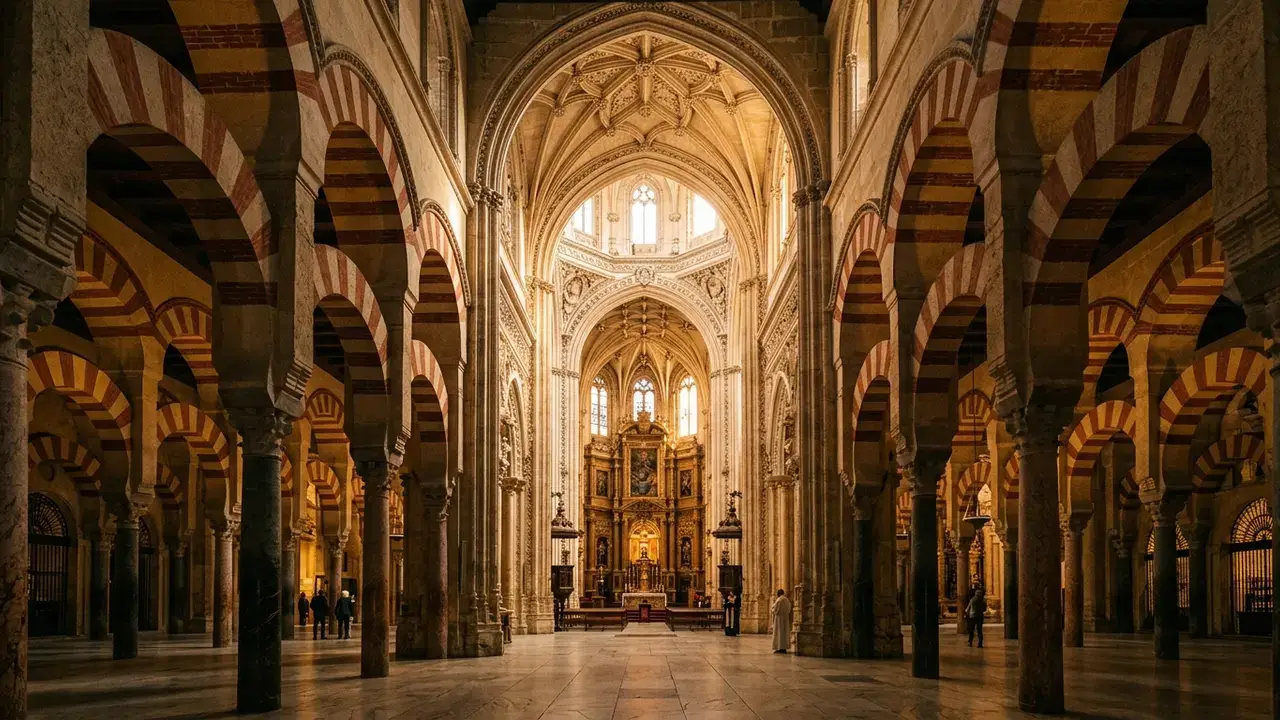
The physical result is a Renaissance cathedral nave rising through the centre of an Umayyad mosque, the two structures physically interlocked. The builders could not simply clear the space and build fresh: they were working around standing columns, existing foundations, and a perimeter wall that had UNESCO value before UNESCO existed. They cut through the mosque's roof and built upward, which is why, standing inside today, you can look left into the ancient column forest and right into a 16th-century European cathedral without taking a step.
The construction also required demolishing approximately 63 columns from Abd al-Rahman's original hypostyle hall[2] to create the nave's footprint. These were not recovered or relocated. They were removed. The number is approximate because the historical documentation of exactly which columns were lost and which were preserved is incomplete, but the physical absence is legible in the floor plan: the regularity of the column grid has a rectangular gap where the nave now sits.
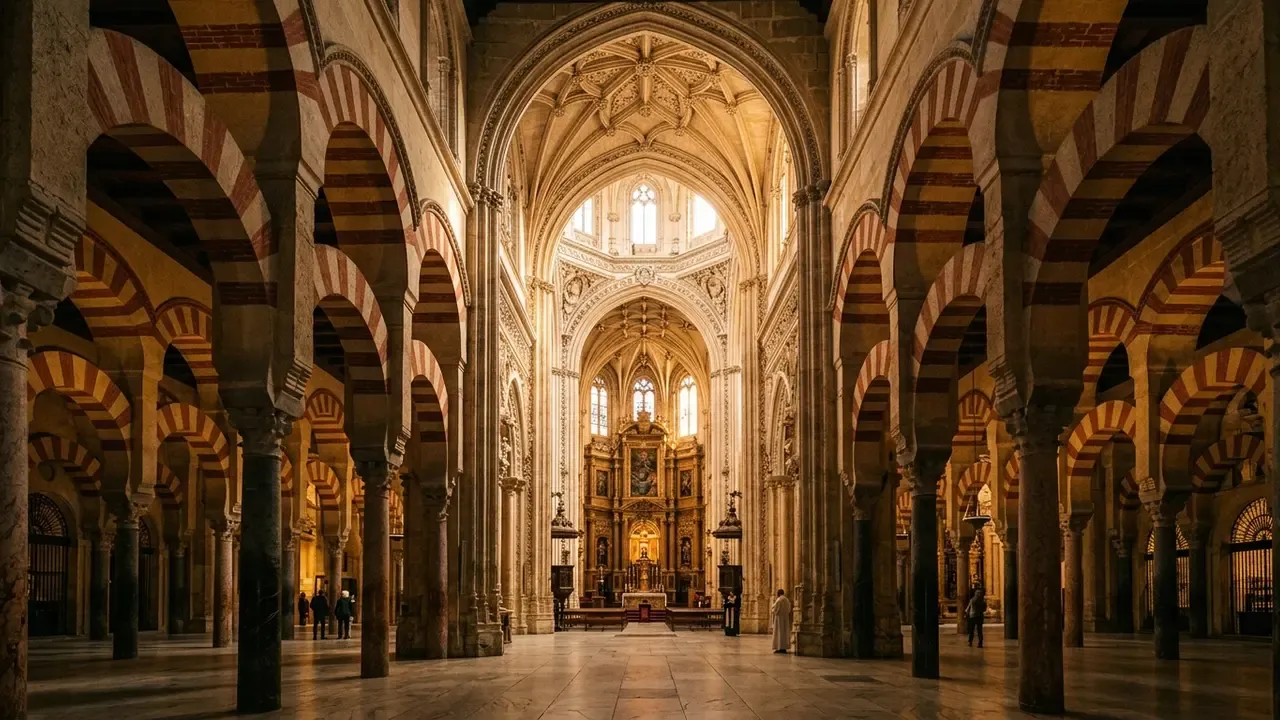
The Renaissance nave commissioned by Charles V in 1523 rises through the geometric centre of Abd al-Rahman I's hypostyle hall. Hernán Ruiz I began the work; Juan de Ochoa finished it in 1607. The two structures are physically interlocked: the builders cut through the mosque roof and built upward around the standing columns.
The quote Charles V probably never said
The most famous line associated with this decision is almost universally attributed to Charles V: "You have destroyed something unique in the world to build something that could have been built anywhere." It is a good line. It has the shape of genuine regret, a ruler acknowledging the cost of his own permission. It is also almost certainly not what Charles V said, and may not be what he said at all.
The provenance of the quote is uncertain, and historians who have traced it find no contemporary documentation to support it[1]. It does not appear in Charles V's letters or memoirs. It does not appear in the accounts of people who were present at his court. The first reliable attributions to Charles V come from 18th-century sources, roughly two hundred years after the event they purport to record.
The most frequently cited early source is Antonio Ponz, the Spanish art historian and traveller who published his Viaje de España between 1772 and 1794. Ponz visited the Mezquita and recorded the story of the emperor's regret. By that point, the anecdote had the quality of local tradition rather than documented history: widely repeated, emotionally satisfying, impossible to verify against a primary source.
Why did the story persist? Because it did exactly what a satisfying historical anecdote should do: it gave the decision a conscience. A king who regretted his own mistake is more interesting than a king who authorized a construction project and moved on to the next petition. The quote also served a purpose for later generations who wanted to frame the Mezquita as a monument that even its destroyers recognized as irreplaceable. An apocryphal line can be more culturally durable than a documented one, precisely because it expresses something true about the situation even if it was never actually spoken.
Modern historians treat the attribution with scepticism, and so should visitors who encounter it on guided tours or in the building's official literature[1]. The regret may have been real. The exact words almost certainly are not.
Did the 1526 visit actually happen?
The quote is usually attached to a specific moment: Charles V's visit to Córdoba in 1526, when he allegedly inspected the construction site and made the remark to the cathedral chapter. This visit has also been questioned.
Charles V was in Seville in 1526, already resident in Spain when the Battle of Pavia was fought in February 1525. He married Isabella of Portugal in Seville in March 1526 and spent several months in Andalusia. That he was in the region is documented. Whether he made a specific trip to Córdoba to inspect the Mezquita construction is not confirmed by any primary source[1].
This matters because the entire narrative of the famous quote depends on the visit. Without the visit, there is no scene at the construction site, no confrontation with the cathedral chapter, no occasion for the remark. The story requires a dramatic moment: Charles V standing inside the unfinished nave, looking at the damage, saying the words that would be remembered. Remove the documented visit and the scene has no anchor.
What we can say with confidence is that Charles V knew about the construction. He had authorized it. He received reports from Andalusia. Whether he ever stood in the Mezquita after 1523 and confronted the physical consequences of his decision is a question the historical record does not answer.
There is a pattern here that applies to many famous architectural regrets: the person with power makes a decision, the decision is implemented, something is lost, and later generations construct a narrative in which the decision-maker recognized the loss. The narrative is satisfying because it restores moral coherence. It does not follow that the recognition was expressed, or that the visit in which it was expressed took place.
The 1526 story also fits the Mezquita Conversion 1236 into a larger pattern: for three centuries after Ferdinand III took the city, the mosque was barely altered. The destruction came in 1523, under a Christian emperor whose power was far greater than any medieval king of Castile. The irony that the building survived the Reconquista and was damaged by the Renaissance is real, and it does not need a fabricated quote to make it resonant.
What visitors see in the Mezquita today
Standing inside the Mezquita-Cathedral today, the story of 1523 is physically readable without any prior knowledge. You enter through the Puerta del Perdón on the north side and cross into the Patio de los Naranjos, the orange-tree courtyard that the Umayyad builders laid out in the 8th century. Then you pass into the interior.
The first impression is the column forest: row after row of double-tiered arches, the lower tier horseshoe-shaped in the Visigothic manner, the upper tier semicircular, everything in alternating red brick and white stone[2]. The effect is of an interior that recedes in all directions, a space designed to make you feel you are inside something much larger than its actual dimensions.
Then, rising through the centre, the Renaissance nave: a completely different spatial logic, vertical and axial where the mosque is horizontal and diffuse, lit by high windows where the mosque was dim. The two structures do not blend. They sit inside each other. The contrast is what makes the Mezquita unlike any other building in the world, and it is a contrast produced by a decision that the city council called worthy of execution.
For visitors who want to read the building architecturally, a few specific things are worth locating:
Deep dive · Article
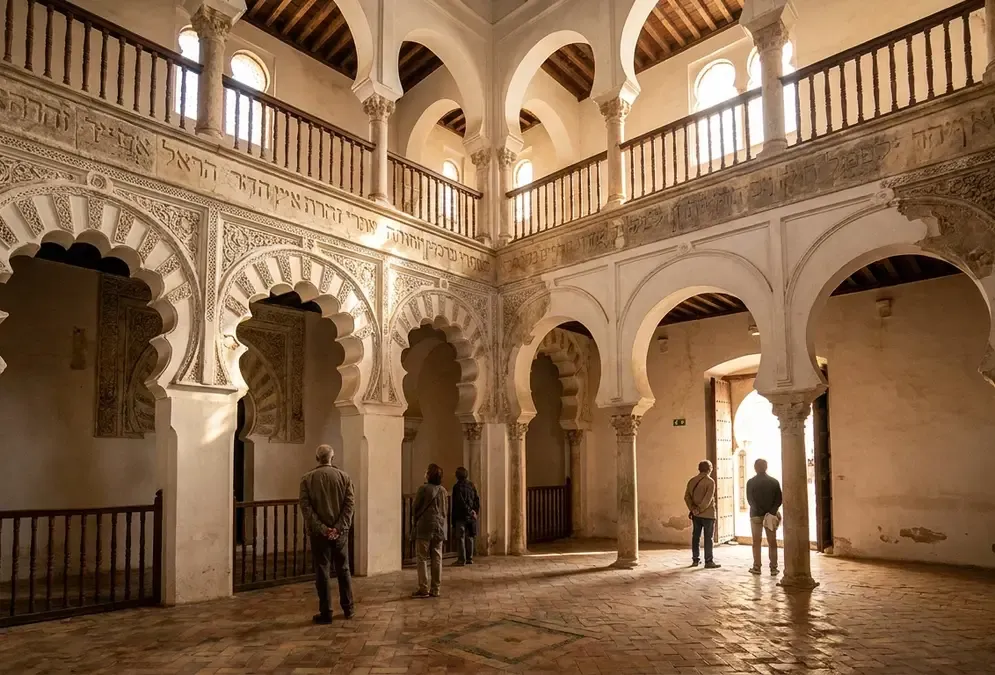
The Córdoba Synagogue's Five Lives Since 1315
Built in 1315 as a private yeshiva, the Córdoba Synagogue survived pogroms, became a rabies hospital, then a cobblers' chapel, before rediscovery in 1885.
- The mihrab in the south wall, finished in 965 under Al-Hakam II, with its Byzantine mosaics and scalloped shell dome. It is the finest surviving example of Umayyad architectural ornament in Spain.
- The Villaviciosa Chapel, immediately to the right of the entrance to the cathedral nave, where the first post-1236 Gothic interventions are visible. The ribbed vaults here predate the Hernán Ruiz nave by roughly a century.
- The choir stalls, completed by Juan de Ochoa in 1607, carved in cedar with scenes from the New Testament. They are excellent Renaissance craftsmanship and entirely out of scale with the columns surrounding them.
- The column grid gap, visible from the south aisle: where the nave sits, the regularity of the hypostyle hall breaks. The columns resume on the far side of the nave as if the grid were continuous, because it was, before Hernán Ruiz began demolishing.
Practical notes: the Mezquita opens at 10:00 daily (check the official Mezquita website for seasonal variations). Admission is free for Catholic Mass on weekday mornings, which is one way to experience the space without crowds, though access is limited during the service. Guided tours that focus specifically on the architectural layers are worth the cost — the building is dense enough that having someone point out the transitions between periods saves considerable time.