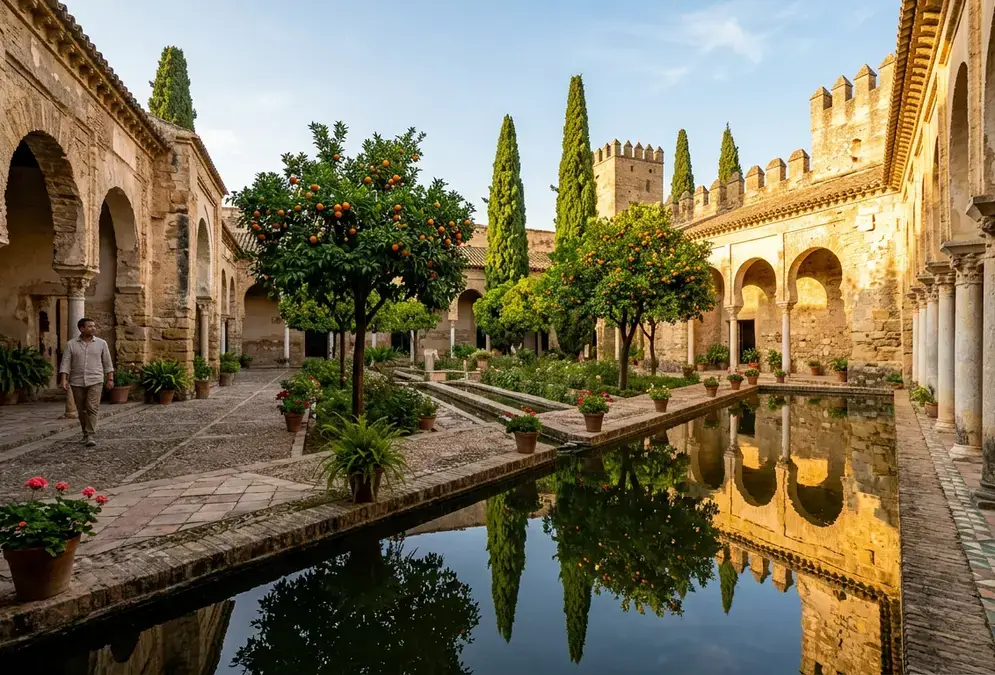

Córdoba, 1486: a Genoese merchant with a very long proposal
Columbus arrived in Córdoba in 1486[9]. He was not yet the Admiral of the Ocean Sea; he was a Genoese merchant and sometime cartographer with an idea, a rudimentary calculation about Atlantic distances that modern astronomers would later prove badly wrong, and a talent for persistence that bordered on the pathological.
The Catholic Monarchs, Ferdinand of Aragon and Isabella of Castile, were in the final decade of the Reconquista, the campaign to take Granada from the Nasrid sultanate and unify Spain under Christian rule. They were expensive wars, and the royal treasury was under strain. This was both a problem and an opportunity for Columbus: the monarchs were too busy and too poor to fund exploratory voyages immediately, but they were interested enough not to dismiss him.
His first royal audience came in May 1486, when Isabella received him at the Alcázar de los Reyes Cristianos in Córdoba[6]. The meeting went well enough that she expressed interest. The practical result was a royal commission: a committee of learned men, headed by the royal confessor Hernando de Talavera, was appointed to evaluate the proposal. Columbus was put on a retainer (enough to live on, not enough to go home) and told to wait.
He waited, on and off, for six years. The Talavera commission rejected his proposal in 1490 as geographically unsound (they were not wrong about the distances, which Columbus had underestimated by a factor of three). He approached the Portuguese court again; they declined. He packed his belongings in 1491 to leave for France, and was recalled only when Isabella and Ferdinand changed their minds at the last moment, after the fall of Granada in January 1492.
The Capitulations of Santa Fe, the final contract defining Columbus's rights, titles, and revenue shares, were signed in April 1492 near Granada at Santa Fe[7], not at Córdoba. The Alcázar was where the early audiences happened; the contract was concluded 130 kilometres to the southeast, at the military camp outside the conquered city. This distinction matters if you're tracing his journey.
A meeting in Córdoba, 1487
Beatriz Enríquez de Arana was born around 1465 in Santa María de Trassierra, a small village in the foothills north of Córdoba, where her family owned orchards, houses, and vineyards[1]. They were prosperous rural people: not common laborers, not nobility. She was literate, which in late 15th-century Castile already placed her well above the average for a woman of her background.
She was living in Córdoba with relatives when Columbus arrived in the city. They met in 1487; she was around 20 to 22 years old[1]. Popular accounts place the meeting somewhere near the Mezquita-Cathedral, one tradition holds they first spoke in the old quarter close to the mosque, though no document records exactly where or how. The detail appears in later chronicles and should be read as local memory rather than verified fact.
What is certain is that they became a couple. Columbus, a widower in his mid-thirties, did not marry her. He did not offer to marry her. He seems to have regarded the relationship as permanent in practice and unofficial by design.
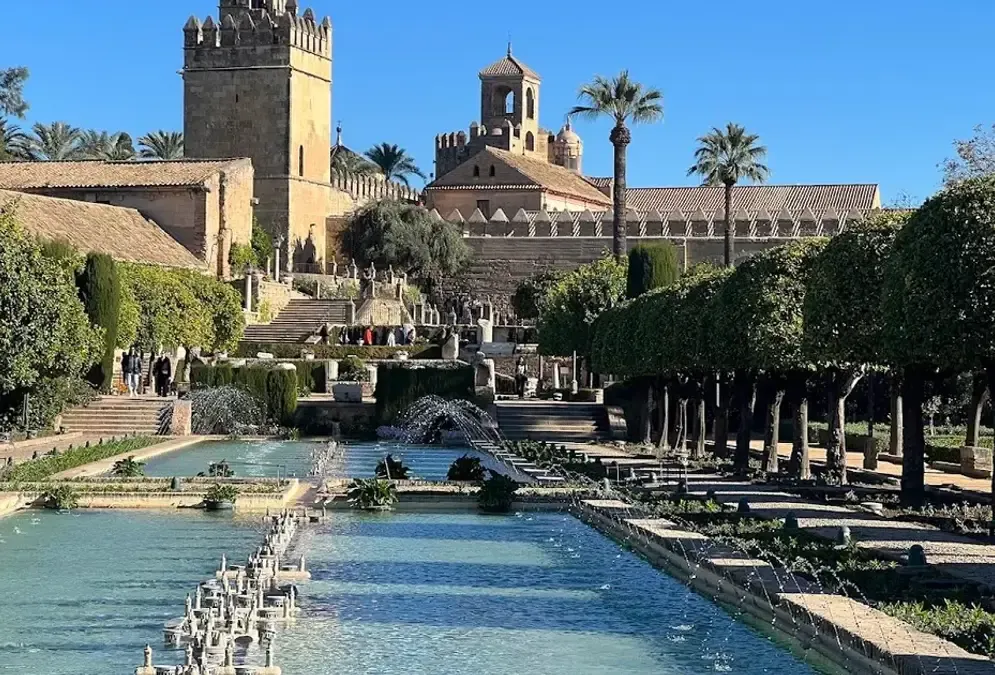
Explore nearby · Monument
Alcázar de los Reyes Cristianos
14th-century fortress where Columbus met the Catholic Monarchs. Roman mosaics, four climbable towers and stunning gardens. Free entry on Tuesdays. UNESCO site.
Their son, Ferdinand Columbus (Fernando or Hernando Colón in Spanish), was born on August 15, 1488, in Córdoba[1]. Columbus was away for much of the pregnancy and much of his son's childhood: lobbying courts, revising proposals, failing to secure funding, trying again. Beatriz raised Ferdinand largely alone, in a city where the father of her child was simultaneously famous by ambition and financially marginal. It was not an easy position.
Why he never married her
The question has no recorded answer. Columbus never explained his decision in any surviving letter or document. What historians can do is assemble the context and name the most probable reason.
By 1487, Columbus was pitching himself to royalty. His proposal was not just a navigational project; it was a social one. The Capitulations of Santa Fe gave him the title of Admiral of the Ocean Sea, the hereditary governorship of any lands he discovered, and ten percent of all revenue from those territories[2]. These were the demands of a man who saw himself becoming a magnate, not a salaried explorer.
To sustain that ambition in 15th-century Castilian society, marriage mattered enormously. A wife from non-noble origins, from a family of rural Córdoban farmers however prosperous and literate, would have been a liability, not an asset. The social arithmetic was cold: marrying Beatriz would have signaled to the Catholic Monarchs that Columbus was content to remain at her social level. He was not.
This is the dominant explanation among historians, and it holds together[3]. What it does not do is make Columbus look good. He built his entire project on the premise that he deserved a title and a percentage; he applied that logic to his partner as well. She produced a son for him, raised that son through years of his absence, and received in return a relationship with no legal standing and a pension that his legitimate heir would often fail to pay.
The codicil of May 19, 1506, dictated the day before his death in Valladolid, names Beatriz Enríquez de Arana directly[4]. He directed his son Diego to provide for her "so she can live honorably, as a person to whom I am under so great obligation." He acknowledged the obligation. He did not, in the remaining lines of a document he had time to think about, explain what the obligation was, or apologize for not having discharged it earlier.
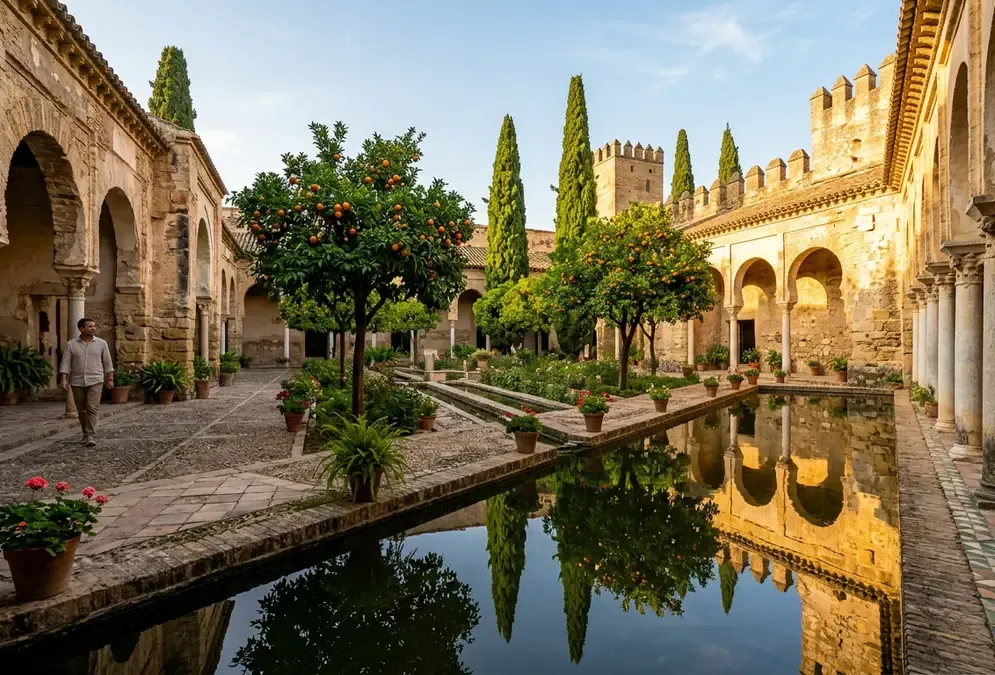
The Alcázar de los Reyes Cristianos hosted Columbus's first audience with Isabella in May 1486. He waited in and around Córdoba for six years before the final contract was signed 130 kilometres away at Santa Fe in April 1492.
Ferdinand Columbus: from Córdoba to the world's largest library
Ferdinand Columbus grew up without his father and with the knowledge that his birth made him the illegitimate son of an increasingly famous man. In 1494, when Ferdinand was six, Columbus took his two elder sons, Diego (the legitimate heir) and Ferdinand, to court, where they were assigned as pages to Prince Juan, the sole male heir to the Castilian throne[1].
This was an elite placement. The royal household ran on the humanist curriculum fashionable in late 15th-century Castile: Latin, rhetoric, history, natural philosophy. Ferdinand absorbed it completely. Where his father had been a practical navigator with an oversized idea, Ferdinand became a humanist bibliophile: a collector, annotator, and organizer of knowledge on a scale that nobody in his generation came close to matching.
His library, built over decades from the revenues of his father's titles and from his own substantial income, eventually held more than 15,000 volumes[2], making it one of the largest private collections in Renaissance Europe. He catalogued it obsessively. The Libro de los Epítomes, a handwritten catalog summarizing the contents of thousands of books, was lost for centuries and then rediscovered at the University of Copenhagen in 2013[2].
After Ferdinand's death in 1539, the collection passed to Seville Cathedral as the Biblioteca Colombina. The transfer was chaotic, the custody poor, and the losses catastrophic. Of more than 15,000 original volumes, fewer than 4,000 survive[2]. The rest were sold, lent out and not returned, damaged by humidity, or simply lost in the organizational disorder of an institution that did not quite know what it had.
15,000+
Ferdinand also wrote a biography of his father, Historia del Almirante, which is the most detailed contemporary account of Columbus's life. He had complicated feelings about the man: he defended him against detractors, organized his documents, and built a library partly in the image of what his father claimed the Catholic Monarchs' court should have been. He never wrote about his mother. Peter Martyr d'Anghiera, who knew Ferdinand at court and was among the first Europeans to write about the New World, described him as learned, precise, and methodical. The biography reads the same way. Ferdinand was raised in the same Córdoban court milieu that produced Gonzalo Fernández de Córdoba, both figures shaped by the moment when the Reconquista ended and Spain suddenly had an empire to run.
What Beatriz did with the rest of her life
The last documented record of Beatriz Enríquez de Arana is from 1521, fifteen years after Columbus died[1]. By that year, Diego Columbus, the legitimate son and Columbus's heir, had been so consistently negligent about paying the pension his father's codicil had directed him to provide that Beatriz hired an attorney to collect unpaid money[1]. The legal action is, in its way, a precise summary of her position: she had to sue to receive what had been promised her by a man who was dead, from a son who owed her nothing legally.
She disappears from the record after that. No date of death has been established. No grave has been identified. The life she led in Córdoba during the decades after Columbus sailed, watching him become famous, watching his legitimacy disputes play out at the Spanish court, raising Ferdinand, dealing with the irregular payments, left no personal account.
She had to sue to receive what had been promised her by a man who was dead, from a son who owed her nothing legally.
Cordoba has no monument to Beatriz. If you visit the Alcázar de los Reyes Cristianos today, you will find on the Paseo de los Reyes a sculptural group showing Columbus presenting his plan to Ferdinand and Isabella[5]. It is a handsome 20th-century installation that gets the politics right: the monarchs seated, Columbus standing, the proposal laid out between them. Beatriz is not there, which is architecturally correct and also quietly accurate about her place in the official story.
The Mezquita-Cathedral, where popular tradition places the beginning of her story with Columbus, gives no indication of the connection. It is a building with many layers: Roman foundations, a Visigothic church, the Umayyad mosque, a Renaissance nave inserted through the center. The Columbus legend is a small footnote to all of them.
There is reportedly a painting by Julio Romero de Torres depicting Beatriz in the Museo de Bellas Artes in Córdoba, though this is difficult to confirm from the museum's current publicly available inventory. If you want the clearest physical trace of where her story intersects with his, the Alcázar is it: the place where Columbus spent years waiting, where the plan was first received, and where the sculpture now stands to commemorate the moment the Catholic Monarchs eventually said yes.
A contemporary of Columbus who also operated from the Alcázar court during these years was the Gran Capitán, Gonzalo Fernández de Córdoba, who negotiated Granada's surrender in January 1492, the same month the Reconquista ended and Columbus's proposal was finally reconsidered. The two men were present at the same court at the same historical inflection point, though no document records that they ever met.
What to see in Córdoba today
The visitor looking for Columbus in Córdoba will find the Alcázar de los Reyes Cristianos the most productive stop. The sculptural group on the Paseo de los Reyes shows the Columbus–monarchs meeting with enough detail to read as a scene, not just a monument[5]. The gardens behind the castle are worth an hour regardless of the historical pretext: the water channels, the orange trees, the Roman mosaics displayed in the ground-floor rooms.[6]
The Alcázar itself was the setting for the Inquisition tribunal that operated from the building from 1482 to 1821, the same years when Columbus was lobbying in the courts above. The contrast between the bureaucratic violence happening in the lower chambers and the diplomatic project being negotiated upstairs is one of the more unsettling aspects of late 15th-century Córdoba that the official signage tends to underplay.
For context on the full historical period, the Mezquita-Cathedral is an unavoidable stop, and the old quarter around it (the narrow streets between the mosque and the Judería) gives a reasonable physical sense of the Córdoba that Columbus and Beatriz moved through. The city had contracted significantly from its 10th-century Caliphal peak; the Reconquista-era Córdoba was a smaller, more provincial place than the city of Abd al-Rahman's dynasty had been.
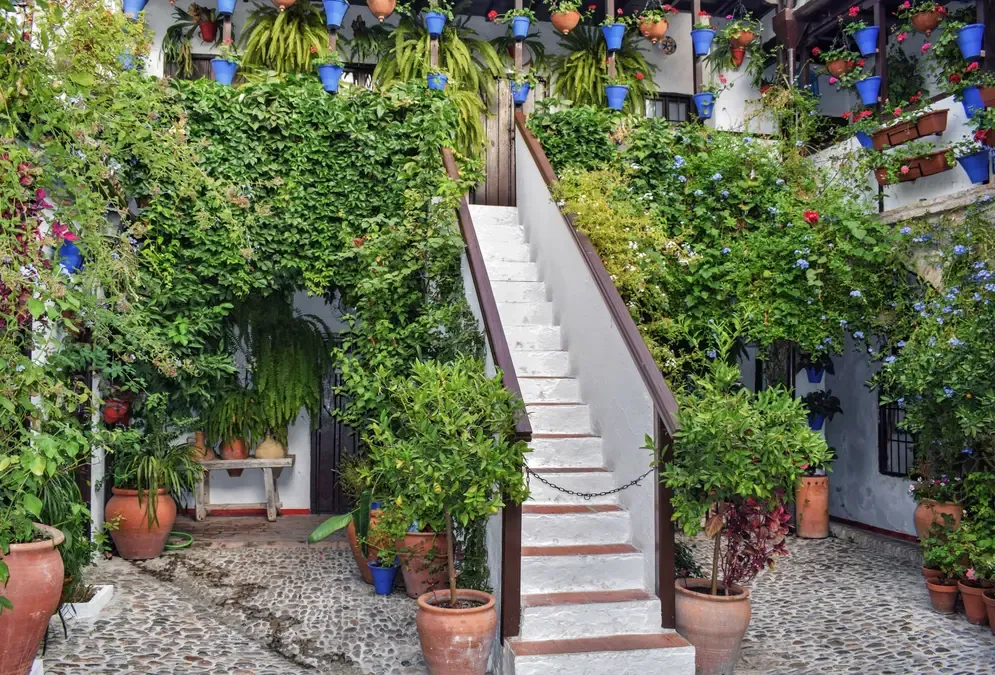
Deep dive · Article
Córdoba's Patios: Why They Exist and Endure
Córdoba's patios stay 10–15°C cooler than the street. Two thousand years of Roman, Moorish and Christian engineering explain why, and why they still work.
Practical notes: the Alcázar opens at 8:15 am Tuesday through Sunday and is closed Mondays. Check current hours and admission on the Alcázar website before visiting — opening times vary by season.[6] The sculptural group on the Paseo de los Reyes is visible from the gardens without paying entry, but the Roman mosaics inside are worth the ticket. Allow 90 minutes for the full visit. From the Alcázar, the Mezquita is eight minutes on foot through Calle Torrijos.