Cordero a la Miel: Córdoba's 10th-Century Lamb Recipe
Cordero a la miel descends from the lamb-and-honey tradition of caliphal Córdoba. The culinary history behind Córdoba's most layered slow-roasted dish.
Seven years covering Córdoba's gastronomy, taberna culture, and the Montilla-Moriles DO.
Published
Updated
Cordero a la miel is slow-roasted lamb glazed with honey, saffron, and Montilla-Moriles wine — a dish that descends from the lamb-and-honey tradition of 10th-century caliphal Córdoba, when Abd al-Rahman III ruled the largest city in Western Europe. No recipe from that court survives on paper, but the flavour logic does: sweet against savoury, spice against fat, the agridulce philosophy that defines Andalusian cooking at its roots. The 13th-century Andalusian cookbooks that preserved the tradition tell us exactly what that kitchen valued.
In this article
What the dish is today, and why the history matters
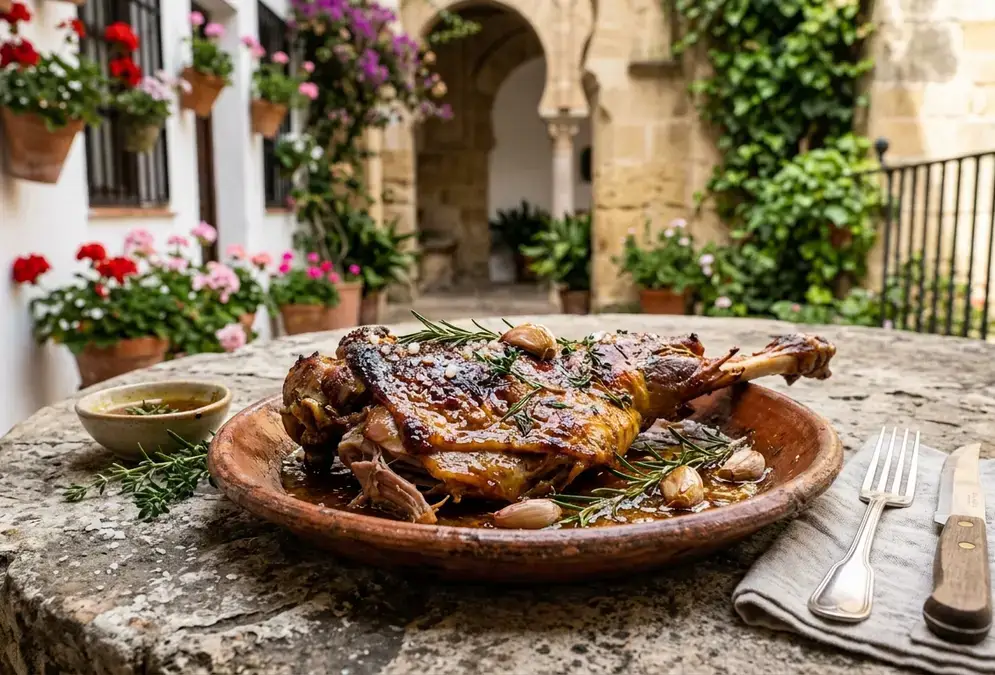
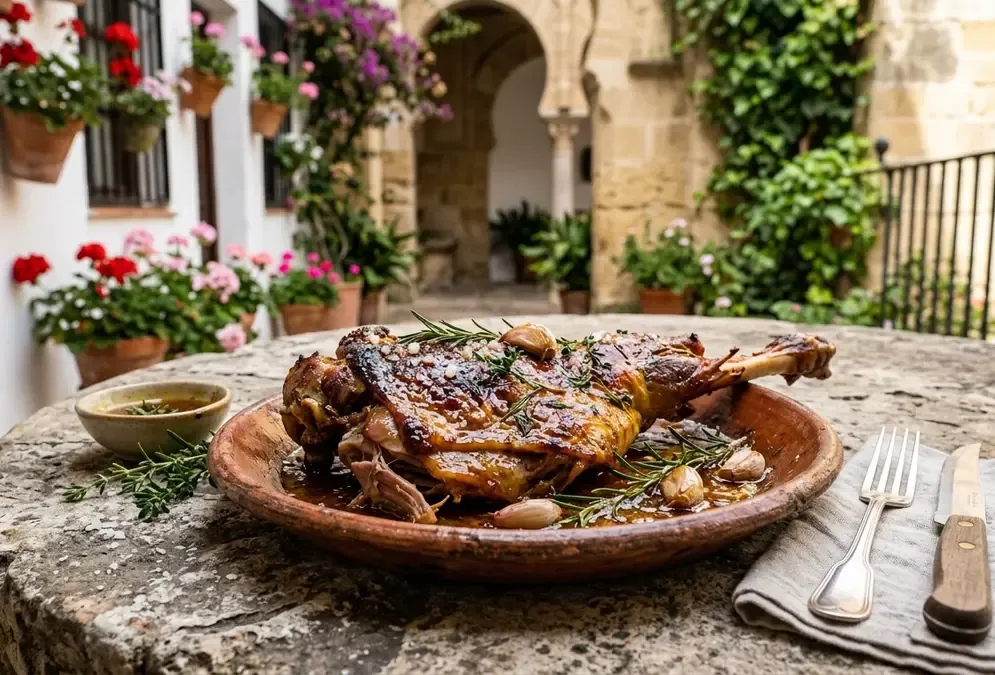
Order cordero a la miel in Córdoba and you get a portion of slow-roasted lamb shoulder or leg, braised until the collagen gives up and the meat falls at the touch of a fork. The sauce is built from honey, white wine or Montilla-Moriles oloroso, garlic, onion, bay, rosemary, and a shot of vinegar that keeps the sweetness from tipping into syrup. It is a main course in the city's more serious traditional restaurants, not a tapas bar order. You sit down, you take your time, and you eat it with roasted potatoes.
The dish shows up on menus year-round at tourist establishments, but the kitchens that know what they are doing only prepare it from October through March. Slow-roasted lamb glazed in honey is winter food. The patience the dish requires in the kitchen is the same patience the season imposes on everything else.
What makes cordero a la miel more than a good lamb dish is the archaeology beneath the recipe. The combination of lamb, honey, vinegar, and aromatic spices is not a modern invention or a restaurant contrivance. It is a flavour grammar that the Islamic culinary tradition of al-Andalus worked out over centuries and encoded in manuscripts that still survive. Eating it in Córdoba's Judería in the shadow of the Mezquita-Catedral is about as direct a connection to that history as food can provide.
929 CE
Abd al-Rahman III proclaimed the Caliphate of Córdoba, making the city the largest in Western Europe with an estimated 500,000 people. Lamb was the prestige meat of the caliphal court; honey a luxury sweetener in both savoury and confection preparations. No cookbook from that specific era survives, but the culinary values are documented in the 13th-century Andalusian manuscripts that followed.
The full cultural context runs deeper than any single dish. The Three Cultures heritage of the city lives in every bowl. The Córdoba gastronomy guide maps the wider picture of how al-Andalus flavours persist across the city's kitchen. This article traces the specific lineage of the lamb-and-honey combination from the caliphal court to the table.
The caliphal table — lamb, honey, and the golden age
Two things need to be said plainly before the history gets underway. First, the lamb-and-honey combination of caliphal Córdoba is a documented culinary tradition, not a documented recipe. No Andalusian cookbook survives from the 10th century. What survives from that era is architecture, biography, and a well-attested culture of court refinement. Second, the cookbook most often cited in this context, the Kitāb al-Ṭabīkh of al-Warrāq, is a Baghdadi and Abbasid text.[1] It dates to the 10th century, yes, but it comes from Baghdad, not Córdoba. Confusing the two is a common error.
What IS documented for caliphal Córdoba is the scale of the city's ambition and its kitchen culture. Under Abd al-Rahman III (r. 912-961), who proclaimed the Caliphate in 929,[2] Córdoba grew to a population approaching 500,000, a library of 400,000 volumes, and a court whose hospitality was a matter of political prestige. Elaborate food was part of that prestige. Lamb was the favoured meat of al-Andalus courts, and honey a luxury ingredient in both savoury preparations and confections.
The 9th-century precursor to this court culture was Ziryab (Ali ibn Nafi), an exile from the Abbasid court who arrived in Córdoba in 822, during the emirate, a full century before Abd al-Rahman III proclaimed the Caliphate. Ziryab reformed the dining table: he introduced sequential coursing (soup, then meat, then sweets), ordered the service of food by weight and temperature, and brought Abbasid sophistication into the Umayyad court. His influence was real enough that one dish in the 13th-century Anonymous Andalusian Cookbook still bears his name: lamb with salt, onion, coriander seed, pepper, caraway, oil, almonds, and bread.[3]
The practical point is this: by the 10th century, Córdoba had been building this culinary tradition for two generations already. The court that Abd al-Rahman III presided over did not invent the lamb-and-honey philosophy. It inherited it from Ziryab's generation, refined it, and made it a statement of Andalusian identity. That statement persisted long after the Caliphate itself ended in 1031.
The earliest surviving Andalusian cookbooks are both 13th-century texts.[3] This matters because they are often presented as if they document 10th-century practice directly, which they do not. What they do is preserve a culinary tradition that had clearly been established for a long time before anyone wrote it down.
The Anonymous Andalusian Cookbook (the Kitāb al-ṭabīj fī l-Maghrib wa-l-Andalus) dates to the Almohad era, roughly the 12th-13th century.[4] It contains more than 460 recipes, structured around lamb and mutton as the primary protein. The meat sections are dense with sweet-savoury preparations across the full al-Andalus spice register:
- Lamb with honey and vinegar (the agridulce core)
- Lamb with dried fruits and almonds
- Lamb with saffron (azafrán), cinnamon, and cumin
This is exactly the flavour register that cordero a la miel inherits today. The cookbook also includes six recipes explicitly identified as Jewish, which tells you something about the kitchen culture it was documenting: these were not hermetically sealed traditions.
The honey-vinegar glaze is not a restaurant invention. The Anonymous Andalusian Cookbook documents the same sweet-sour lamb logic in the 13th century, written when Córdoba still carried the memory of the Caliphate.
Ibn Razīn al-Tujībī's Fuḍālat al-khiwān was composed around 1260 CE, after its author had relocated to Tunis by 1259; his lifespan was c. 1227–1293.[8] His sections on mu'assalat (honey and sugar preparations) and on meat with aromatic spices read like a direct ancestor of the modern Córdoban dish. The agridulce principle runs throughout both texts: the balance of sweet and sour, of honey against vinegar, is not incidental but structural to how Andalusian cooks thought about meat. A published English translation of Ibn Razīn appeared in 2021, making these recipes accessible beyond specialist scholarship.[5]
Neither text is a recipe card in the modern sense. They assume the reader knows the kitchen, knows the ingredients, knows when to add and when to hold back. But they document something important: a confident, elaborated cooking tradition built around lamb as the prestige meat, honey as the sweet element, and a layering of spices that no contemporary European cuisine came near. The dish described in Córdoba's restaurants today is not a reconstruction. It is a continuation.
After 1236 — wine enters the pot
Ferdinand III of Castile took Córdoba in 1236. The Mezquita became a cathedral. The city's Muslim population left or converted. And the kitchens, which had been working with a specific set of ingredients for four centuries, acquired access to an ingredient that Islamic practice had restricted: wine.
The word "restricted" carries some nuance. Mozarabs, the Christians who lived under Muslim rule and adopted Arabic language and culture, had access to wine throughout the Islamic period. And nabidh, a mildly fermented drink made from dates or raisins, occupied a grey area in al-Andalus that kept something like wine adjacent to the table. But for the cooking tradition that produced the sweet-savoury lamb preparations in the Anonymous Andalusian Cookbook, grape wine was not a standard ingredient.
After 1236, it became one. No single manuscript records the moment when wine entered the lamb-and-honey recipe. What happened was slower and more diffuse: Christian cooks inherited the flavour vocabulary of al-Andalus and began cooking with wine alongside it. The honey stayed. The saffron stayed. The vinegar stayed. And a cup of white wine or oloroso joined the braise, adding its own oxidative depth to the sauce.
Timeline
822 CE
Ziryab arrives in Córdoba
Ali ibn Nafi ("Ziryab"), exiled from the Abbasid court, arrives in Córdoba during the emirate and transforms court dining. His influence on sweet-savoury lamb preparations is preserved in the 13th-century Anonymous Andalusian Cookbook.
929 CE
Abd al-Rahman III proclaims the Caliphate
Córdoba becomes the largest city in Western Europe. The caliphal court is the apex of al-Andalus culinary culture: lamb is the favoured meat, honey a prestige sweetener, the agridulce tradition fully established. No cookbook survives from this specific period.
c. 1260 CE
The 13th-century cookbooks are written
Ibn Razīn al-Tujībī completes the Fuḍālat al-khiwān around 1260 CE in Tunis. The Anonymous Kitāb al-ṭabīj fī l-Maghrib wa-l-Andalus is compiled in the same broad era. Both document the sweet-savoury lamb tradition that had been practised in al-Andalus for centuries.
1236 CE
Reconquista — Ferdinand III takes Córdoba
Christian kitchens inherit the al-Andalus flavour vocabulary. Wine, previously restricted under Islamic law, enters the lamb-and-honey recipe. No single moment is documented; the evolution is gradual and cumulative.
20th century onwards
Restoration and revival
El Caballo Rojo and later Noor research and serve cordero a la miel as an ancestral recipe, explicitly connecting it to the Mozarabic-influenced culinary heritage of caliphal Córdoba. The dish enters gastronomic discussion as a Three Cultures document.
This is not a documented culinary event. It is a plausible evolution supported by what we know about post-Reconquista Córdoba's kitchen culture. Modern versions of cordero a la miel, including El Caballo Rojo's recipe,[6] use Montilla-Moriles wine as a standard ingredient. The wine and honey work together in the sauce, producing something neither tradition had alone.
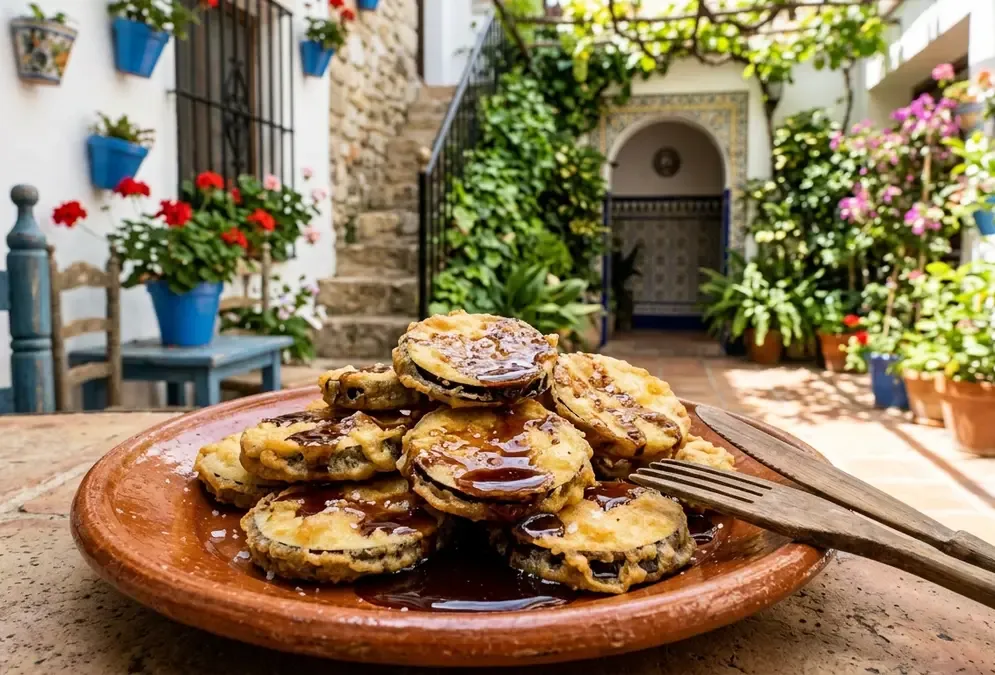
The same logic runs through berenjenas con miel, aubergines with honey, and rabo de toro, where Montilla-Moriles oloroso is the structural liquid in a braise that also traces its identity to Córdoba's specific confluence of cultures. Different dishes, same palimpsest.
The Three Cultures on the plate
A palimpsest is a manuscript page that has been scraped and reused, earlier writing still visible beneath the new text. The word describes Córdoba's cuisine more accurately than "fusion" does. Nothing was erased. Each layer built on the one before, and all of them are still there.
The honey and saffron in cordero a la miel are the Islamic layer, documented in the 13th-century cookbooks and inherited from the caliphal tradition. The wine is the Christian addition, arriving in the post-1236 kitchen. The slow-roasting technique, which does not require the oven but uses the residual heat of a wood fire, may be older than any of these recorded layers. Roman Corduba had its own tradition of roasted meats; Visigothic kitchens built on it.
The Jewish culinary thread runs through the Anonymous Andalusian Cookbook directly: six recipes are explicitly identified as Jewish-origin, in a text compiled under Islamic rule. The Jewish community of caliphal Córdoba operated in proximity to the Islamic court for generations. Maimonides, who grew up in 12th-century Córdoba before the Almohad conquest drove him out, came from that world. The cookbook's Jewish recipes are a trace of the exchange that characterised the city at its most open.
The Three Cultures thesis (Las Tres Culturas) is sometimes presented as a romantic myth of perfect coexistence. The history is messier than that. Persecution, conversion, and expulsion were real. But the culinary record shows genuine exchange, and the Anonymous Andalusian Cookbook is part of that record: techniques, ingredients, and flavour principles crossing the boundaries that theology tried to enforce.
Cordero a la miel is not a symbol of harmony. It is a document of contact. The honey and wine in the same pot is not a metaphor anyone planned. It is what happened when kitchens overlap over enough centuries. The Three Cultures of Córdoba guide unpacks this history beyond the kitchen, covering the synagogue, the Judería, and what the archaeological record actually shows.
For the parallel story in Córdoba's other foundational dishes, the salmorejo history article traces how Roman, Moorish, and post-Columbian elements converged in a single bowl of cold soup.
Where the history lives today
El Caballo Rojo sits directly across from the Mezquita-Catedral, and has been serving cordero a la miel as what it calls an "ancestral recipe" for decades.[6] The restaurant's framing is explicit: this is Mozarabic culinary heritage, traced to the sweet-savoury lamb tradition of caliphal Córdoba. The word "Mozarabic" here is culinary branding rather than strict historical terminology. What El Caballo Rojo means is that the dish reflects the Three Cultures era of the city, the period when Islamic, Jewish, and Christian communities were in genuine if unequal contact. The recipe they serve uses Baena olive oil, Montilla-Moriles wine, honey, saffron, and aromatic spices: the al-Andalus pantry, supplemented with wine.[7]
Noor, Córdoba's Michelin-starred restaurant, approaches the same history differently. Chef Paco Morales works from medieval Moorish manuscripts and treats the 13th-century Andalusian cookbook tradition as a research document rather than a menu. His cordero a la miel is a contemporary interpretation, not a recreation, but the flavour architecture is the same: the sweet-savoury logic, the spice layering, the honey used as structure rather than sweetener.
These two restaurants represent different relationships to the same source material. El Caballo Rojo is the tradition-keeper: four decades of the same recipe, refined but not reimagined. Noor is the historian-cook: manuscripts consulted, flavours extrapolated rather than reproduced.
For where exactly to eat, which version is worth the price, and how the dish fits into a full day of eating in Córdoba, the dish page covers current restaurant addresses, seasonal timing, and what to pair with it. The practical note is simple: order it in winter, ask whether they use local honey (orange blossom or thyme, not commercial), and pair it with a Montilla-Moriles oloroso rather than a standard red. The sweetness of the glaze needs the wine's oxidative depth to meet it. That pairing logic is not arbitrary. It is the same logic the caliphal table worked out 1,100 years ago.[2]
FAQ about cordero a la miel history
Is there a surviving 10th-century recipe for cordero a la miel?
No. No Andalusian culinary manuscript survives from the 10th century. The earliest known Andalusian cookbooks are both 13th-century texts: the Anonymous Andalusian Cookbook (Kitāb al-ṭabīj fī l-Maghrib wa-l-Andalus) and Ibn Razīn al-Tujībī's Fuḍālat al-khiwān. The 10th-century Kitāb al-Ṭabīkh of al-Warrāq, often cited in this context, is a Baghdadi and Abbasid text, not an Andalusian one. What IS documented for 10th-century caliphal Córdoba is a court culture in which lamb and honey were prestige ingredients — but no specific recipe from that era is on record.
Is cordero a la miel a Moorish dish or a Spanish dish?
The distinction is less useful than it appears. The sweet-savoury lamb-with-honey combination comes from the Islamic culinary tradition of al-Andalus, documented in 13th-century Andalusian manuscripts. After Ferdinand III took Córdoba in 1236, Christian cooks inherited the flavour vocabulary and began adding wine, which Islamic practice had restricted. Today's Córdoban version — slow-roasted lamb with honey, saffron, and Montilla-Moriles wine — is a record of both traditions working on the same dish over centuries.
What does agridulce mean in the context of Andalusian cooking?
Agridulce means sweet-sour, and it describes the defining flavour philosophy of al-Andalus cuisine as documented in the 13th-century cookbooks. The pairing of honey against vinegar in cordero a la miel is a textbook agridulce construction: the honey adds sweetness and gloss to the lamb, the vinegar cuts the richness and prevents the sauce from becoming cloying. Modern Córdoban versions extend the same principle by adding Montilla-Moriles wine, which brings its own acidity and oxidative depth.
What spices belong in a traditional cordero a la miel?
The classic profile traces directly to the al-Andalus pantry: saffron for colour and depth, cinnamon for warmth, cumin and coriander (both documented in the 13th-century Andalusian cookbooks), black pepper, and paprika, which entered the recipe after the Columbian Exchange brought chillies to Spain. Honey is balanced with vinegar in the agridulce tradition, and modern Córdoban versions add Montilla-Moriles wine as the post-Reconquista element. The spice combinations documented in the Anonymous Andalusian Cookbook and Ibn Razīn al-Tujībī's text are recognisably the same set.
What is the difference between Mozarabic cuisine and Islamic Andalusian cuisine?
Mozarabic (mozárabe) refers strictly to the Christians who lived under Muslim rule in al-Andalus, adopted Arabic language and cultural practices, and formed a distinct community within Islamic Spain. In a culinary context, "Mozarabic cuisine" as used by restaurants like El Caballo Rojo is an evocative label for the Three Cultures era, but the sweet-savoury lamb tradition originated in Islamic culinary practice rather than specifically in Christian-under-Islamic-rule communities. The term is historically suggestive rather than technically precise.
Where can you eat cordero a la miel in Córdoba?
El Caballo Rojo, directly opposite the Mezquita-Catedral, is the most cited address for the traditional version and has served it as an ancestral recipe for decades. Noor, Córdoba's Michelin-starred restaurant, offers a contemporary interpretation based on research into medieval Moorish manuscripts. Bodegas Campos and El Churrasco serve versions closer to the traditional recipe. It is a winter dish at serious traditional kitchens; tourist restaurants list it year-round but the best versions appear October through March.
What is the palimpsest thesis about Córdoban cuisine?
A palimpsest is a manuscript page scraped and reused, earlier writing still visible beneath the new text. Applied to Córdoba's cuisine, it describes how each successive civilisation added a flavour layer without erasing what came before. In cordero a la miel, the honey and saffron are the Islamic layer from the 13th-century manuscripts; the wine is the Christian addition after 1236; the slow-roasting technique may predate both. The dish is not simply Moorish or Spanish. It is an edible stratigraphy of the city's history.
Why did Córdoba's Three Cultures heritage produce such distinctive food?
Under Abd al-Rahman III (Caliphate proclaimed 929 CE), Córdoba was the largest city in Western Europe. Islamic, Jewish, and Christian communities lived in proximity and traded culinary knowledge as well as scholarship. The Anonymous Andalusian Cookbook explicitly includes six Jewish-identified recipes alongside Islamic preparations. Spices, techniques, and ingredients crossed religious communities in a way that had no parallel in contemporary Europe. The result was a cooking tradition dense with cross-cultural exchange, which the post-1236 Christian kitchen inherited rather than replaced.