
Forty-six degrees and no shade: the problem that made the patio
Córdoba is the hottest city in Europe during summer. AEMET, Spain's State Meteorological Agency, has recorded a maximum of 46.6°C here. Average July highs sit around 37°C, and daily temperatures of 40°C or above are common enough that locals call the Guadalquivir valley the sartén de España, the frying pan of Spain.
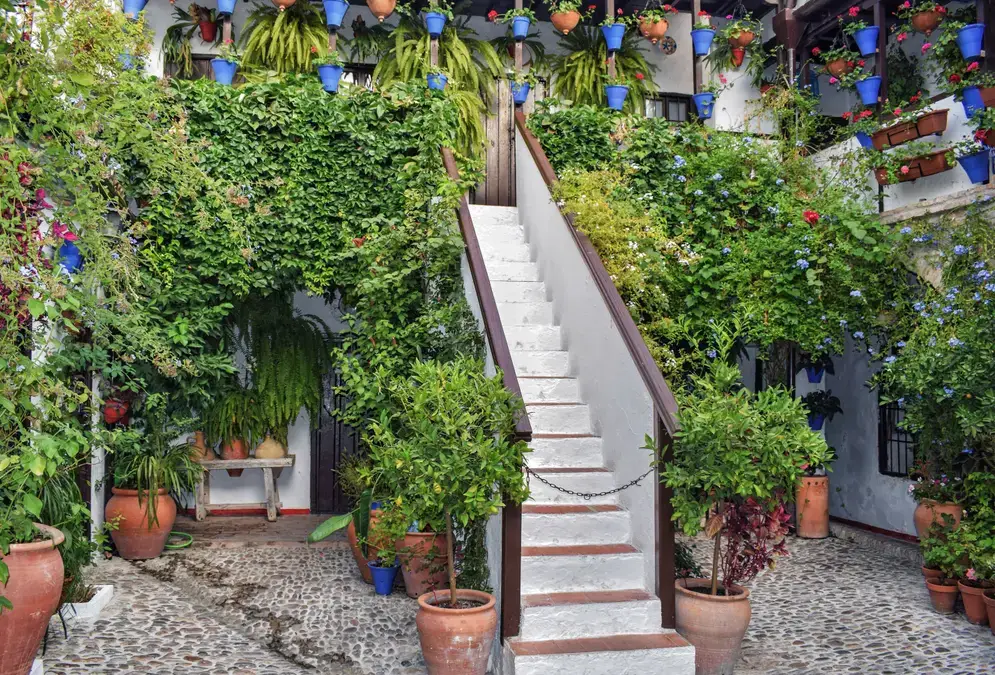
For nineteen centuries before electric fans and refrigerated water supply arrived, there was no mechanical alternative. What there was, was the patio: an open courtyard at the centre of the house, walled on all four sides, planted with flowers and trees, threaded with water. A machine for surviving the Andalusian summer, dressed up as a garden.
46.6°C
Every element serves a thermal function: the thick stone walls, the whitewash, the geraniums, the fountain. The ornamental effect is real, but it follows from the engineering.
Why this domestic form exists at all, and why it persisted through conquest, religious change and five centuries of Spanish history, comes down to one stubborn fact: it works. No alternative worked as well in this climate.
From Roman impluvium to Umayyad aljibe: the same problem, two solutions
The design arrived with the Romans. From the 1st century BCE, the Roman domus organised domestic life around an internal courtyard: the atrium. At its heart sat the impluvium, a shallow basin sunk into the floor beneath the compluvium (an opening in the roof that admitted light and collected rainwater into a cistern below). The system solved two problems at once: it cooled the house through evaporation and stored water through the long dry summers.
Roman Córdoba, known as Colonia Patricia, was a substantial city, birthplace of philosophers including Seneca. The ruins at nearby Itálica, outside Sevilla, and the remains at Mérida give a clear picture of how the domus looked: arcaded galleries on the ground floor, rooms opening onto a shaded central space, water always at the centre.
The Moorish conquest of 711 CE deepened the tradition rather than replacing it. Under the Umayyad Caliphate, which made Córdoba its western capital and transformed it into one of the largest cities in medieval Europe (a city where the philosopher Averroes would later teach that reason and faith could coexist), the courtyard house became the Andalusi bayt. The same impulse that shaped the Mezquita-Catedral (water, shade, enclosed geometry) drove the domestic patio toward more elaborate hydraulics and a richer plant vocabulary. The aljibe (from the Arabic al-jib, cistern) replaced or augmented the Roman impluvium as the hydraulic heart of the house. Fountains grew more elaborate. Plants multiplied. The Casa Andalusí, still open to visitors in the old Jewish quarter, preserves layers of this evolution: Roman foundations, Moorish waterworks, and the accumulated decisions of twenty generations of householders.
Then came the Reconquista. Ferdinand III of Castile took Córdoba in 1236. The Christian settlers who moved in did not tear out the patios. They kept them, adapted them, and passed them down. The Córdoba patio survived conquest because the design works. No alternative performed better in this climate. Sentiment had nothing to do with it.
Half a million people, every house built around a courtyard
At its 10th-century peak, Córdoba under Abd al-Rahman III had a population that modern historians estimate at between 100,000 and 450,000[3] — Tertius Chandler put it at roughly 450,000 around 1000 CE — though even conservative figures place it among the largest cities in western Europe, alongside Constantinople and well ahead of Paris or London. The residential fabric of that city was almost entirely organised around courtyards. Water reached them through an aqueduct system the Umayyads rebuilt from Roman infrastructure. The same ruler who ordered Medina Azahara built outside the city applied the same hydraulic principles (water channels, shade, enclosed geometry) at palace scale. To live in Córdoba was to live around water and stone, in a house built to manage heat.
How a patio cools 10–15°C below the street
A 10–15°C temperature differential between patio and street comes from six mechanisms working together — none of which requires modern technology.
- Thermal mass. The thick stone and ceramic walls of a traditional patio house absorb heat slowly during the day and release it slowly at night. The interior temperature lags behind the exterior by several hours, keeping the house cool when the street peaks.
- Evapotranspiration. Plants (geraniums, jasmine, carnations, ivy) transpire water vapour through their leaves, drawing heat from the surrounding air. A patio with 30 large potted plants does continuous passive air-conditioning. The choice of species is not arbitrary: Pelargonium hortorum and Dianthus caryophyllus are drought-tolerant and dense-flowering, maximising cooling without demanding much water. Jasminum officinale climbs walls and arches, adding shade and scent.
- Water evaporation. The central fountain (or, in older houses, the aljibe fed by a well) cools the air through direct evaporation. Running water lowers surrounding air temperature by several degrees. Combined with plant transpiration, the effect compounds.
- Shade. Arcaded porches (soportales) block direct solar radiation from reaching the ground and lower walls during the hottest hours. Vines trained over timber pergolas add a living ceiling. By noon in July, a well-planted patio may have less than 20% of its floor area in direct sunlight.
- Albedo. Whitewashed walls (cal, traditional lime wash, not modern paint) reflect solar radiation rather than absorbing it. The characteristic white of Andalusian architecture is functional, not purely aesthetic.
- Natural convection. The enclosed courtyard geometry creates a thermal chimney effect: hot air rises from the centre, draws cooler air down from upper levels or in through doorways, and establishes a gentle circulation that keeps the patio consistently cooler than the street.
Explore nearby · Monument
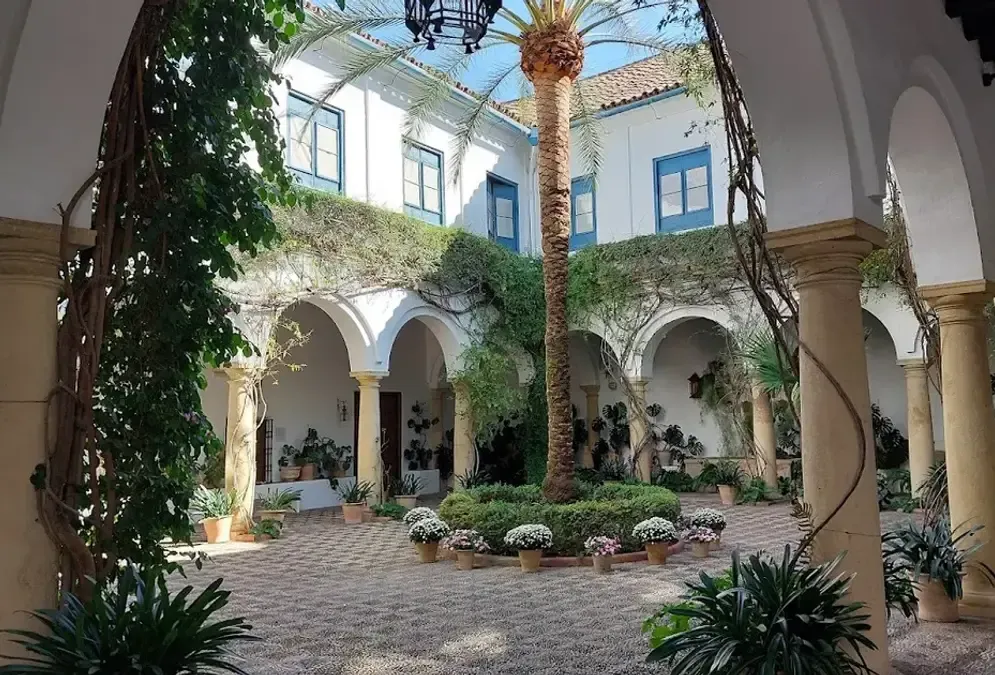
Palacio de Viana
Renaissance palace with 12 themed courtyards, six centuries of art and the best Cordoban leather collections in the city. Known as the Museum of Patios.
These six mechanisms explain why a patio house built in 711 or 1521 outperforms a window unit on a 40°C afternoon.
Geraniums are not decoration — they are the cooling system
Pelargonium hortorum flowers abundantly in pots with minimal soil and tolerates the intense Andalusian summer without wilting. Its dense foliage maximises evapotranspiration per litre of water given, making it the most efficient cooling plant for a hot-climate container garden. The jasmine that climbs the upper walls adds fragrance (it flowers in early summer, precisely when the heat is building), and the carnations at the base of walls provide colour at ground level where geraniums would dry out. The arrangement is bioclimatic first, beautiful second.
When the patio was the living room: the casa de vecinos
From the Roman period through the 18th century, Córdoba's patios belonged to single families. The 19th and early 20th centuries changed that. Rapid urban growth, the subdivision of older aristocratic properties and the pressure of a growing working-class population produced a new domestic form: the casa de vecinos, or neighbours' house. Multiple families (sometimes eight or ten households) shared a single large patio. Individual rooms opened onto the gallery; the courtyard was common ground.
In these houses, the patio was the living room, laundry and social hub of working-class Córdoba. Washing was done on stone scrub boards by the fountain. Chickens sometimes lived under the stairs. In the hottest part of the afternoon, families dragged chairs into the shaded corners and sat there through the dead hours. The patio was where children played, where arguments happened, where news travelled, where the smell of cooking from a dozen different stoves mixed with jasmine and whitewash.
The annual competition between patios, informal at first, then formalised through the city council's Concurso de Patios Cordobeses in 1921[2], grew directly from this communal life. Neighbours competed to produce the most beautiful display: today, the Patios de San Basilio in the San Basilio quarter are among the most decorated in the competition's history. They shared plants, cuttings, seeds and knowledge across the common space. The competition created a transmission mechanism for practical horticultural and architectural knowledge that operated entirely outside formal institutions.
Deep dive · Article
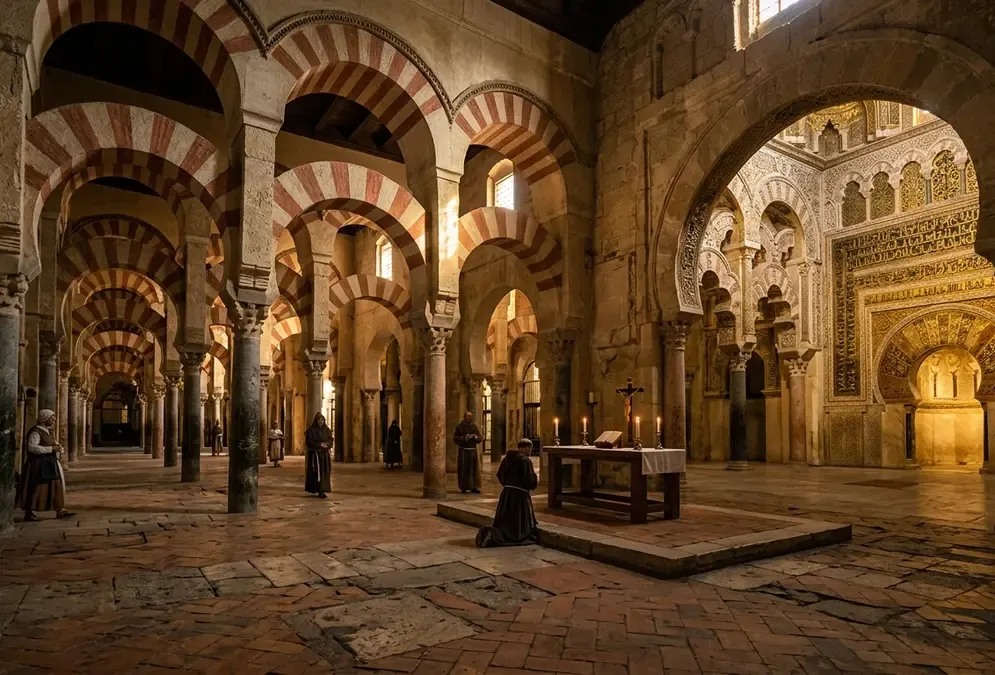
Mezquita Conversion 1236: What the Reconquista Actually Did
On June 29, 1236, Ferdinand III converted the Great Mosque into a cathedral. What changed immediately, what survived, and what Charles V later destroyed.
This is what UNESCO recognised in 2012. The inscription (Fiesta of the Patios in Córdoba, reference 7.COM 11.30 on the Representative List of the Intangible Cultural Heritage of Humanity)[1] does not protect the patios as buildings. It recognises the festival as a living cultural practice: the community cooperation, the traditional arts (flamenco, song, cooking), the ancestral practices of sustainable communal coexistence that the patios embody. The patios are the stage. The vecindad tradition is the play.
Seven cultural domains: what UNESCO actually inscribed
The 2012 UNESCO inscription recognises the Fiesta de los Patios, the twelve-day festival each May, not the patios as physical structures. This distinction matters. The festival covers seven cultural domains: architecture and urban spaces, dance and performing arts, music, food customs, festivals and social rituals, traditional craftsmanship, and houses and domestic spaces. For the full festival calendar and routes, the Córdoba Patio Festival guide covers logistics in detail. The inscription honours the community that maintains the tradition, not just the buildings that house it. That distinction is precisely why the patios can still be sold, converted or let as tourist apartments, while activists argue those conversions erode exactly what UNESCO came to protect. For a detailed explanation of why UNESCO inscribed a twelve-day event rather than a building — and the six practical reasons residents cannot sustain the extraordinary preparation year-round — see why Córdoba's patios open for only 12 days a year.
The same climate that built the patio is now its best argument for survival
Approximately 50–60 patios take part in the annual competition each May[4]. The casco histórico contains hundreds more: private, unregistered, maintained by individual families without institutional support or public recognition. The festival patios get the visitors and the awards. The private ones keep the tradition alive the rest of the year.
Read next · Article
Why Is Córdoba So Hot? The Science Behind Europe's Hottest City
Córdoba records 46.9°C and averages 16 days above 40°C every year. Geography, climate science, and how locals in Europe's hottest city actually survive it.
The architectural range is wide: from the intimate working-class courtyard to the twelve linked patios of the Palacio de Viana, each a distinct composition of water, stone and plant. Two organisations work to prevent that private stock from disappearing. The Asociación de Amigos de los Patios Cordobeses documents and campaigns for patio preservation across the historic centre. PAX-Patios de la Axerquía has taken a more active approach, combining architectural restoration with community-based urban regeneration in the Axerquía neighbourhood (the eastern half of the old medina), where depopulation has left many patio houses empty or converted to single-family use.
The threats are structural. Young people leave the historic centre for newer housing with air conditioning, parking and modern kitchens. The casco histórico ages in place: elderly residents who maintained the tradition cannot always sustain it alone, and their heirs often sell rather than take on the maintenance cost. A traditional patio house requires constant attention: replanting seasonal flowers, maintaining water features, repainting lime wash, repairing tilework.
Property values are the second pressure. Since UNESCO recognition in 2012, and particularly since the short-term rental boom, the same houses that were working-class housing in 1980 now carry asking prices that exclude the families who created the tradition. A patio house in the Judería or the Axerquía that sold for a modest sum in the early 2000s might list at several times that price today. When converted to a tourist apartment, the patio becomes scenery rather than commons.
What keeps the tradition alive is not sentimentality. It is the same force that created it: the climate. On a July afternoon at 40°C, a patio is still the most effective cooling system available for a house built in 711 or 1521 or 1890. The same city that gave us the layered history of the Mezquita-Catedral and the slow-cooked traditions behind rabo de toro also preserved this bioclimatic inheritance through every political upheaval. As Córdoba's summers grow longer and hotter, the engineering that made the patio necessary two millennia ago is becoming relevant again to cities that abandoned passive cooling in favour of mechanical air conditioning. The patio was ahead of its time. It may be ahead of ours.