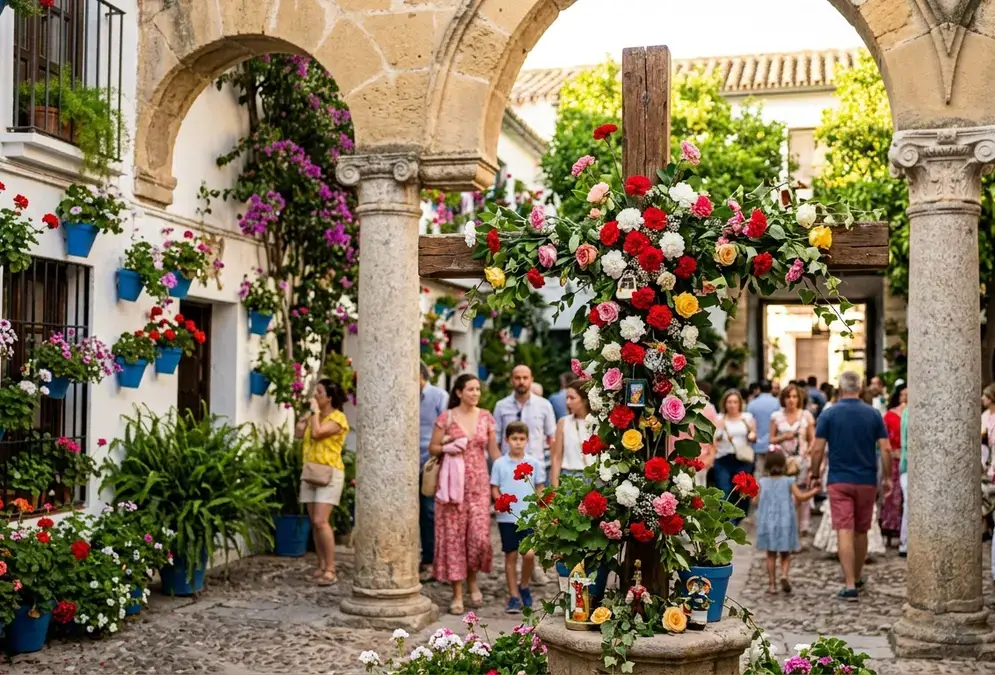

Roman Floralia: the spring rite underneath
The Floralia, festival of Flora (Roman goddess of spring and flowering plants), ran annually from April 28 to May 3.[1] The Romans called it the ludi Florales, or Games of Flora, and it was about as decorous as spring fertility rites tend to be: theatrical performances, flower-strewn processions, and public looseness that Roman moralists complained about in writing.
The festival became permanent in the Roman calendar in 173 BCE,[2] not long after Rome incorporated Hispania Baetica into its growing empire. Colonia Patricia, the name Córdoba held as the provincial capital of Baetica, was the most Romanised city in the peninsula. Latin was the administrative and literary language. Roman civic religion was the official religion. If the Floralia was observed anywhere in Hispania, it was observed here.
173 BCE
One caveat: no specific inscription or archaeological find yet documents Floralia celebrations in Colonia Patricia itself. What the record shows is a thoroughly Romanised city at the heart of Baetica in the relevant period. The connection between Roman spring rites and later May celebrations is plausible given the geographic and chronological overlap, but historians treat it as inference, not documented fact.
Saint Helena and the Invention of the Holy Cross
Whatever happened in Roman-era Córdoba, the formal Christian date of May 3 has a specific origin: the feast commemorating the inventio crucis, the Invention (meaning Discovery) of the Holy Cross.
The account, recorded in early Church chronicles, runs as follows. In the late 320s AD, Helena Augusta, mother of the emperor Constantine, travelled to Jerusalem on a pilgrimage. At Calvary, she ordered excavations. Workers reportedly uncovered three crosses.[3] The question of which was the cross of Christ was resolved, according to the narrative, by a miracle: a sick or recently dead woman (accounts vary) was touched by each cross in turn; only one healed her. This event became the basis for veneration of the True Cross and relics derived from it.[4]
Helena's discovery is traditionally placed in the late 320s AD, though sources range across 320–328. The May 3 date was not fixed by Helena or Constantine. It was established as a feast day in the 8th century,[5] when the Western Church formalised the calendar around relics and saint commemorations. The feast persisted for more than a millennium before Pope John XXIII removed it from the Roman Calendar in 1960[6] during a broader liturgical reform.
Explore nearby · Monument
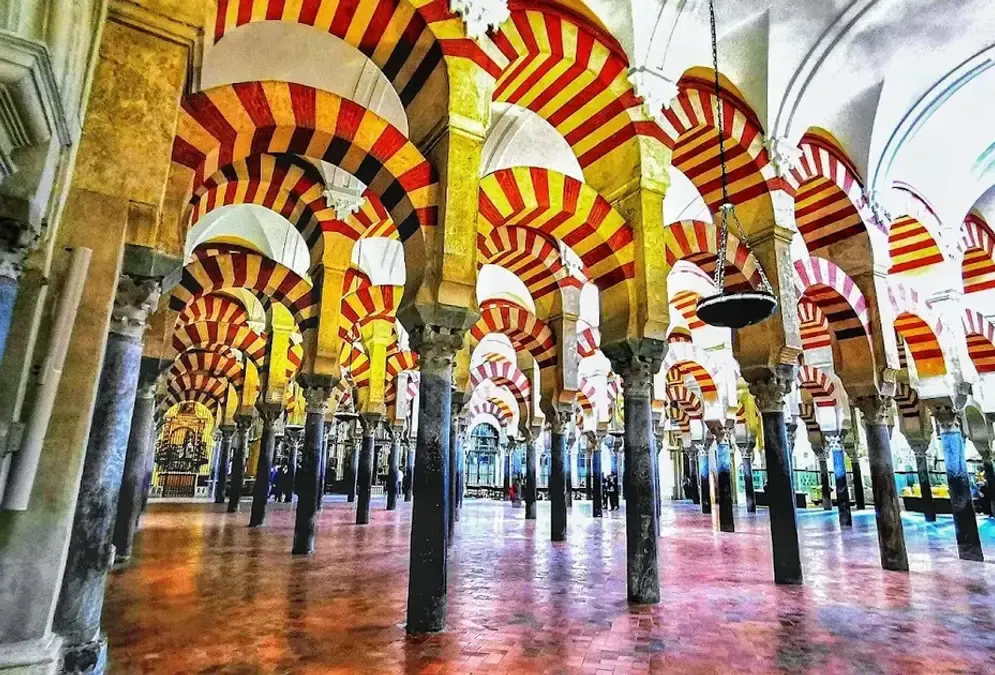
Mezquita-Catedral de Córdoba
856 columns, 1,300 years of Islamic and Christian history inside one UNESCO building. Red-and-white arches, Byzantine mosaics, and a Renaissance nave.
What the feast was actually called shifted over the centuries. Inventio Sanctae Crucis (Invention of the Holy Cross) was the name until 1960. A separate September feast, the Exaltatio Crucis or Exaltation of the Holy Cross, commemorated the return of True Cross relics from Persia in 629 and survives to this day. The May 3 feast is gone from the official calendar; the tradition it anchored in folk practice is not.
How the Church turned a spring rite into a Christian feast
The convergence between a pagan spring festival ending May 3 and a Christian feast beginning May 3 is not coincidence, and it is not secret. The Church's policy of absorbing folk religion into Christian practice is documented explicitly in Pope Gregory the Great's letters to Augustine of Canterbury (c. 601 AD), in which Gregory advised against destroying pagan temples and instead recommended rededicating them and replacing their festivals with Christian celebrations of saints or martyrs.
This strategy, sometimes called pagan Christianisation or inculturation, was applied systematically across Europe for several centuries. The spring cycle, already charged with symbolism around death and rebirth, was particularly suited to overlay with the Passion narrative. The cross, an instrument of death that Christians associated with resurrection, carried the same ambiguity that winter-to-spring transitions had always expressed.
The figure of La Maya illustrates the folk-Catholic hybrid that resulted. In spring celebrations documented across Castile, Andalusia, and parts of Portugal, a young girl would be dressed in flowers and seated on a throne: sometimes in front of a cross, sometimes as a substitute for the cross itself. Ethnographers in the 19th and early 20th centuries recorded the custom widely. The maya figure directly echoes the fertility-goddess tradition of Flora: the garlanded girl-as-spring-goddess, now Christianised as a companion to the True Cross rather than displaced by it.[7]
The Festival de los Patios preserves a related impulse: the private interior made public for a brief spring window, abundance expressed through flowers rather than through text or doctrine. The cross is not incidental to that tradition. It is where the pagan and the Christian version of spring observance converged.
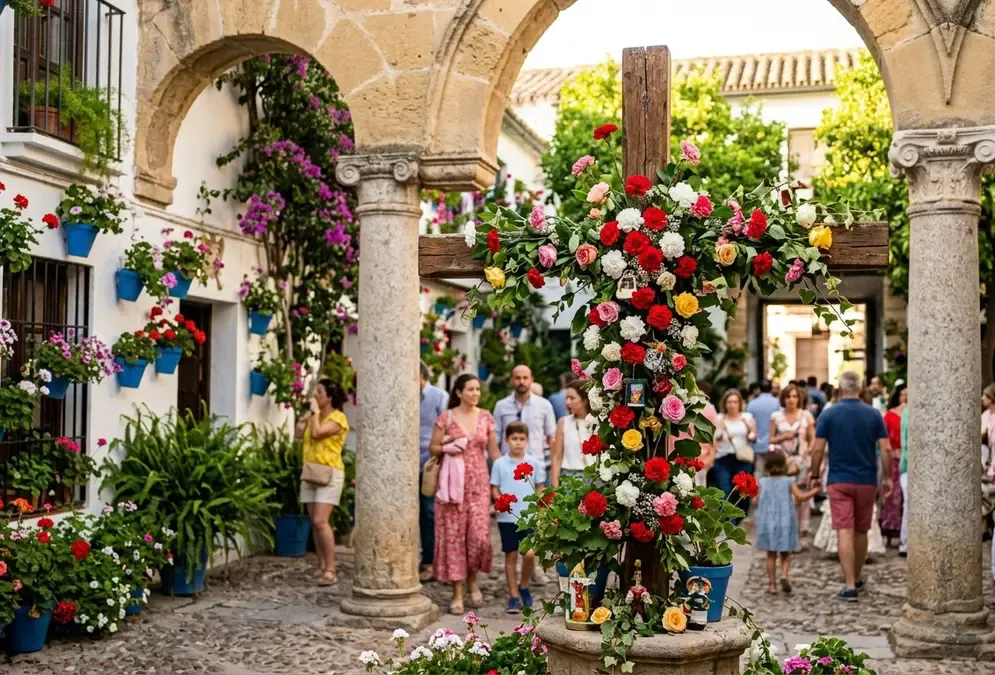
The decorated cross condenses more than twelve centuries of religious layering: Roman spring rites, the feast of the Invention of the Holy Cross, folk-Catholic tradition, and the post-1953 municipal competition. None of these origins appears on the prize card.
Córdoba's neighbourhood tradition: what the records actually say
Tourist materials frequently state that Córdoba's Cruces de Mayo tradition dates to the 17th century. The problem is that no source for this specific claim has been identified by historians of Andalusian folk religion. The 17th-century date appears to be a working assumption that has circulated long enough to become received wisdom.
What the documentary record does support: by the 18th century, decorated May crosses were a widespread Andalusian custom, observed in streets and plazas across the region.[8] In Córdoba specifically, the tradition is documented in neighbourhood accounts from at least the early 20th century: the Matadero Viejo, Huerta de la Reina, and Alcázar Viejo neighbourhoods were among those known for elaborate cross installations in the 1920s and 1930s. Neighbours pooled resources, decorated the cross with flowers, and gathered around it in the evenings for music and socialising. The essential structure is the same as today, minus the judging panel.
The urban form mattered. Córdoba's cofradías (religious brotherhoods) and its tightly organised neighbourhood structure gave the tradition an institutional backbone. A cross in a Córdoba barrio was not just a private devotional object but a neighbourhood statement, maintained by the same social networks that organised processions and patronal feasts. This is why the tradition survived urbanisation more robustly in Córdoba than in many smaller Andalusian towns.
Deep dive · Article
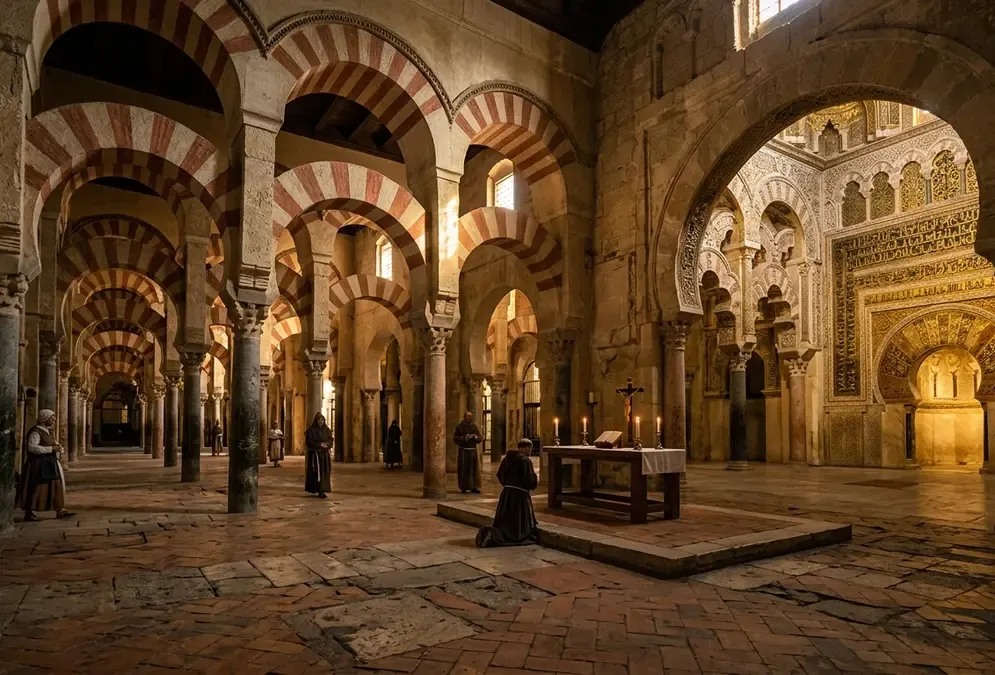
Mezquita Conversion 1236: What the Reconquista Actually Did
On June 29, 1236, Ferdinand III converted the Great Mosque into a cathedral. What changed immediately, what survived, and what Charles V later destroyed.
The Cruces de Mayo event page covers the current festival calendar and logistics. What this article addresses is how the custom got here, which turns out to be a longer story than most festival guides mention.
1953: the competition that formalised everything
The transformation of a neighbourhood custom into a city-wide competitive event happened in 1953. Mayor Antonio Cruz Conde incorporated the Cruces de Mayo into the new Real Feria de Mayo de Córdoba, a broad spring festival designed to draw visitors and consolidate several local traditions under one promotional umbrella.[9]
A judged competition was added: neighbourhoods and associations submitted their cross installations for scoring on criteria including floral arrangement, decorative originality, and setting. The following year, 1954, the crosses were separated from the Festival de los Patios, which had been part of the same event. The split gave each competition its own judging criteria and its own audience, and it set the template still in use today.
Two decades later, the character of the competition changed again. From 1974, Córdoba's cofradías began installing their own crosses, adding a layer of formal religious brotherhood participation to what had been mainly a neighbourhood tradition. The Hermandad de Nuestro Padre Jesús Nazareno was the first cofradía to enter, and its participation brought a different scale of resources and craft to the installations.
The result of this 70-year formalisation process is a festival that can be tracked across at least four distinct phases:
- Neighbourhood custom (documented early 20th century and almost certainly earlier)
- Municipal competition (1953, under Cruz Conde)
- Split from the patios competition (1954)
- Cofradía participation (from 1974)
Each layer added resources, visibility, and competition while smoothing away some of the rougher, more spontaneous edges of the earlier tradition. The history guide for Córdoba covers the broader political context of Franco-era cultural policy that shaped these mid-century festivals.
One practical note: the judged format created a strong incentive for scale. A cross that wins prizes is elaborate; an elaborate cross requires funding. The cofradías brought both. This is partly why contemporary Córdoba cross installations can run to several metres high and involve hundreds of individual flowers.
Three meanings in one cross
The decorated cross of Córdoba's May festival is not one thing. It is at least three meanings compressed into a single object that most visitors simply photograph.
The spring fertility layer comes first in time if not in official recognition. A structure covered in seasonal flowers placed in a public space at the turn of May is doing what the Floralia did and what the maya custom did: marking the season's change through visible abundance. The flowers are not decoration applied to a religious symbol. The flowers are the point, and the cross is what they attach to.
The True Cross layer comes from Helena's discovery and the feast that commemorated it for twelve centuries before its removal in 1960.[6] May crosses across Andalusia were historically erected on or near May 3 precisely because of this feast. The cross is not a generic symbol of Christianity in this context; it is a specific reference to a specific relic and a specific date. That specificity has been mostly forgotten, but it explains why the Reconquista connection also clusters around May: Christian military victories in the peninsula were frequently commemorated with crosses erected on the dates of saints' feasts, and May 3 was one of the most prominent.
The flowers are not decoration applied to a religious symbol. The flowers are the point, and the cross is what they attach to.
The neighbourhood piety layer is the one that made the tradition durable in Córdoba. The cross in the plaza was not a monument to the Roman church or to a political victory. It was a collective object belonging to the barrio: paid for by neighbours, decorated by neighbours, gathered around by neighbours. That local ownership is what allowed the tradition to survive changes in official policy, urban migration, and secularisation. You can remove a feast from the liturgical calendar without removing the custom that grew up around it.
What the Córdoba Crosses of May guide documents in terms of locations and viewing strategies is, at bottom, the same question made visible in stone and flowers: which neighbourhood made the most convincing claim, this year, on two thousand years of accumulated spring symbolism.