
1284 vs 1847: two ferias with nothing in common
Córdoba's feria predates Seville's by 560 years. King Sancho IV granted the city a royal charter in 1284[1] establishing a medieval livestock fair on the banks of the Guadalquivir. For the first four centuries of its existence, it was a commercial event: cattle trading, grain markets, a city positioning itself as a post-Reconquista economic centre.
560 years
Then in 1665, two farmers discovered an image of the Virgin in a well[2] whose waters were credited with healing powers. The fair attached itself to the new cult, took the name Feria de Nuestra Señora de la Salud, and acquired a religious dimension it has never lost. The procession of the Virgen de la Salud still opens the week. That layering of civic economy and popular devotion is what gives the Córdoba feria its current character: a neighbourhood celebration with religious roots, not a social showcase.
Seville's Feria de Abril has a completely different origin. Founded in 1847 by José María Ybarra, a Basque industrialist, and Narciso Bonaplata, a Catalan entrepreneur,[3] the first fair opened on April 18 at the Prado de San Sebastián as a livestock market. Within a generation, the bourgeoisie of Seville had converted it into a social institution where the right caseta invitation signalled your position in the city's hierarchy. The livestock fair became a gatekeeping apparatus. That transformation is the feria.
Córdoba's version did not undergo that transformation. The civic and religious character held, and the casetas stayed open. Whether that was policy or inertia is debatable; the result is not.
Open door vs invitation: how casetas actually work
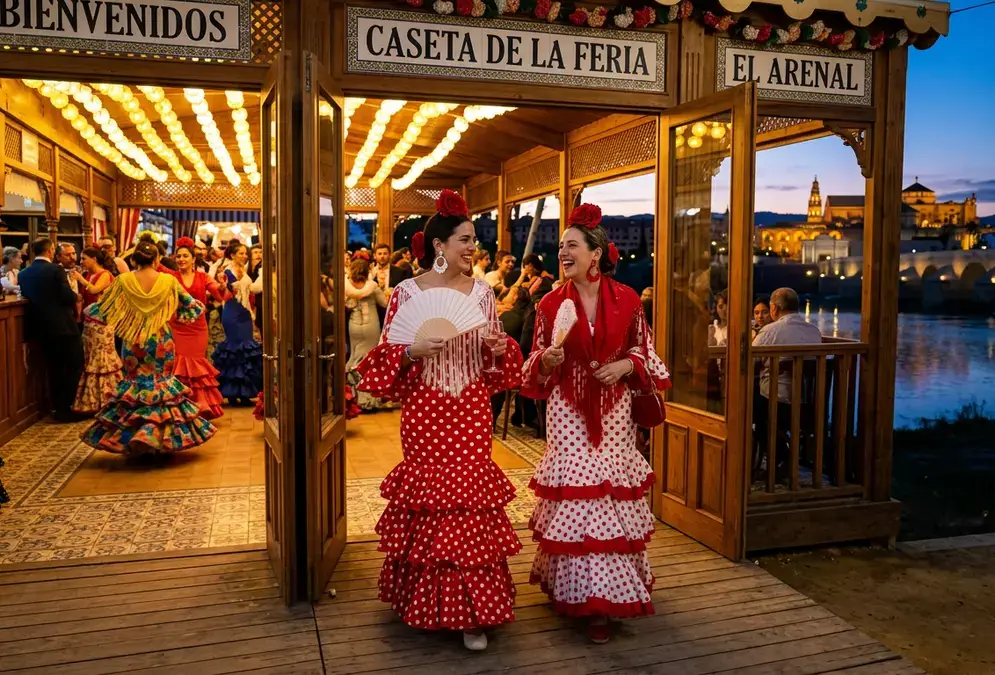
The Córdoba Feria runs 85 casetas across the El Arenal fairground beside the Guadalquivir. Most are operated by neighbourhood associations, cultural groups, professional bodies, or groups of friends who pool costs each year. You walk in, find a table, order a rebujito, and sit down. No one checks your name against a list. A small number of corporate or association casetas keep the door closed, but the default is open.
In Seville, the arithmetic runs the other way. The Real de la Feria fills with over 1,250 casetas[3]. Approximately 98% are private, belonging to families with multi-generational memberships, clubs, trade associations, political parties, and corporate sponsors who use caseta access as client hospitality. Each membership carries social weight. An invitation from the right family caseta is currency. Travellers who arrive expecting to wander freely often spend their first evening unable to sit down anywhere.
| Córdoba | Seville | |
|---|---|---|
| Founded | 1284 (royal charter, Sancho IV) | 1847 (livestock fair, Ybarra & Bonaplata) |
| Caseta count | ~85 | ~1,250 |
| Public access | ~98% open to all | ~98% private, invitation required |
| Venue | El Arenal, riverside | Real de la Feria, Los Remedios district |
| Fairground area | ~1,400 m² | 450,000 m² (24 city blocks) |
| Wine | Montilla-Moriles (Pedro Ximénez) | Jerez sherry / Manzanilla |
| Signature dish | Salmorejo, rabo de toro | Pescaíto frito, montaditos |
The dress code (traje de flamenca for women, traje corto for men) is enforced at the door of private casetas as a visual membership check: if you know the code, you belong. In Córdoba, the same dress is common on weekend afternoons, but it is never a condition of entry. People in jeans share tables with women in full ruffled dresses. The point is the dancing, not the vetting.
A local phrase captures this precisely. Visitors to Córdoba who ask permission before walking into a caseta are sometimes told: Este no es Sevilla — "this is not Seville." The line is a friendly correction, but it also explains everything.
Same dance, different feeling: sevillanas in two cities
Both ferias run on sevillanas. The form is Andalusian, not specifically Sevillan despite the name: a four-part dance with a fixed choreographic structure that anyone can learn at a basic level. It is not flamenco, despite sharing the dress, the guitar, and the Andalusian setting — the two forms diverged from a common root into entirely separate traditions. At both ferias, the music starts in the afternoon and does not stop until the early hours.
What differs is who dances and how. In Córdoba, the dancing is participatory. Amateur groups occupy the space between tables in neighbourhood casetas. Teenage girls who learned the steps in class, old men who have been dancing the same four moves for forty years, couples who met at last year's feria: they all share the same floor, and nobody is watching. The music comes from local ensembles or recorded tracks. The standard varies. The point is not the standard.
In Seville's private casetas, professional groups are hired to perform. The production values are higher; the audience watches from tables. The social dynamic shifts: you are a guest in someone's space, and the performance is laid on for you.
Córdoba's connection to flamenco runs deeper than the feria itself. The city is home to the Centro Flamenco Fosforito, named after Antonio Fernández Díaz, known as Fosforito, the Córdoba-born singer who defined the cante cordobés in the 1950s and 1960s. The local tradition includes styles the Seville school never developed: fandangos de Lucena, the cante cordobés lineage, a cante jondo rooted in the mountains of the province rather than the Sevillan lowlands. None of that appears in the feria directly, but it gives the dancing a different gravity.
What you eat and drink: Montilla-Moriles vs Jerez
Both ferias serve rebujito, but the base wine is different, and the taste follows it.
In Córdoba, the rebujito is built on fino from the Montilla-Moriles designation of origin, which covers vineyards south of the city. The Pedro Ximénez grape dominates plantings (over 80%) and the wines are naturally fortified: the climate is hot enough that alcohol levels reach 15–16% without added spirit,[4] the legal distinction that separates Montilla-Moriles fino from Jerez sherry despite near-identical production methods. The result is slightly fuller and rounder than a Jerez fino, with less of the briny iodine note that defines Sanlúcar manzanilla.
Explore nearby · Monument
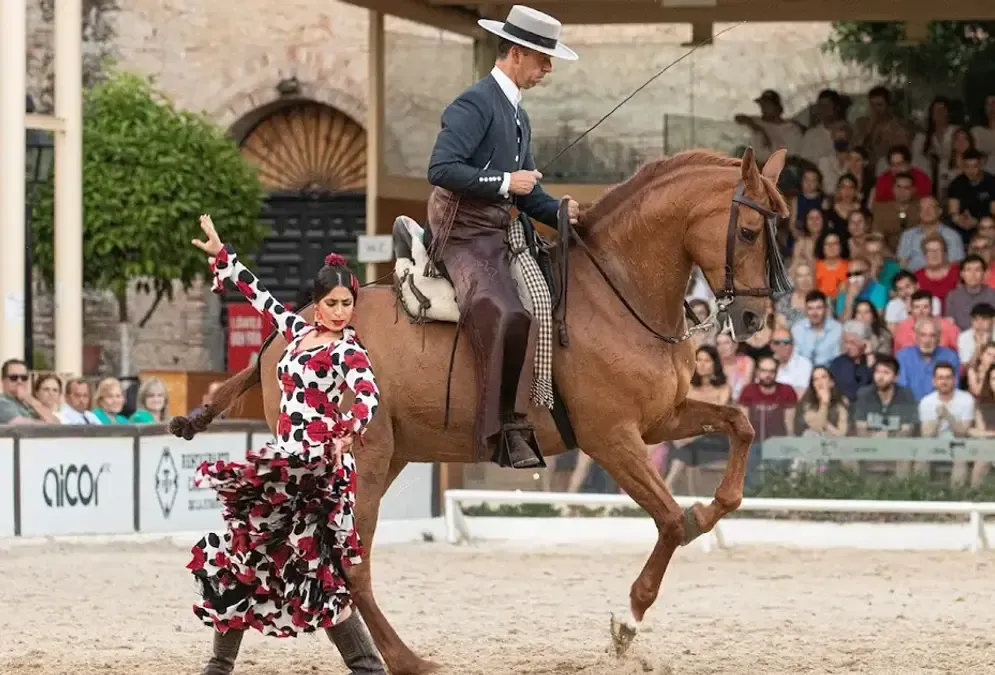
Caballerizas Reales de Córdoba
Philip II's 1568 Royal Stables, birthplace of the Andalusian horse. Evening show combining classical dressage, vaquera riding and flamenco. UNESCO heritage.
Seville's rebujito uses manzanilla from Sanlúcar de Barrameda or fino from Jerez, both within the Sherry Triangle designation. The fortification is controlled rather than natural; the wines carry that characteristic salty, mineral quality from proximity to the Atlantic. At the feria, the practical difference matters less than the provenance: Córdoba pours a wine made in its own province. Seville pours wines from a different designated origin entirely.
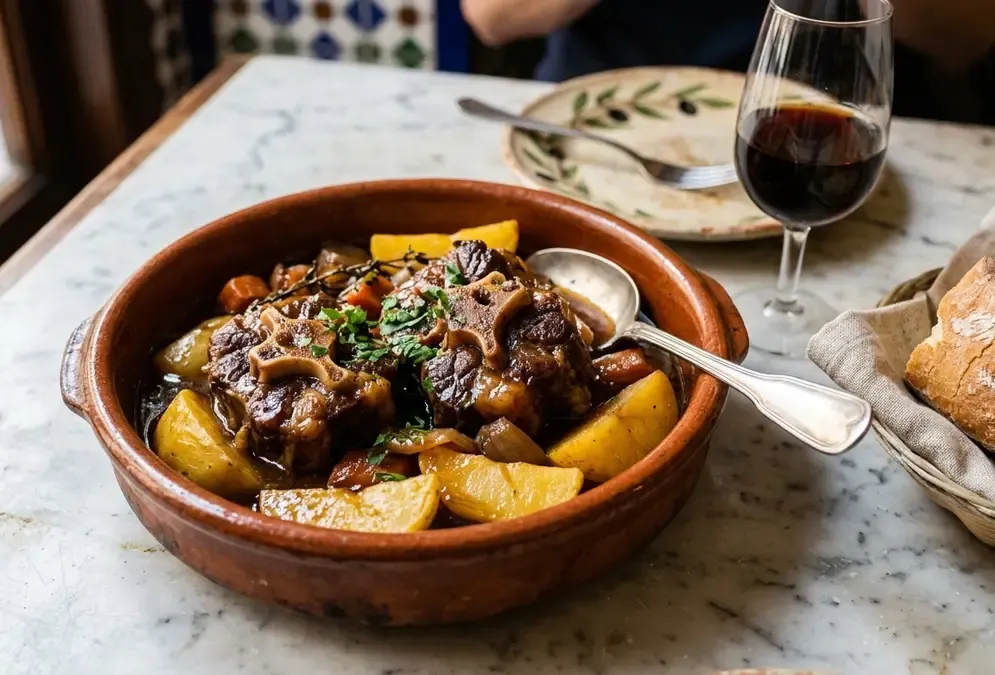
The food follows the same inland-versus-coastal divide. Córdoba serves salmorejo, the cold tomato cream thickened with bread and drizzled with egg and jamón; flamenquín, a fried pork roll; and rabo de toro, the slow-braised oxtail with its own gastronomic brotherhood in the city. Seville's feria table runs to pescaíto frito (fried fish, the traditional opening-night dinner), montaditos, and gazpacho. The sea is 80 kilometres from Seville; the food remembers it. Córdoba's feria food is entirely land-based: game, slow braises, cold soups made from summer tomatoes and local olive oil.
Intimate vs immense: what the scale difference feels like
Seville's Real de la Feria covers 450,000 m²[3] across 24 city blocks in the Los Remedios district. It is built fresh each year, a temporary city with its own streets, lighting, and infrastructure, and reaches a peak-night population of around 850,000 people[3]. To reach it from the historic centre, you take a bus or taxi. It does not connect to the old city on foot in any meaningful way.
Córdoba's fairground at El Arenal is human-scaled: an expanded footprint of around 1,400 m²[1] after the 2025 expansion, beside the Guadalquivir and walkable from the historic centre. The Calahorra Tower is visible from the fairground entrance. You arrive on foot if you are staying in the centre, and the feria is not separated from the city but folded into it for eight days.
At Seville, the crowd is immense and the scale produces spectacle. The Paseo de Caballos, the daily horse parade along Calle Pepita, is photographed internationally: pure Spanish breed horses, high-stepping, women in flamenca dresses riding sidesaddle against a backdrop of coloured lanterns and street lamps. Córdoba has the Día del Caballo on Thursday, and the morning horse parade is worth seeing, but it is not built for cameras. It is a city showing its horses to itself.
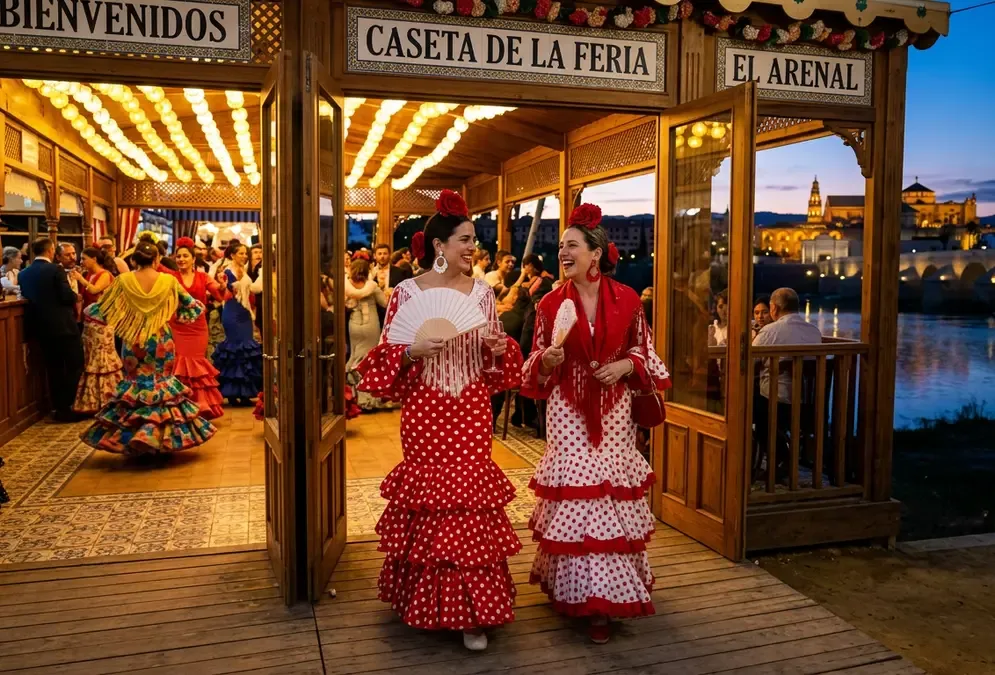
The casetas at El Arenal stay open until 6am and most take no invitation. That single fact separates Córdoba's feria from Seville's.
Seville in April, Córdoba in May: doing both in one trip
Seville's Feria de Abril runs for six days in late April. Córdoba's feria opens in late May, roughly four weeks later, leaving enough room to make the double itinerary workable.
The AVE high-speed train covers the 140 kilometres between the two cities in roughly 45 minutes. Day trips are common year-round, and the journey is cheap enough that spending two nights in each city rather than one is not an unusual way to structure an Andalusian spring. The feria dates do not overlap, so no choice is required between the two.
Seville first, Córdoba second is the natural order: partly because of the calendar, partly because Seville's scale is the defining first encounter with what an Andalusian feria is. Coming to Córdoba after Seville, the differences are immediate: the ease of entry, the neighbourhood scale, the absence of the gatekeeping dynamic. Visitors who reverse the order sometimes find Seville's private-caseta culture genuinely disorienting after Córdoba's openness.
Deep dive · Article
Rabo de Toro: Córdoba's Dish Born at the Bullring
Rabo de toro began as offal from Córdoba's bullring, given free to working-class families. How a 19th-century survival food became a €30 taberna staple.
The timing also places both ferias inside a denser Córdoba festival calendar. The Cruces de Mayo runs from May 1 to 5; the Festival de los Patios from May 6 to 13. All three together cover most of what makes Córdoba's spring exceptional — and the Córdoba patios article explains why the patios exist at all, which is not the decorative story most guides tell.