Manolete of Córdoba was born in Santa Marina in 1917 and died at 30, gored by a Miura bull. Spain mourned for three days. Islero's head is still in the museum.
Ten years covering Córdoba's UNESCO heritage sites, sourcing from Junta de Andalucía documentation.
Published
Updated
Manolete of Córdoba barely moved in the bullring — and that was the point. Born poor in Santa Marina in 1917, Manuel Laureano Rodríguez Sánchez earned $4 million over eight years standing still while Miura bulls passed inches from his body. He died doing it at 30 in Linares, and twenty thousand Cordobans came to see him off.
In this article
Santa Marina, poverty, and a dead father
The house where Manolete was born stands in Santa Marina, Córdoba's oldest working-class neighborhood, a barrio of narrow streets and low whitewashed houses that crowds into the northeast corner of the old city. His father, Manuel Rodríguez Sánchez 'Sagañón', was also a matador, and not a prosperous one. He died when his son was five, leaving the family with little. His great-uncle had been killed by a bull before him.
The neighborhood is still there. Santa Marina has the quality Córdoba's tourist zones have mostly smoothed away: an ordinariness that reads as authenticity. The square at its center has a statue of Manolete[1] cast by sculptor Amadeo Ruiz Olmos (who also made the city's bronze of Seneca) — a thin man in a suit of lights, holding his muleta. Children pass it on the way to school.
100
Corridas Manolete fought in a single year at his peak, in a career that ran from 1939 to 1947. He earned an estimated $4 million across eight seasons, more than any matador before him.
He began training at age twelve at El Lobatón farm, outside the city. His mother Angustias, who would become a formidable presence in his career, supported the decision. What choice was there? Bullfighting was the one industry that rewarded poor Andalusian boys who were willing to be gored. His family had already paid the other price.
By the time he took the alternativa (the formal ceremony confirming senior matador status), on July 2, 1939, in Seville, with Chicuelo presenting him and Gitanillo de Triana as witness, the Spanish Civil War had just ended. Spain was rebuilding from rubble under Franco, and the bullfighting world was rebuilding too. Manolete arrived at exactly the right moment, with exactly the wrong face for optimism, and the crowd loved him for it.
For anyone following Córdoba's history, the arc is familiar: a city shaped by loss producing a figure who embodies it.
The technique nobody else had
Most matadors of the era moved. They swept, pivoted, danced. Manolete stood still.
His signature move became known as the manoletina: he held the muleta (the red cloth) low beside his leg, parallel to his thigh, and kept his feet rooted. The bull passed inches from his body, sometimes grazing cloth that was pressed against his hip. There was no deception of distance, no footwork to open space. What he offered the bull was himself — specifically the part of himself that, if the bull deviated slightly, would be gored.
His manager, José Camará, a retired matador, had spent years refining his technique. Camará understood that Manolete's natural stillness and gaunt frame — the long limbs, the face like a Byzantine saint — were not limitations but assets. He should do less, not more. Economy of movement was the principle. Four or five linked passes, executed as one fluid sequence, then the walk away. In the kill, the suerte de la muerte (the stroke of death), he excelled: the sword went in correctly, deeply, without fuss.
The contrast with his contemporaries was jarring. Other matadors were exciting; Manolete was correct, cold, and total. Audiences who came expecting spectacle came away converted. The Miura bulls he preferred to fight (the most aggressive and least predictable breed, the ones other matadors avoided) made the stillness seem almost suicidal. He had sustained eleven serious gorings across his career before the one that killed him.
He fought six bulls in a single afternoon once. A record. He didn't brag about it.
The nickname the critics gave him was El Monstruo (The Monster), meaning something too complete, too perfect to be quite human. The nickname the public preferred was the Sad God of Córdoba, which captured something the former missed: the tristeza (sadness) was not a mood. It was his subject. He performed grief in a form that had been ritualizing death since the Romans, in a city where the equestrian tradition runs as deep as the bullfighting one, in a country that had just buried half a million of its own.
The crowds understood what they were watching.
The rival who wouldn't let him retire
By 1943, Manolete was the most famous bullfighter in Spain, with 71 appearances in a single season[2]. He was earning on a scale unprecedented in the sport and carrying the weight of a nation's need for heroes during Franco's grim early years. By 1946, some accounts suggest he was ready to stop. He was 28, wealthy, and had collected enough wounds.
Arruza was everything Manolete was not: athletic, flamboyant, openly joyful in the ring. He was drawing crowds who compared the two in ways that stung. Manolete's retirement plans, never formally announced, kept getting postponed. The rivalry did not operate through insults or formal challenges; it operated through bookings. If Arruza was selling out Mexico City's Plaza México, Manolete needed to be somewhere comparable.
In 1946, Manolete spent a season in Mexico, performing at the Plaza México before enormous crowds. He came back to Spain for the 1947 season with at least one more year committed to the circuit. Whether it was pride, money, or genuine love of the work that kept him going is a question Córdoba has been arguing ever since. His biographers tend to blame Arruza. His admirers tend to blame the Spanish public's insatiable demand. Both accounts are probably right.
Luis Miguel Dominguín, then barely twenty and already famous, was also on the bill for the corrida in Linares on August 28, 1947. Manolete was the senior name. The Miura bull assigned to him in the second lot of the afternoon was named Islero.
Linares, August 28: the wound and the morning after
At 6:42 PM, Manolete went in for the kill on Islero. As the sword went home, the bull's right horn caught his right thigh, driving in and upward. He completed the kill. The bull went down. Then Manolete went down too, carried from the arena to the infirmary in Linares.
The wound severed the femoral artery. Surgery was attempted through the night. He died at 5:07 AM on August 29, 1947, aged thirty years and fifty-six days[3].
Francisco Franco ordered three days of national mourning. Spanish radio broadcast only funeral dirges. The headline in El Ruedo magazine read: "¡Murió matando y mató muriendo!" — He died killing and he killed dying. Camilo José Cela, who would go on to win the Nobel Prize in Literature, wrote novelistic accounts of his death within the year.
Timeline
1917
Born in Santa Marina
Manuel Laureano Rodríguez Sánchez born July 4 in Córdoba.
1922
Father dies
The family falls into poverty. Training begins at El Lobatón farm, age 12.
1939
Professional debut
Debut in Seville, July 2. Takes his alternativa presented by Chicuelo.
1943
Peak season
71 corridas. Spain's most famous matador.
1946
Mexico season
Performs at the Plaza México. Carlos Arruza's rivalry keeps him from retiring.
1947
Death in Linares
Gored by the Miura bull Islero, August 28. Dies the following morning, aged 30.
His body was returned to Córdoba. More than 20,000 people[1] filed through his house in Santa Marina to view the corpse. The city's population at the time was around 200,000[1]. One in ten Cordobans.
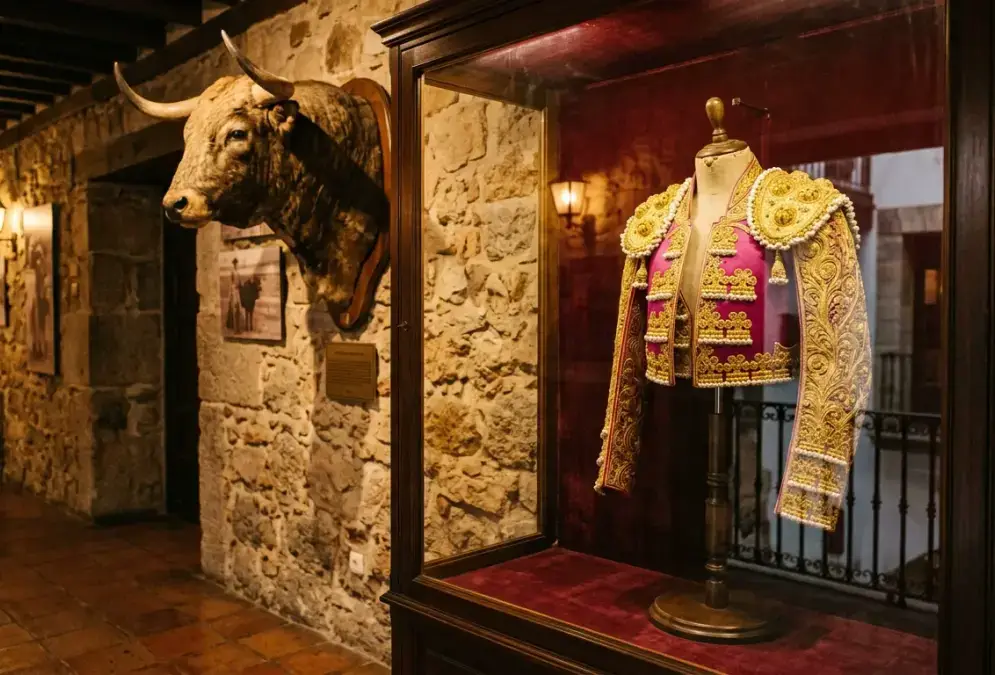
Islero's mounted head went to the Museo Taurino de Córdoba, where it remains, positioned at eye level in a glass case, looking out at visitors who may have no particular opinion about bullfighting but find themselves standing in front of the animal's face for longer than they expected. The museum holds his trajes de luces (suits of lights), personal items, and a replica of his funeral mausoleum. It sits in a 16th-century building called the Casa de las Bulas at Plaza Maimónides, and admission runs €4 full price, €2 reduced[4]. It is an undervisited room in a city that has not quite decided how to feel about the thing it produced.
Islero's mounted head at the Museo Taurino de Córdoba, Plaza Maimónides. The bull that killed Manolete on August 29, 1947, is the museum's heaviest exhibit.
The pastel cordobés, the city's laminated pastry filled with angel hair and candied pumpkin, was the kind of thing Córdoba pastry shops were selling the day he died, and the day before, and the day after. Some things the city keeps without asking why.
What Córdoba keeps
Córdoba claims five Caliphs of bullfighting — matadors from the city who redefined the art in their era:
20,000
People who filed through Manolete's house in Santa Marina to pay their respects after his death. The city's population was roughly 200,000 at the time. Franco declared three days of national mourning.
The Museo Taurino at Plaza Maimónides documents all five, but the Manolete room pulls hardest. The trajes de luces behind glass, the personal correspondence, the replica mausoleum, Islero's head. It's the museum of a city that does not quite know what to do with having produced a man who died in front of thousands of people at thirty.
The Museo Taurino is closed Mondays only[5]. On weekdays (Tuesday to Friday) it opens at 8:15 AM; Saturdays at 9:30 AM; Sundays 8:15 AM to 14:15[5]. Admission €4[4], reduced €2[4]. It's a ten-minute walk from the Mezquita in the old city, through the Jewish quarter and past the statue of Maimonides, a philosopher from the same neighborhood who also died in exile after a career spent trying to reconcile two things that didn't want to be reconciled.
Santa Marina is quieter. No tour buses stop at the barrio's streets. His birthplace is marked, the square has the Ruiz Olmos statue, but the neighborhood resists the kind of packaging that the Judería has accepted. This may be correct. Manolete's appeal was always that he didn't try to be charming.
His sadness was not performed for tourists. It was performed for a country that had buried its Civil War dead and couldn't quite find its way back to something lighter. He gave them a figure who was excellent, mortal, and unafraid of the second quality. Spain found that combination necessary in 1947. Córdoba still doesn't know what to do with it except visit it on a Tuesday morning for €4[4] and stand in front of a bull's glass eyes longer than expected.
A short walk from the museum, the Caballerizas Reales houses the royal stables where Córdoba's equestrian tradition predates the bullfighting tradition by centuries. The horse and the bull have been the city's two great animals for two thousand years. Manolete understood that. His father did too, and his father's father.
FAQ about manolete cordoba
Where was Manolete born in Córdoba?
Manolete was born on July 4, 1917, in the Santa Marina neighborhood of Córdoba, a working-class barrio in the northeast of the old city. His birthplace is marked, and the square at the neighborhood's center has a bronze statue of him by sculptor Amadeo Ruiz Olmos.
How did Manolete die?
Manolete was gored by a Miura bull named Islero at a corrida in Linares on August 28, 1947. The bull's right horn caught his right thigh and severed the femoral artery as Manolete went in for the kill. Surgery was attempted through the night; he died at 5:07 AM on August 29, aged 30. Franco declared three days of national mourning.
Where can I see Manolete exhibits in Córdoba?
The Museo Taurino de Córdoba (Bullfighting Museum) at Plaza Maimónides holds Manolete's trajes de luces (suits of lights), personal items, and the mounted head of Islero, the bull that killed him. Admission is €4 (€2 reduced). Closed Mondays; open Tuesday–Friday from 8:15 AM, Saturdays from 9:30 AM, and Sundays 8:15 AM–14:15. It's a ten-minute walk from the Mezquita through the Jewish quarter.
What was the manoletina pass?
The manoletina was a pass developed around Manolete's natural stillness: he held the muleta low beside his thigh and kept his feet completely rooted while the bull passed inches from his body. Most matadors use footwork to create distance; Manolete offered none. The pass is named after him and is still performed today, though rarely with his original rigid-foot technique.
Why does Córdoba have a special connection to bullfighting?
Córdoba claims five matadors considered to have redefined the art in their era: Lagartijo, Guerrita, Machaquito, Manolete, and El Cordobés, the five 'Caliphs of bullfighting.' The Museo Taurino at Plaza Maimónides documents all five and remains one of the best bullfighting museums in Spain. The city's claim to bullfighting goes back to the 19th century, when Lagartijo and Guerrita set the modern technical standards for the corrida.