
The philosopher from Córdoba who shaped an empire
Córdoba's claim on Seneca is not metaphorical. He was born in Corduba, the Roman colonial capital of Hispania Baetica, modern Córdoba, around 4 BCE[1], into an equestrian family called the Annaei[2]. His father, Seneca the Elder, was a rhetorician who taught in Rome. The family was provincial elite in the truest sense: wealthy enough to educate their children in the imperial capital, ambitious enough to do it.
The stakes of Seneca the Younger's life were Roman-scale. He became the most powerful private citizen in the empire during Nero's first years, effectively co-governing Rome with the Praetorian prefect Burrus. He wrote plays that Corneille adapted, essays that Montaigne lifted wholesale, and letters that still get quoted in self-help books. He held an estimated 300 million sesterces[4] in personal wealth while preaching that money was indifferent to happiness. He drafted the Senate's justification for the murder of Agrippina. And in 65 CE, when Nero sent a tribune to his house with orders to die, he opened his veins, bathed in warm water, poured out a libation to Jupiter the Liberator, and drank hemlock, talking philosophy until the end.
3
For anyone exploring Córdoba's history, Seneca is the city's oldest claim to world significance. His story predates the Mezquita, the Caliphate, and the convergence of three cultures. It is the moment a provincial city first sent its ideas to govern an empire.
Four writers, one address in Roman Corduba
Seneca the Elder (c. 54 BCE – c. 39 CE) was born in Corduba and became Rome's foremost chronicler and anthologist of rhetoric[5]. A wealthy private gentleman, he attended declamations as an observer throughout his life and later compiled the Controversiae and Suasoriae from memory — the most complete surviving record of Augustan oratorical culture. His surviving works document the oratorical world his son grew up in. His wife Helvia, whom Seneca would console in the letters he wrote from Corsican exile, shaped the household's intellectual character.
Of the three sons, two achieved Rome-wide fame. Lucius Annaeus Novatus, the eldest, took the name Gallio after adoption and served as proconsul of Achaea around 51–52 CE. He appears in the New Testament: in Acts 18:12–17, Paul of Tarsus stands before Gallio in Corinth, and Gallio refuses to judge the apostle's religious dispute as a legal matter. A proconsul's snap ruling, recorded in Scripture and still debated by scholars centuries later, from Corduba. The youngest brother, Marcus Annaeus Mela, stayed closer to commerce and private life, but his son was Lucan, the poet who wrote Pharsalia, Rome's epic of civil war, before Nero ordered him to die in the same Pisonian purge that killed his uncle.
The family built a provincial-to-imperial pipeline: one generation teaching rhetoric in Rome, the next advising emperors, governing provinces, and writing the poems that would outlast them. Seneca himself moved to Rome around age five, taken by his mother's stepsister. He spent almost his entire adult life there, but Corduba stayed in the family name. Later, emperors Trajan and Hadrian also came from Hispania; Seneca was the first wave of Hispanic-Roman intellectual ascendancy.
You can see the Annaei's world made physical in the Roman temple on Calle Capitulares, built in the first century CE, the same decades Seneca spent rising through Rome's courts.
Rome, exile, and the climb to Nero's tutor
Seneca reached Rome young, studied under Attalus the Stoic and the Pythagorean-inflected Sotion of the Sextii, and nearly died of chronic respiratory illness in his twenties (possibly tuberculosis). He spent roughly 16–31 CE recovering in Egypt, where his aunt's husband was Prefect, and returned to Rome to begin a senatorial career under Caligula. Around 39 CE, Caligula nearly had him executed for oratorical brilliance; he was saved, according to Suetonius, only by a court lady's claim that he was already dying of illness.
Claudius sent him to Corsica in 41 CE on charges of adultery with Julia Livilla, Caligula's sister. The accusation was almost certainly fabricated, most likely engineered by Empress Messalina to remove a rival. Seneca spent eight years on the island, writing consolatory essays to his mother Helvia and to the court freedman Polybius, and producing De Ira, his treatise on anger as the most destructive of passions. The exile produced some of his best early work.
Explore nearby · Monument
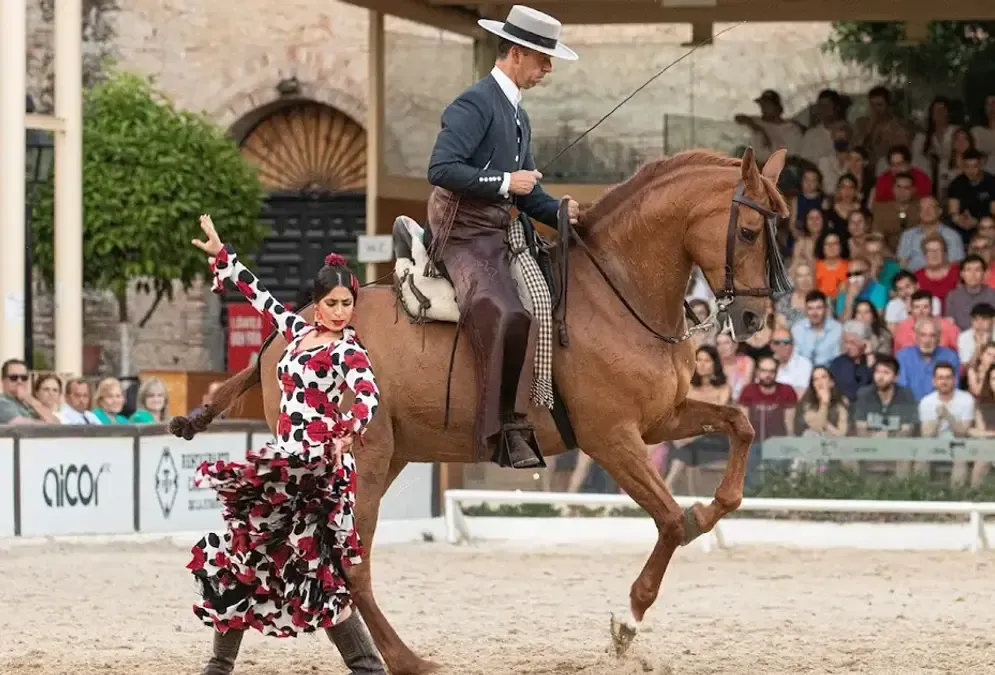
Caballerizas Reales de Córdoba
Philip II's 1568 Royal Stables, birthplace of the Andalusian horse. Evening show combining classical dressage, vaquera riding and flamenco. UNESCO heritage.
Empress Agrippina the Younger, Claudius' new wife, recalled Seneca in 49 CE to tutor her twelve-year-old son, later Nero. After Claudius died in 54 CE, Seneca and Burrus effectively co-governed Rome during what Tacitus calls the quinquennium Neronis (roughly 54–59 CE), a period of fiscal reform and relatively humane governance that later Romans looked back on with regret.
The relationship between Seneca and Nero corroded. When Nero murdered his mother Agrippina in 59 CE, Seneca drafted the Senate's letter justifying the act. He was a moralist who wrote at length about the corrosiveness of anger and the wickedness of flattery, and when the moment came, he wrote the document that gave the matricide a legal face. Ancient biographers and modern historians have argued about his motives: fear, political pragmatism, genuine loyalty to an institution he hoped to moderate from within. None of the explanations is flattering. After Burrus died in 62 CE, Seneca asked Nero for permission to retire, offered to return his wealth, and withdrew to a semi-private life that lasted three years.
His Corduba contemporary, the philosopher Averroes, would face his own exile from Córdoba twelve centuries later, a pattern the city seems fated to repeat.
The letters that taught Europe to write essays
The three years between Seneca's semi-retirement in 62 CE and his forced death in 65 CE produced most of what survives. The 124 Epistulae Morales ad Lucilium[3] (the Moral Letters to his friend Lucilius Junior) are addressed like actual correspondence but were almost certainly composed for publication. They cover anger, friendship, death, time management, the proper attitude toward enslaved people, how to read, how to age, how to face illness. The tone differs from the formal treatises: more digressive, more personal, more willing to admit uncertainty.
Montaigne read Seneca obsessively and said so. His Essays draw directly from the Senecan model: first person, anecdote, topic pursued without strict resolution, a mind thinking rather than a teacher pronouncing. Francis Bacon read Montaigne. The European essay as a form traces a line from Seneca's portable letters to every personal non-fiction writer working today.
The same years produced:
- De Brevitate Vitae (On the Shortness of Life): the argument that we don't have too little time, we waste what we have
- Naturales Quaestiones: seven books on natural philosophy, covering earthquakes, comets, and lightning
- Nine tragedies including Medea, Phaedra, and Thyestes, not Greek drama revised but something more interior, more obsessed with the corrupting effects of power, more viscerally violent. Corneille, Racine, and Elizabethan scholars have argued that Senecan drama gave Shakespeare's revenge plays their particular darkness.
The modern Stoic revival (Ryan Holiday's The Obstacle Is the Way, Massimo Pigliucci's philosophy writing, the whole productivity-adjacent genre that rediscovered memento mori and amor fati) draws overwhelmingly from Seneca. The letters are genuinely useful. What the revival tends to miss is the man behind them: the one who preached simplicity from a fortune of 300 million sesterces[4], who wrote about anger while helping govern the most powerful autocracy in the Western world, who counselled rational acceptance while writing justifications for murders he could not stop.
That contradiction is real and he was aware of it. Several of the letters address the gap between the life he described and the one he lived. The Epistulae Morales are more interesting because of it, not less.
Dying like a philosopher
In April 65 CE, the Pisonian conspiracy (a plot to assassinate Nero) was discovered and crushed.[4] Seneca's exact role remains contested; ancient sources differ on whether he was a genuine conspirator or a name added to a list by someone trying to save themselves. Nero sent a tribune, Granius Silvanus, to Seneca's country house with the order.
Tacitus tells it in Annals 15.60–64, and the scene has the quality of a performance staged by the dying man himself. Seneca accepted the news calmly. His wife Pompeia Paulina insisted on dying with him; both opened their veins. The bleeding was slow. He bathed in warm water to accelerate blood loss and summoned his secretaries to take dictation. He was still talking, still composing. He poured out a libation to Iuppiter Liberator, a gesture at once Stoic and defiant: framing his compelled death as a voluntary act of freedom. He took hemlock, as Socrates had, when the bleeding was not enough. The steam from the warm bath finally completed it.
Nero halted Paulina's death; she lived on for years, visibly marked by the scars.
He poured out a libation to Jupiter the Liberator, as his life drained away, framing a compelled death as a voluntary act of freedom.
The symbolic weight that accrued to this scene is disproportionate to its historical moment. Later Christian writers used it as a template for martyrdom: rational composure before unjust execution. Medieval and Renaissance readers quoted it constantly. Aquinas cited Seneca alongside Aristotle on practical ethics. Petrarch made him a moral hero. The death scene became more famous than most of the letters, which is almost certainly not what Seneca would have wanted.
A 1965 bronze, funded by a bullfighter, on Roman walls
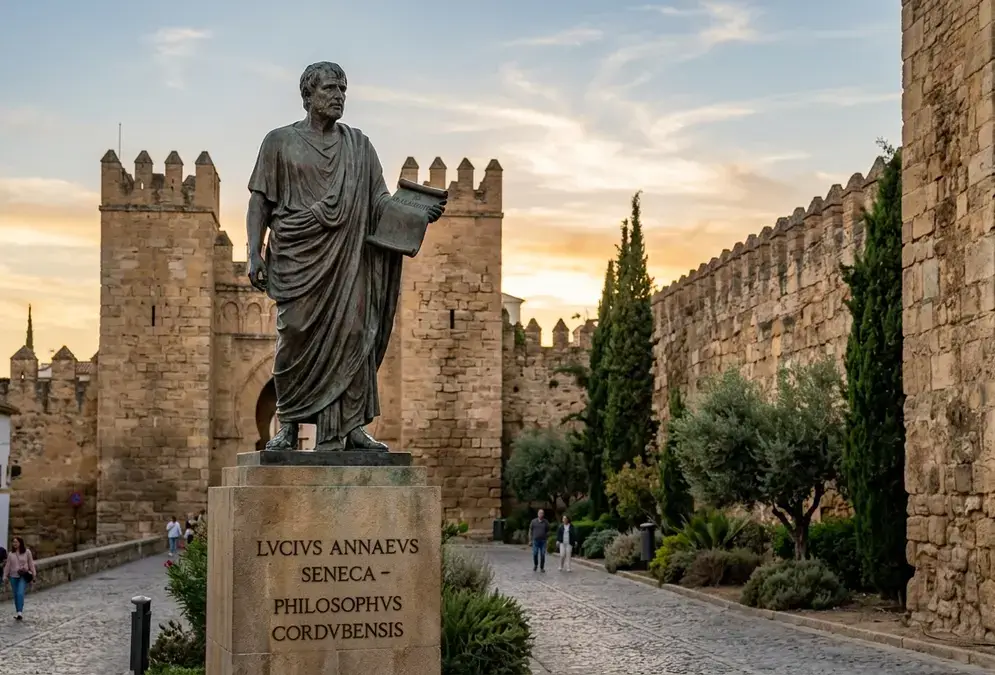
Córdoba was slow to claim him. The bronze statue standing beside the Puerta de Almodóvar in the old city was cast by sculptor Amadeo Ruiz Olmos and unveiled in 1965, a full two millennia after Seneca's birth. The funding came from Manuel Benítez, the bullfighter known as El Cordobés, whose patronage of the arts in his home city ran to things that brought the city international attention. The statue shows Seneca on a high pedestal in a toga, holding a scroll, looking out over the medieval gate built on Roman foundations. Two years later, Ruiz Olmos cast the Averroes statue near the Puerta de Almodóvar as well: Córdoba was recovering its philosophical patrimony in batches.
The Puerta de Almodóvar is a 14th-century Muslim gate built atop Roman walls dating to the 1st–2nd centuries CE, precisely the era of Seneca's family. The walls and the Roman bridge a few hundred metres away are the most tangible remnants of the Corduba the Annaei knew. The Roman bridge's foundations trace to the 1st century BCE; Seneca likely crossed an earlier version as a small child, before the journey north to Rome.
Read next · Article
Averroes: Córdoba's Philosopher Who Saved Aristotle
Born in Córdoba in 1126, Averroes wrote the commentaries that returned Aristotle to Christian Europe. Thomas Aquinas read him. Paris called him the Commentator.
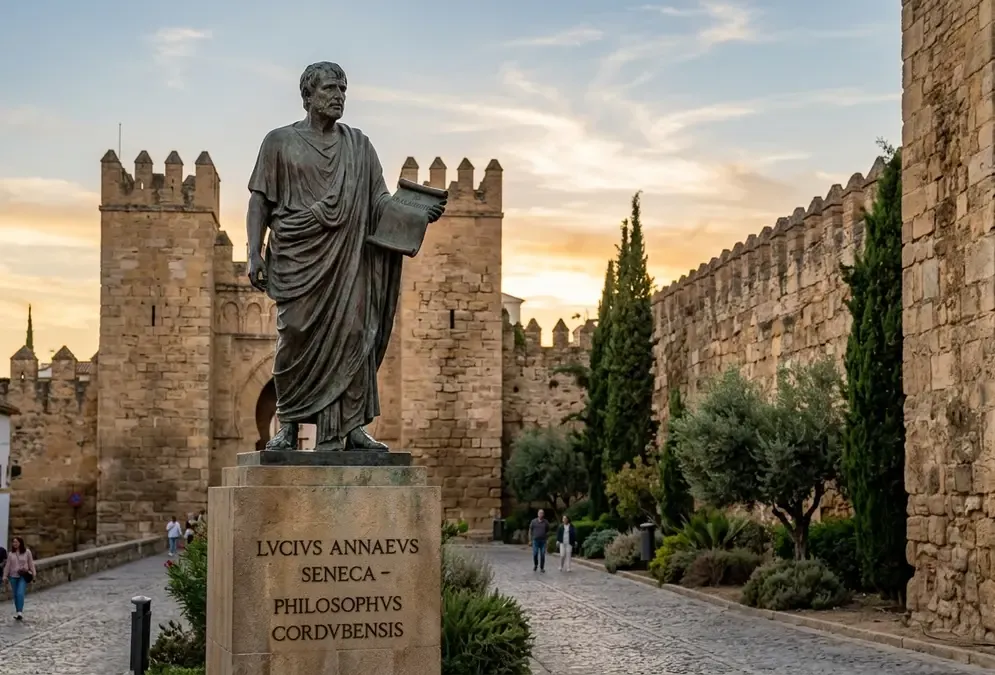
Amadeo Ruiz Olmos's 1965 statue of Seneca, funded by the bullfighter Manuel Benítez 'El Cordobés'. The Puerta de Almodóvar gate behind him sits on Roman foundations contemporary with the Annaeus family.
Walking out of the Judería towards the Puerta de Almodóvar in the late afternoon, when the light hits the Roman stones sideways, is the closest you will get to the city's layered biography in a single frame. Medieval Muslim gate. Roman walls. A 1960s bronze philosopher funded by a bullfighter. Córdoba accumulates significance without quite explaining itself.
Deep dive · Article
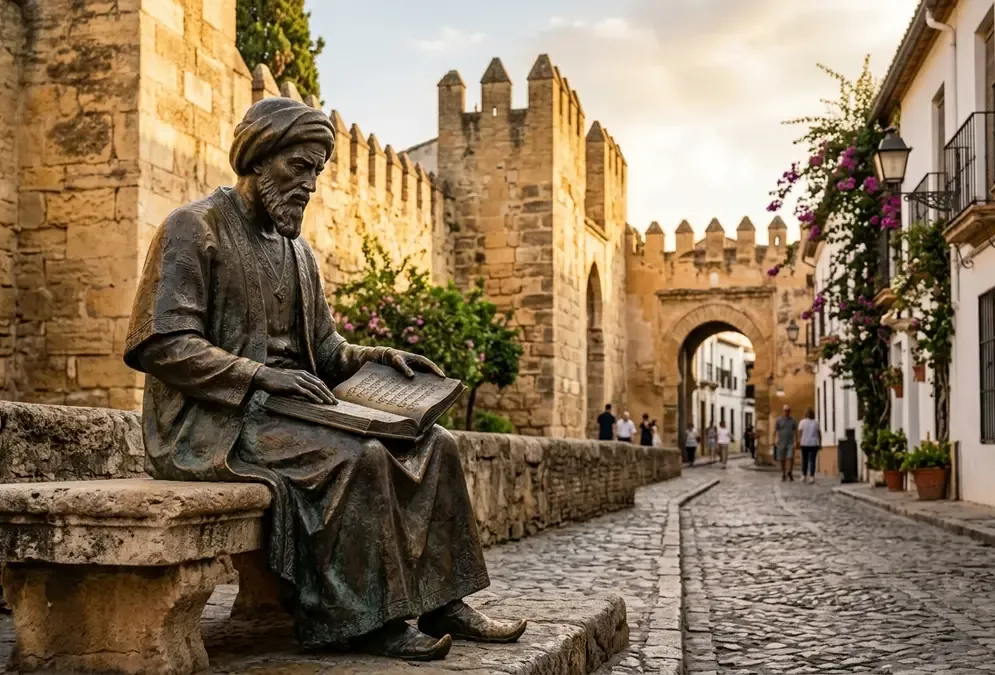
Averroes: Córdoba's Philosopher Who Saved Aristotle
Born in Córdoba in 1126, Averroes wrote the commentaries that returned Aristotle to Christian Europe. Thomas Aquinas read him. Paris called him the Commentator.
The Museo Arqueológico, a short walk into the old city, holds Roman artefacts that contextualise what daily life in 1st-century Corduba actually looked like: coins, ceramics, the material detail that Seneca's letters describe in theoretical terms (otium, virtus, adiaphora) but never photograph. The Roman temple on Calle Capitulares, visible and partially reconstructed, gives the urban scale. Corduba in Seneca's time was a proper city. The Roman Córdoba guide maps the surviving monuments, from the bridge to the temple, that frame the city Seneca was born into.
None of this makes Córdoba a Seneca pilgrimage site in any organised sense. There is no museum dedicated to him, no formal walking route, no entry fee. You visit his statue on the way to something else, probably the Puerta de Almodóvar or a restaurant in the Judería. The same afternoon can take you to the contested history of the Mezquita-Catedral or the shaded courtyards of Córdoba's patio tradition. The philosopher as a stop on an ordinary afternoon seems about right for a man who insisted that philosophy was not an institution but a practice.