
Expelled from Baghdad by his own teacher
The city that shaped Ziryab was not Córdoba but Baghdad, specifically the court of Caliph Harun al-Rashid of the Abbasid dynasty, where the finest musicians in the Islamic world competed for patronage and position.[1] Ziryab was born around 789 CE in Baghdad (some sources say Mosul; the birthplace is disputed) and given the full name Abul-Hasan Ali Ibn Nafi.[2] The nickname Ziryab, meaning Blackbird in Arabic, came from his dark complexion and his voice, which contemporaries described as extraordinarily melodious — a fact that would eventually get him expelled.
He studied under Ibrahim al-Mawsili, the preeminent court musician of the age, one of the most celebrated teachers the Abbasid court had ever produced.[1] The trouble was that Ziryab turned out to be better than his master. The story, preserved in later Arab chronicles, is that the Caliph heard Ziryab play in secret and immediately preferred him. When Ibrahim realised what he was dealing with, he gave his student a stark choice: leave Baghdad, or face the consequences of outshining the man who fed you. Ziryab left.
This kind of expulsion carried no legal penalty but it was socially catastrophic. A musician's reputation was inseparable from his patron, and to leave Baghdad under those circumstances meant he would not find another patron there. He headed west, first to North Africa, then toward Al-Andalus.[3] He had been invited to Córdoba by Emir al-Hakam I, but al-Hakam died before Ziryab arrived in 822 CE. His son Abd al-Rahman II received him instead, and made an immediate decision: Ziryab would stay.
822 CE
What Abd al-Rahman II bought for 200 gold dinars a month
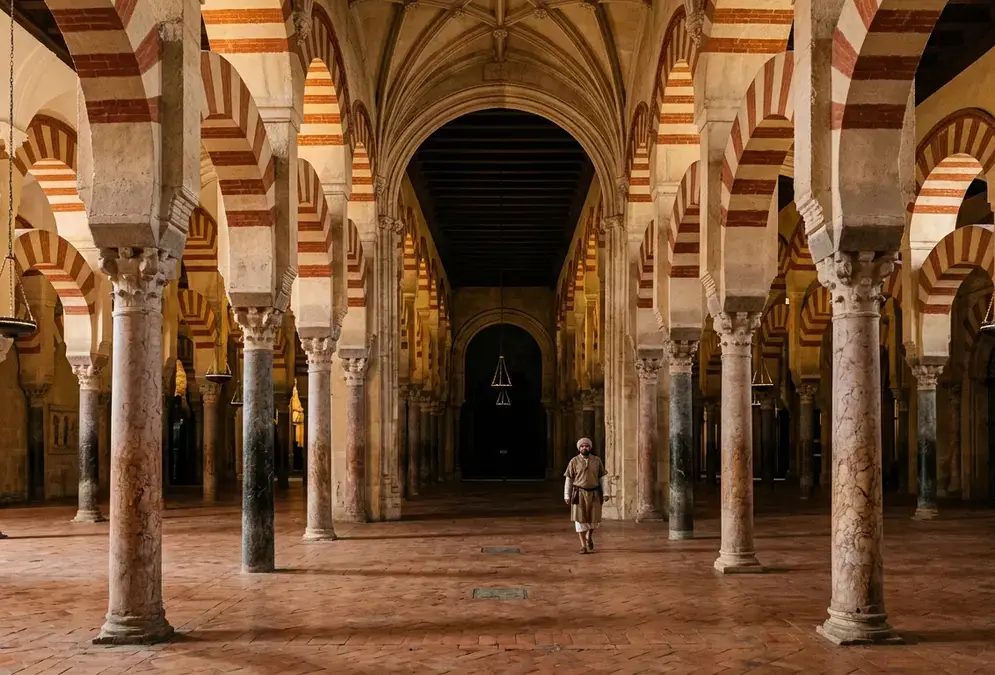
Abd al-Rahman II was expanding the Great Mosque when Ziryab arrived, adding new columns to the prayer hall his grandfather had built.[1] He was also building a court culture to match the Abbasid sophistication that Córdoba had heard so much about. Ziryab arrived already famous, already trained by the best, already carrying a reputation that had preceded him across the Mediterranean. Abd al-Rahman settled on him a salary of 200 gold dinars per month plus gifts, estates, and the title of court companion (nadim).[2] It was an enormous sum. The Emir was not buying a musician. He was buying a civilisation transplant.
Ziryab's practical impact on the Umayyad emirate's court was immediate and wide-ranging. He introduced seasonal fashion to the Córdoba elite: white linen for summer, heavy furs for winter, transitional weights for the shoulder seasons.[3] He replaced the rough linen tablecloths of the Córdoba table with fine leather, and swapped the gold and silver goblets in use at court for crystal glassware.[5] He brought spices, dried fruits, and fruit syrups from the Abbasid culinary tradition, and is credited with introducing asparagus to Spain.[6]
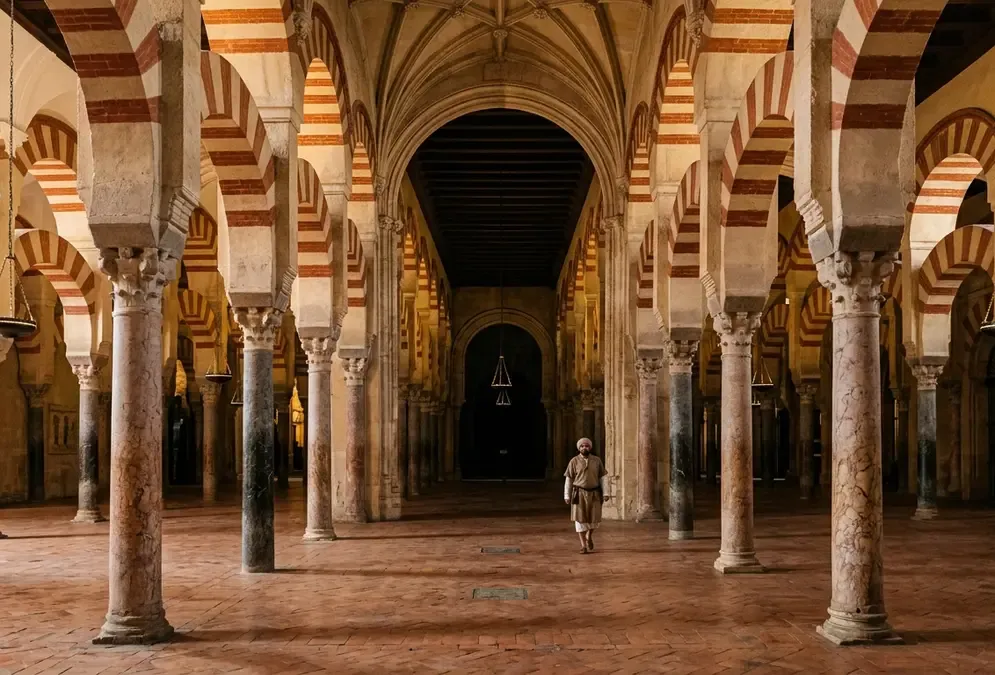
Abd al-Rahman II was adding columns to the Great Mosque during Ziryab's 35 years in Córdoba. The court musician and the caliph's architect were working in parallel.
None of these were trivial gestures. The court of Al-Andalus was engaged in a sustained competition with Baghdad for cultural prestige, and Ziryab was the most direct possible transfer from the source. What he wore, how he set a table, what he played — all of it carried the weight of the Abbasid standard, now adapted and planted in Iberian soil.

Explore nearby · Monument
Plaza de la Corredera
Andalusia's only Castilian arcaded square, built in 1683 over a Roman forum. Once a bullfighting ring, now lined with bar terraces and a Sunday flea market.
The fifth string and the music school
Ziryab's most durable technical contribution was to the oud (al-ud), the fretless lute at the centre of Arabic classical music and the ancestor of the European lute.[1] The instrument as he found it had four strings, each one associated with a humour in medieval Arabic medical theory: yellow bile, blood, phlegm, black bile. Ziryab added a fifth string, rose-coloured gut, placed between the second and third strings and said to represent the soul. He also replaced the standard wooden plectrum (risha) with a sharpened eagle-feather quill, producing a cleaner, more precise attack on the string.[2]
These were not cosmetic changes. The fifth string expanded the instrument's harmonic range and altered the character of the maqam patterns available to a player. The quill changed how the string spoke: softer at the tip, more nuanced in the decay. Players who came up through Ziryab's school learned on this instrument, and because the school existed for 35 years, from 822 until his death in 857, the effect compounded across multiple generations of students.[1]
The school enrolled both male and female students, which was unusual. Ziryab taught the nuba (or nawba), a form of vocal-instrumental suite structured in nine movements, each with a distinct rhythmic character.[7] The nuba is the foundation of Andalusian classical music, and its survival is one of the remarkable stories of medieval cultural transmission. When the Reconquista pushed Muslim populations out of Al-Andalus over the following centuries, Andalusian musicians carried the nuba west across the Strait of Gibraltar into North Africa. The tradition is alive today in Morocco, Algeria, Tunisia, and Libya, where orchestras play the same suite structures that Ziryab codified in 9th-century Córdoba.[8]
The relationship between Ziryab's nuba and the later muwashshah (the Andalusian strophic song form) and the emotional concept of tarab, the state of musical ecstasy sought by both performer and listener, is traced by musicologists directly back to the Baghdad-trained court musician who settled in the city. His influence on what became the Maghreb musical tradition was not incidental. It was structural.
Did Ziryab invent the three-course meal?
The claim that Ziryab established sequential dining in Córdoba, replacing the practice of piling all dishes on the table at once with the now-universal sequence of soup, then meat or fish, then fruits, nuts, and sweets, is widely repeated and almost impossible to verify.[4] The earliest written source for it is Ibn Hayyan, the 11th-century Córdoban chronicler, who was describing events roughly 200 years after they supposedly occurred.[5] That does not make it false. It means it belongs in the category of plausible attribution rather than documented fact, and it is worth treating it accordingly.
What is clear from the sources is that Ziryab brought Hispano-Muslim cuisine in Córdoba into contact with the considerably more elaborate culinary tradition of the Abbasid court.[6] He introduced asparagus. He brought spices and fruit syrups and techniques for using dried fruits that had no tradition in the Iberian kitchen. Whether the three-course sequence was a deliberate innovation, an Abbasid norm he simply carried with him, or a later legend that accreted to a man already famous for changing everything, tradition holds that the Blackbird of Córdoba was responsible for it.[4]
Whether the three-course sequence was a deliberate innovation, an Abbasid norm he simply carried with him, or a later legend that accreted to a man already famous for changing everything, tradition holds that the Blackbird of Córdoba was responsible for it.
The honest version of this story is also the more interesting one. A trained musician from the most sophisticated court in the Islamic world arrives in a city that wants to be exactly that, and he starts teaching it how to eat like Baghdad does. Whether he sat down one evening and announced that soup must precede meat, or whether the sequence simply arrived with him as natural practice, the effect on Córdoba's elite dining culture was real. You can visit the Alcázar gardens and read a menu at half the restaurants in the old quarter that offer what they call Andalusian-influenced courses, and the ghost of those 9th-century dining rooms is not entirely gone.
Ziryab's Córdoba: what you can still trace
Ziryab died on 27 January 857 CE in Córdoba, aged approximately 67.[1] He left no building, no text, no surviving manuscript. What he left was a set of practices that took root in a city already predisposed to absorb them, and a musical lineage that outlasted the civilization that created it.
The Mezquita — the Great Mosque that Abd al-Rahman II was expanding during Ziryab's time — still stands and is the most direct architectural link to the court that housed him. Walk through the forest of 856 columns of jasper and marble and you are inside the same building complex where the Emir who paid 200 gold dinars a month for a musician held court.[1] The Medina Azahara, built after Ziryab's death by Abd al-Rahman III, is the physical embodiment of the Umayyad court culture that Ziryab helped define — it was built to express exactly the kind of civilizational ambition he represented, and you can still walk through its reception halls on the hillside west of the city.
For food-lovers planning time in Córdoba, the food tour cordoba operators in the old quarter sometimes work the Ziryab connection into their narrative, and correctly so. The city's commitment to local produce and sequential small courses owes something, even if indirectly, to the 9th-century logic he brought from Baghdad. The olive oil tasting tradition in the province belongs to the same Mediterranean culinary inheritance he was drawing from.
Restaurants and bars named Ziryab appear in the old quarter with some regularity, which is either a compliment or a tourist trap depending on the establishment. The name is recognition, at least, that the city knows who he was. For the music, the best evidence of his legacy is not in Córdoba at all but in Fez or Tunis, where the orchestras of the Andalusian classical music tradition still perform the nuba suite cycle on instruments that include the fifth-stringed oud he modified twelve centuries ago.
The polymath problem: what we actually know
Ziryab has become the kind of historical figure onto whom later ages project whatever they most want to believe. Claims circulate that he invented toothpaste, established the world's first conservatoire, pioneered underarm deodorant. None of these are supported by the early sources. The early sources are themselves limited: the accounts we have come primarily from Ibn Hayyan and later Andalusian chroniclers writing at a significant remove from the 9th century.[3]
What the serious scholarship agrees on is narrower and still genuinely remarkable. He was trained by the best musician of the Abbasid age. He arrived in Córdoba with a superior musical education and an instrument he had improved. He spent 35 years teaching, enrolling students of both sexes, and codifying a suite form that survived in living performance tradition across three continents for more than a thousand years.[2] He introduced Abbasid dietary habits and presentation to the Córdoba elite, with an effect on local culinary culture that later chronicles describe in detail. He changed how the city's court dressed.
The tendency to add ever more inventions to his ledger is understandable. A man who changed music, cooking, and fashion in a single career is genuinely extraordinary, and it is tempting to credit him with more. The honest historical Ziryab is already one of the more interesting figures to have lived in 9th-century Córdoba, which was itself one of the more interesting cities in the 9th-century world. You do not need the toothpaste.
The honest historical Ziryab is already one of the more interesting figures to have lived in 9th-century Córdoba, which was itself one of the more interesting cities in the 9th-century world.

Deep dive · Article
Feria Córdoba vs Seville: The Real Differences
85 public casetas vs 1,253 private ones. Founded in 1284 vs 1847. Here is what actually separates Córdoba's feria from Seville's and why it matters to visitors.
For the context that produced him, read Averroes and Maimonides, the two Córdoba-born philosophers who came three centuries after Ziryab and worked in the same tradition of Al-Andalus's sustained, competitive, occasionally catastrophic intellectual ambition. Ziryab was not a philosopher but he was, in his own domain, doing the same thing: taking what Baghdad had and making it into something Córdoba could claim. Abd al-Rahman I, the emir who founded the Umayyad emirate of Al-Andalus, is the wider political origin without which none of this court culture existed.