City comparison
Córdoba or Toledo?
Toledo is the obvious choice from Madrid. Córdoba is the better one. Here's how they compare, and when to choose each.

Written by
María Fernanda González Ten years covering Córdoba's UNESCO heritage sites, sourcing from Junta de Andalucía documentation.
Published
Updated
At a glance
- From Madrid
- Toledo 30 min; Córdoba 1h 45min by AVE
- Córdoba duration
- 2–3 days
- Toledo duration
- 1 day (compact)
- Córdoba wins
- Warmer climate, richer Moorish heritage, patios
- Toledo wins
- Easy Madrid day trip, El Greco, sword crafts
- Suggestion
- Toledo as Madrid day trip; fly in/out of Córdoba
In this guide
Side-by-side comparison
| Category | Córdoba | Toledo |
|---|---|---|
| Flagship monument | Mezquita-Cathedral (€15) | Toledo Cathedral (€12) |
| Ideal duration | 2–3 days | 1–2 days |
| Daily budget | €70 | €65 |
| Double room | €60–100 | €50–90 |
| Train from Madrid | 1h45, €25–75 | 34 min, €7–20 |
| Historical identity | Caliphate capital (8th–10th c.) | City of Three Cultures |
| Atmosphere | Intimate, Andalusian | Medieval, hilltop |
| Food scene | Salmorejo, rabo de toro | Marzipan, game dishes |
| Crowds | Moderate | Heavy (Madrid day-trippers) |
| Population | 325,000 | 83,000 |
So which one should you visit?
Toledo wins on convenience. Thirty-four minutes from Madrid Atocha, cheap tickets, easy day trip. Every guidebook says the same thing, which is part of the problem: the old city is a pedestrian pinch-point jammed with tour groups by 10am.
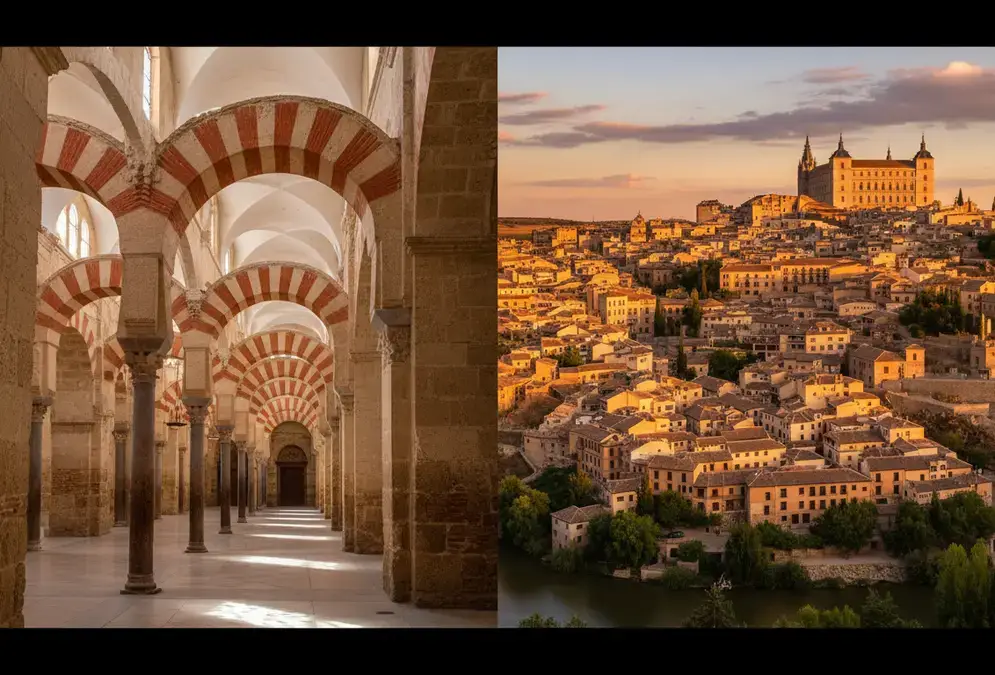
Córdoba takes 1h45 by AVE from Madrid and starts at €25. What you get for those 65 extra minutes: the Mezquita-Cathedral (856 double arches of alternating red and white voussoirs, a building that exists nowhere else on earth), plus a food scene built around Andalusian tradition rather than tourist menus, and streets that thin out considerably once you step beyond the main entrance.
If you have one day and prioritize ease, Toledo makes sense. If you have one day and want the better experience, take the longer train. If you have two days, do both; they're genuinely different cities making genuinely different arguments.
Córdoba: Europe's forgotten caliphate capital
In the 10th century, Córdoba was the largest city in Europe: a caliphate capital of 500,000 people with 300 mosques, running water in the palaces, and a library of 400,000 volumes when most of Europe had barely heard of books. That layered past still shapes the city. You feel it in the compressed streets of the Judería, in the weight of the Mezquita's columns, in the ruins of Medina Azahara spread across the sierra eight kilometres west of the city.
The city is compact. You can walk from the train station to the Mezquita in 20 minutes, cross the whole historic centre in under an hour. Accommodation runs €60–100 for a decent double. The set lunch menu at a good restaurant (not a tourist trap) is €10–13. Compare that with Granada or Seville and the difference adds up over two days.
Must-sees
- • Mezquita-Cathedral: 856 double arches, caliphal mihrab, Gothic nave inside (€15)
- • Alcázar de los Reyes Cristianos: Roman mosaics, terraced gardens (€5)
- • Judería: former Jewish quarter, UNESCO listed, Synagogue del Córdoba (14th c.)
- • Medina Azahara: caliphal palace city, 936 AD, partially excavated (€3)
Best for
Islamic history, Andalusian food, slow travel, couples, budget-conscious visitors, first-timers to the south.
Córdoba's strengths
- + The Mezquita: architecturally unique in the world
- + Moderate crowds compared to Toledo and Seville
- + Authentic Andalusian food scene (salmorejo, rabo de toro)
- + Compact; everything walkable from the historic centre
- + Lower prices than Seville or Granada (€10-13 set lunches)
- + Medina Azahara: Toledo has nothing equivalent
Watch out for
- - Summer heat: 40°C+ in July and August
- - No international airport (Madrid connection required)
- - Quieter nightlife than Seville
Toledo: El Greco's hilltop fortress city
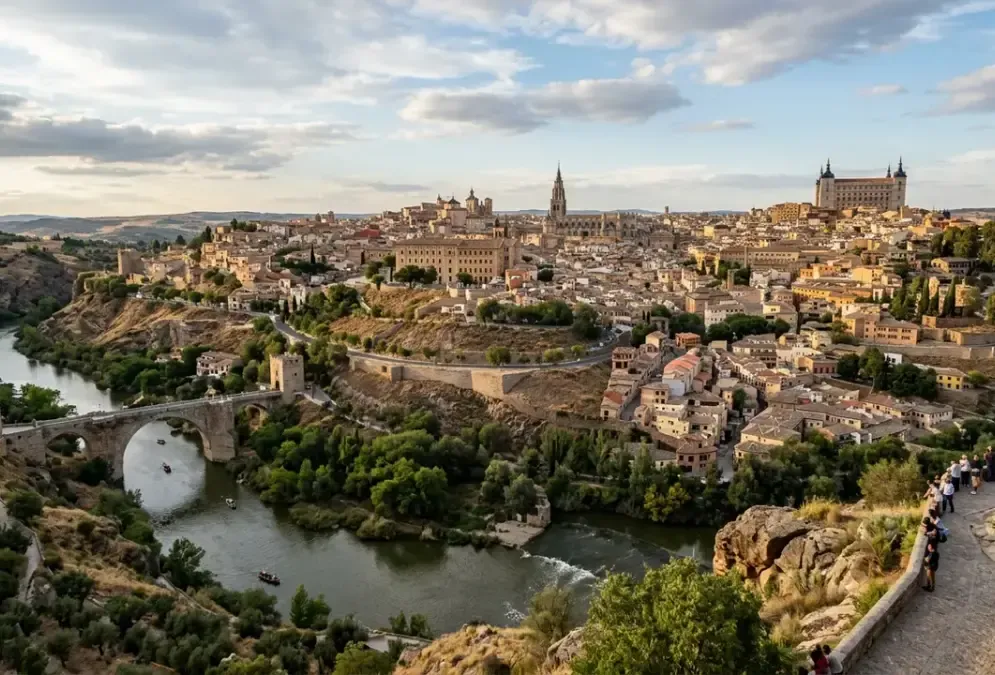
Toledo sits on a granite hill above a tight bend in the Tagus, which gives it a dramatic setting that Córdoba's flat river plain cannot match. The view from the Parador across the valley (cathedral towers, Alcázar battlements, the whole medieval silhouette) is genuinely arresting. Architecturally, the city layers Christian, Muslim, and Jewish monuments in close proximity: hence the "City of Three Cultures" label that appears on every brochure.
El Greco spent most of his working life here from 1577 until his death in 1614, and his paintings are scattered throughout the city's churches and museums. The dedicated Museo del Greco near the old Jewish quarter is the most concentrated collection, but The Burial of the Count of Orgaz in the Church of Santo Tomé is the one painting worth a specific detour.
The city's main problem is its own popularity. Toledo is exactly 34 minutes from Madrid Atocha, cheap enough for a spontaneous morning trip, and heavily promoted as a day-trip destination. By 10am on a Saturday, the narrow streets around the cathedral are genuinely difficult to navigate. If you're going, either arrive before 9am or go on a weekday.
Must-sees
- • Toledo Cathedral: Gothic, 13th century, El Greco paintings inside (€12)
- • Alcázar de Toledo: fortress-museum above the city (€5)
- • Sinagoga del Tránsito: 14th-century synagogue, now a Sephardic museum (€3)
- • San Juan de los Reyes: Gothic monastery, Franciscan, 15th century (€3)
- • Church of Santo Tomé: El Greco's Burial of the Count of Orgaz (€3)
Best for
Art history lovers, El Greco fans, quick day trips from Madrid, those wanting medieval drama and hilltop views.
Toledo's strengths
- + Closest major heritage city to Madrid (34 min)
- + Budget-friendly (€7 train tickets, €65/day budget)
- + Dramatic hilltop setting above the Tagus
- + El Greco concentration unmatched anywhere
- + Compact old city; one full day covers it well
Watch out for
- - Saturdays and public holidays: severely overcrowded
- - Tourist-heavy restaurants near the monuments
- - Limited to one day; less to explore beyond the old town
Monuments head to head
Mezquita-Cathedral vs Toledo Cathedral
The Mezquita was begun by Abd al-Rahman I in 785 on the site of a Visigothic church. Subsequent caliphs expanded it until it covered nearly 24,000 square metres. The effect inside (rows of columns extending in every direction, red-and-white voussoirs drawing the eye upward, the gold mosaic of the mihrab at the far end) is unlike any other building in Europe. The Gothic cathedral built inside it in the 16th century is itself large and handsome, but it's a monument inside a monument.
Toledo Cathedral is magnificent on its own terms: started in 1226, completed over three centuries, Gothic in structure, with a treasury containing works by El Greco, Goya, and Velázquez. It costs €12 versus the Mezquita's €15. Both justify their entrance fee. The Mezquita offers the more architecturally singular experience.
What Toledo has that Córdoba doesn't
The El Greco connection is genuine and deep. The painter arrived in Toledo in 1577 and never left: 37 years of work produced in the city's churches and private homes. The Sinagoga del Tránsito, a 14th-century synagogue with extraordinarily detailed Hebrew stucco work, deserves an hour of your time. And the setting itself (that Tagus bend, the cliff walls, the full silhouette of the city from across the valley) delivers a drama that Córdoba's flat river plain simply cannot match.
What Córdoba has that Toledo doesn't
Medina Azahara, a complete caliphal city built from scratch in 936 AD by Abd al-Rahman III and partially excavated, has no equivalent anywhere else in Spain. The Alcázar gardens in spring are among the finest in Andalusia. And the Judería's courtyard houses (particularly during Patios Festival in May) offer something Toledo's more heavily touristed lanes do not: the feeling that you've actually arrived somewhere.
Where you'll eat better
Andalusian cuisine and Castilian cuisine are different traditions, and for most visitors, Andalusian comes out ahead. In Córdoba, the salmorejo (a thick cold tomato soup finished with olive oil and topped with cured ham and hard egg) is made from local tomatoes; the dense texture comes from good bread, not a blender shortcut. Rabo de toro (braised oxtail) has been on Córdoban menus since the city's bullring opened in 1765. Córdoban gastronomy runs deep.
Toledo's food traditions are Castilian: hearty game dishes like perdiz estofada (stewed partridge) and carcamusas (a Toledo-specific stew of pork, vegetables, and white wine), plus the ubiquitous mazapán. Toledo marzipan is genuinely good and worth buying. Each one has deep local roots.
The problem is that Toledo's restaurant scene near the monuments tilts heavily tourist. The city processes hundreds of thousands of day-trippers and the menus reflect it: set lunch deals that get the job done without any particular ambition. You can eat well in Toledo if you research ahead; in Córdoba, even the places on the tourist strip are operating within a stronger culinary tradition. See our Córdoba restaurant recommendations and local dishes guide for specifics.
Getting there from Madrid
| Route | Travel time | Price | Train | Departs from |
|---|---|---|---|---|
| Madrid → Córdoba | 1h45 | €25–75 | AVE | Puerta de Atocha |
| Madrid → Toledo | 34 min | €7–20 | AVE | Puerta de Atocha |
For Córdoba: Book via Renfe at least a few days ahead; the cheapest seats (€25 Promo fares) sell out. The AVE stops at Córdoba Central station, 20 minutes' walk from the Mezquita or a short taxi ride. First trains depart Madrid around 6:30am; last return trains leave Córdoba around 9pm. Full transport logistics at /plan/getting-to-cordoba and our Madrid to Córdoba by train guide.
For Toledo: Trains run roughly every hour from Atocha. Tickets are cheap enough to buy day-of, though weekends sell out by late morning. Toledo's train station is outside the old city; take the bus or taxi up the hill to the historic centre (15 min, €1.50 by bus). Last trains back to Madrid run past 10pm.
Pick your city
Choose Toledo if...
- • You have only half a day or a very tight schedule in Madrid
- • You are specifically interested in El Greco's work
- • You want dramatic scenery: the Tagus gorge and hilltop setting
- • Budget is the primary constraint (€7 train vs €25+)
- • You've already been to Córdoba
Choose Córdoba if...
- • You want the single most impressive monument in Moorish Spain
- • Crowds matter to you: Córdoba is measurably quieter
- • Food is important: Andalusian cuisine outclasses Castilian for most visitors
- • You have two or more days: Medina Azahara alone justifies the extra time
- • This is your only trip to the region
Have two days? Visit both
Toledo in the morning (first AVE at 6:30am, arrive 7:04am), cathedral and main monuments by noon, back to Madrid by 2pm. Take the 3pm AVE to Córdoba, check in, walk the Judería at dusk. Full Mezquita visit next morning before the tour groups arrive. Two cities, two nights, one trip. The Córdoba one-day itinerary shows exactly how to structure the Córdoba leg. For the full case for staying overnight, see our day trip vs overnight guide. Check our Córdoba vs Granada or Córdoba vs Cádiz if you're also considering other Andalusian cities.
Decided on Córdoba?
Plan your visit with our detailed itineraries: from a single packed day to a three-day deep dive into caliphal history and Andalusian food.
Common questions about Córdoba vs Toledo
Should I visit Córdoba or Toledo from Madrid?
Toledo is quicker (just 34 minutes by AVE) but it gets crushed by Madrid day-trippers, especially on weekends. Córdoba requires 1h45 but rewards with fewer crowds, deeper Islamic heritage, and significantly better food. If you have one day and want ease: Toledo. If you want quality: Córdoba. If you have two days, do both; Córdoba first.
Is Córdoba worth the extra travel time from Madrid?
Yes. The 65 extra minutes buy you the Mezquita (856 double arches, the most architecturally extraordinary monument in Spain), authentic Andalusian cuisine like salmorejo and rabo de toro, moderate crowds versus Toledo's day-tripper crush, and a genuinely different atmosphere. Travelers who visit both frequently rank Córdoba as the more rewarding stop.
Can you do Córdoba as a day trip from Madrid?
Yes, though it's tight. The first AVE departs around 7am, arriving by 8:45am. The last return is around 9pm, giving you roughly 10 hours. That's enough for the Mezquita, the Judería, lunch, and one more site like the Alcázar gardens. An overnight stay lets you see Medina Azahara and explore the city after the tour groups leave; worth it if your schedule allows. See our Madrid to Córdoba by train guide for schedules and booking tips.
How does the Mezquita compare to Toledo Cathedral?
The Mezquita is a former mosque with 856 alternating red-and-white double arches, with a Gothic cathedral built inside it in the 16th century: an architectural situation that exists nowhere else in the world. Toledo Cathedral is a magnificent 13th-century Gothic building housing several El Greco paintings. Both cost around €12–13. The Mezquita is the more unusual experience; Toledo Cathedral is the more conventional great church.
Further reading
Official sources
- Turismo de Córdoba (opens in a new tab)
Official information on Córdoba's monuments, events and visitor services
- Toledo Tourism (opens in a new tab)
Official tourism website for the city of Toledo
- Renfe (opens in a new tab)
Timetables and fares for AVE high-speed trains between Madrid, Córdoba and Toledo