Al-Andalus
Qurtuba, jewel of the Caliphate
In the 10th century, Córdoba was the largest city in Western Europe, ahead of Constantinople and Baghdad. At its peak, it had 500,000 inhabitants, 3,000 mosques, and a library of 400,000 volumes. Most European cities then counted only a few thousand souls.

Written by
María Fernanda González Ten years covering Córdoba's UNESCO heritage sites, sourcing from Junta de Andalucía documentation.
Published
Updated
In 711, Arab-Berber troops led by Tariq ibn Ziyad crossed the Strait of Gibraltar and swept through the Iberian Peninsula with startling speed. Córdoba (Qurtuba in Arabic) fell within months and within decades had become the capital of Al-Andalus, the Muslim-ruled territory that would cover most of what is now Spain and Portugal. Abd al-Rahman I, the last survivor of the Umayyad dynasty that had ruled from Damascus, made Córdoba his seat in 756, declaring an independent emirate and beginning the transformation of a Roman provincial city into one of the great metropolises of the medieval world.
The golden age arrived in 929, when Abd al-Rahman III proclaimed himself Caliph (Commander of the Faithful), establishing the Caliphate of Córdoba and asserting Córdoba's equal standing with Baghdad and Constantinople. The city grew to half a million inhabitants, the largest in Western Europe, sustained by sophisticated irrigation systems, a thriving silk and leather trade, and 300 public baths. Scholars from across the Islamic world and beyond converged on its libraries. Averroes wrote his commentaries on Aristotle here; Al-Zahrawi pioneered surgical techniques that European physicians would use for five centuries; and the convivencia, the layered coexistence of Muslim, Jewish and Christian communities, produced a culture of translation and exchange that would eventually seed the European Renaissance.
The caliphate collapsed in 1031 after decades of civil war, and Córdoba was reconquered by Ferdinand III of Castile in 1236. But five centuries of Moorish rule could not be erased. The Mezquita still stands: an architectural argument in stone and marble that no later structure has answered. Medina Azahara still waits under the Sierra Morena foothills, only 10% excavated. The streets of the Judería still follow their medieval plan. The pages below explore each thread of this heritage in depth: the monuments, the history, the intellectual legacy, and the living experience of a city that has never quite stopped being Qurtuba.
Moorish Córdoba: at a glance
- Period
- 711–1236 (Moorish rule, 525 years)
- Golden Age
- 10th century (Caliphate of Córdoba)
- Population at peak
- ~500,000 (largest city in Western Europe)
- UNESCO
- Mezquita-Catedral, Medina Azahara (World Heritage)
- Must-see
- Mezquita-Catedral, Medina Azahara, Hammam Al Ándalus
- Legacy
- 1,000+ Arabic loanwords in Spanish
In this guide
Explore Moorish Córdoba
Mezquita-Cathedral Guide
The mosque-cathedral that defines Córdoba: its history, architecture and how to visit
UNESCO Heritage
Córdoba's three UNESCO World Heritage Sites: the Mezquita, historic centre and Medina Azahara
Jewish Heritage
The Judería, the medieval synagogue, and the story of Córdoba's Sephardic community
Roman Córdoba
The Roman layers beneath Al-Andalus: temple, bridge and the city that came before
500,000
inhabitants in the 10th century
3,000
mosques in the city
400,000
volumes in the library
300
public baths
UNESCO Heritage
The Great Mosque of Córdoba
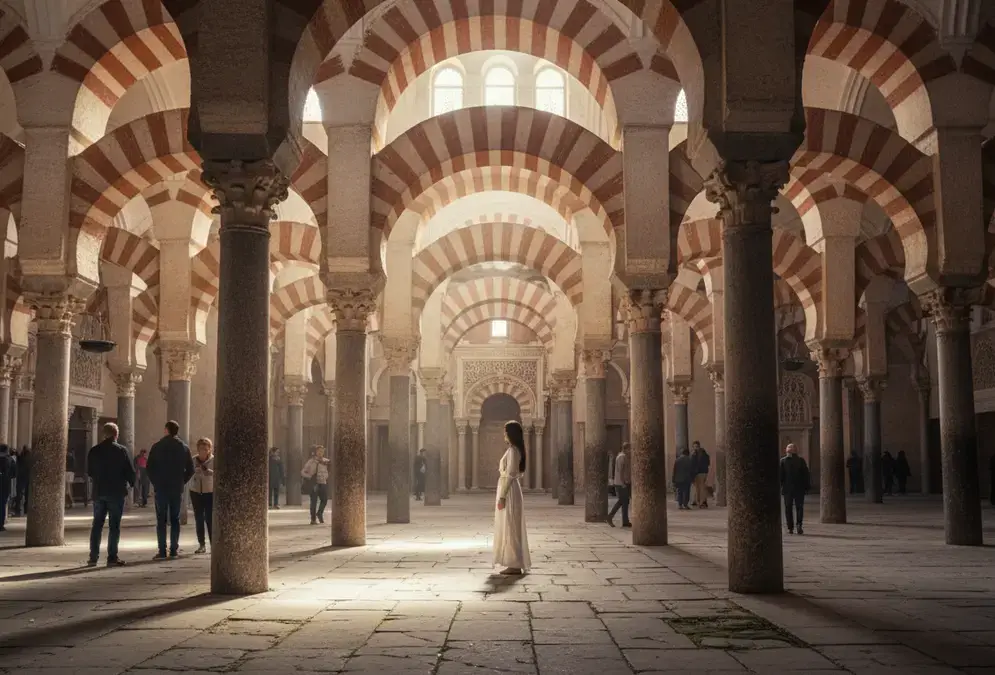
Begun in 786 by Abd al-Rahman I on the site of a Visigothic church, the Mezquita was enlarged four times. With 23,000 m² and 850 columns, it was the largest mosque in the world after Mecca.
- 856 columns of jasper, marble and granite
- Mihrab decorated with Byzantine mosaics gifted by the Emperor of Constantinople
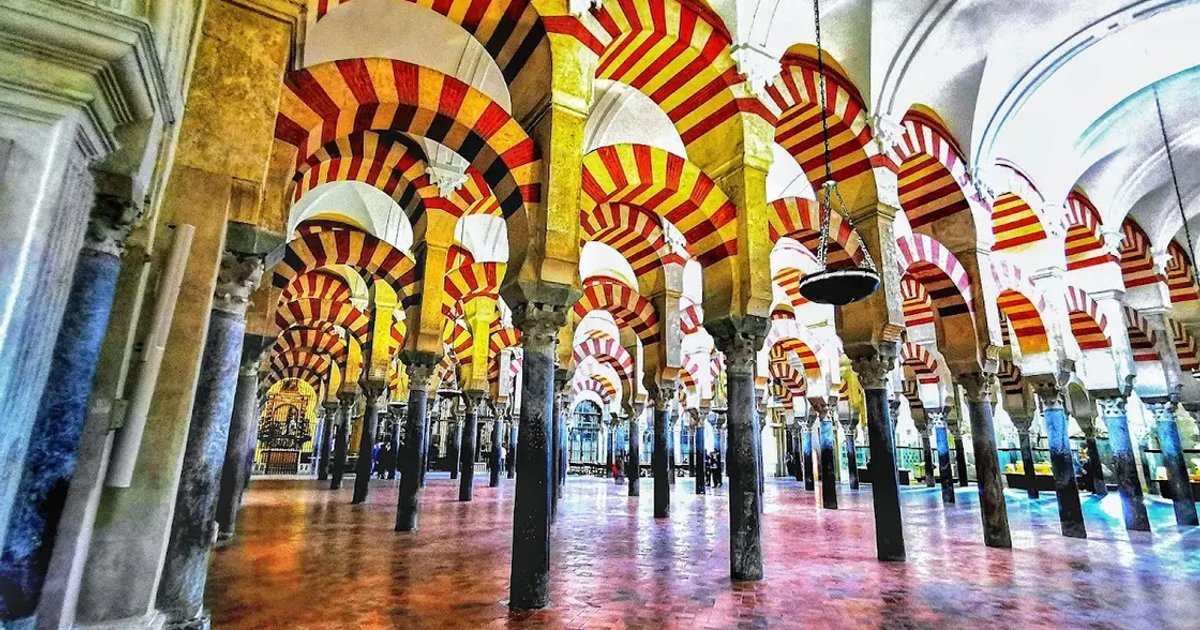
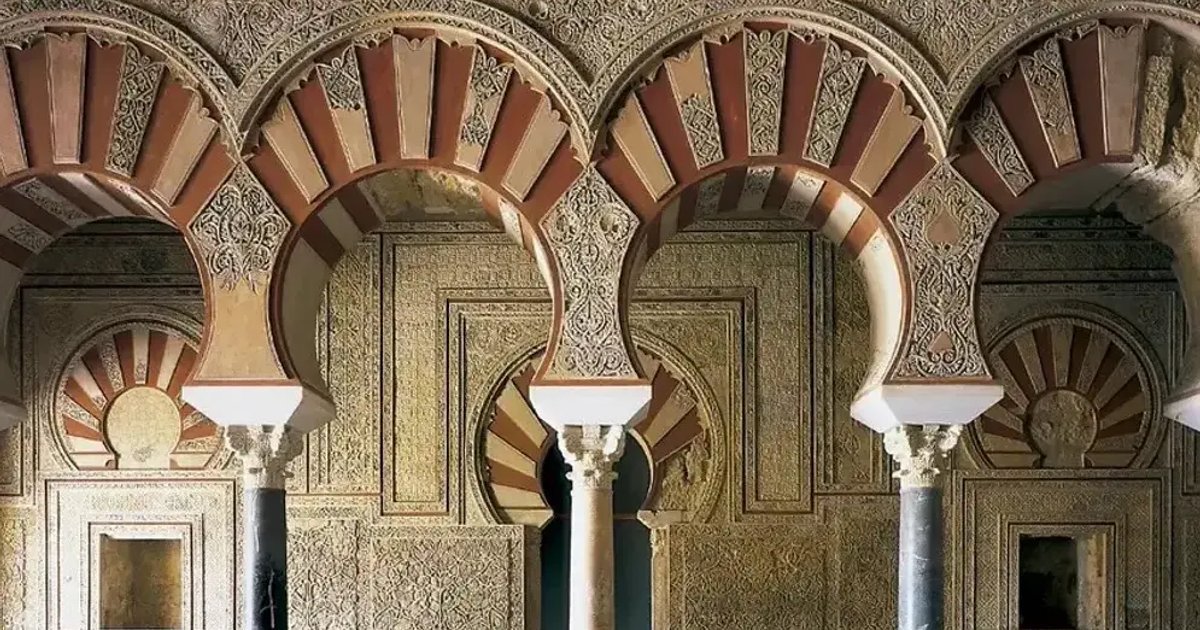
- Red and white horseshoe arches, a unique architectural innovation
The expansions
- 786 Initial construction by Abd al-Rahman I
- 833 First expansion by Abd al-Rahman II
- 961 Al-Hakam II creates the current mihrab
- 987 Al-Mansur doubles the floor area
UNESCO 2018
Medina Azahara, the palace city
Built from 936 by Abd al-Rahman III, Madinat al-Zahra (the "brilliant city") served as the administrative seat of the Caliphate for 75 years. The complex covered 112 hectares: three concentric terraces cut into the Sierra Morena foothills, housing 10,000 people at its height.
During the civil war of 1009–1010, the fitna, the palace was stripped and burned. It remained buried for centuries before excavation began in the 1910s. Only 10% of the site has been uncovered.
Visit Medina Azahara →Practical info
- Distance: 8 km from Córdoba
- Access: Shuttle bus from the centre
- Duration: Allow 3 hours
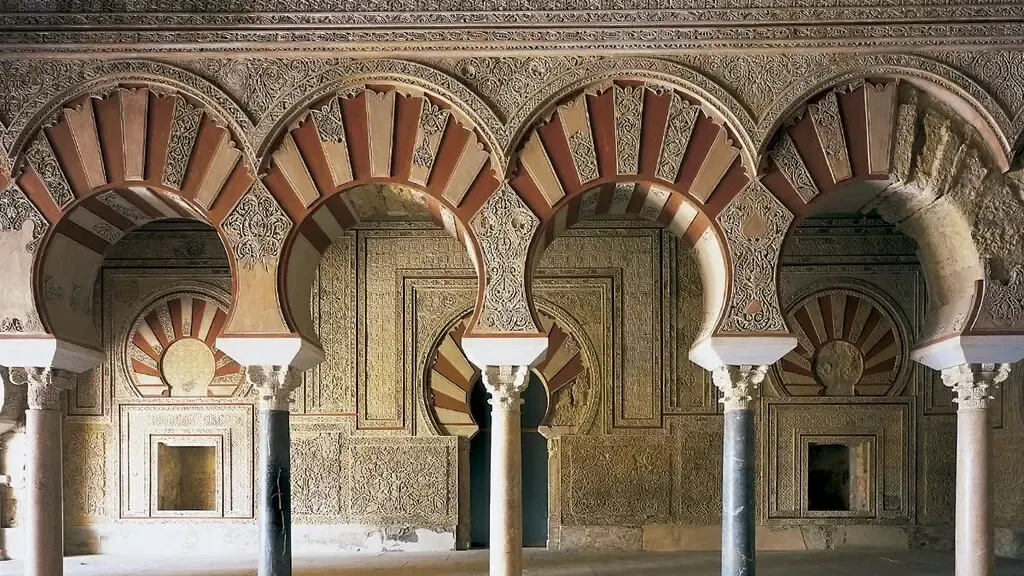
Medina Azahara, the palace city built by Abd al-Rahman III from 936
The great thinkers of Córdoba
Córdoba was a city where Muslim, Jewish and Christian scholars worked in the same milieu. The Arabic term for this coexistence, convivencia, produced thinkers whose influence on European philosophy and medicine lasted centuries.
Averroes (1126–1198)
Philosopher, physician and jurist, known as "The Commentator" for his work on Aristotle. His commentaries were read in European universities for three centuries.
Philosophy, medicineMaimonides (1135–1204)
Rabbi, philosopher and physician, author of The Guide for the Perplexed. Born in Córdoba, he left with his family when the Almohads arrived and banned the practice of Judaism.
Philosophy, theologyAl-Zahrawi (936–1013)
Considered the father of modern surgery. His illustrated medical treatise was used in European medical schools for five centuries.
Medicine, surgeryKey dates of Al-Andalus
711
Conquest of the Iberian Peninsula by Tariq ibn Ziyad
756
Abd al-Rahman I founds the independent Emirate of Córdoba
786
Construction begins on the Great Mosque
929
Abd al-Rahman III proclaims the Caliphate of Córdoba
936
Foundation of Medina Azahara
1009–1010
Civil war (fitna), destruction of Medina Azahara
1031
Fall of the Caliphate, fragmentation into taifa kingdoms
1236
Ferdinand III of Castile reconquers Córdoba
Experience Al-Andalus
La Judería
The old Jewish quarter is where the convivencia (Muslim, Jewish and Christian communities living side by side) is most legible in the city's streets.
The Synagogue
One of three medieval synagogues preserved in Spain, featuring Mudéjar stuccowork with Islamic geometric influence.
Capilla de San Bartolomé
A late 14th-century Gothic-Mudéjar chapel on Calle Averroes with exceptional yesería plasterwork that fuses Christian vaulting with Islamic geometric decoration.
Hammam Al Andalus
Arab baths in a 9th-century building near the Mezquita. Thermal circuit, essential oil massages and original Moorish vaulting.
Preserved Al-Andalus Heritage
The caliphal period left its mark not just on monuments but on the city's built fabric. Two historic palaces now operating as hotels give visitors direct access to that layering.
Hospes Palacio del Bailio
This 16th-century palace blends late Gothic, Plateresque Renaissance and Moorish influences from the Islamic medieval era. Built over the remains of a 1st-century Roman villa, it shows how Córdoba has been rebuilt on top of itself, layer by layer, for 2,000 years.
The inner courtyards with fountains and azulejos, along with brick vaulting, echo the domestic architecture of Al-Andalus adapted into a Renaissance nobleman's palace.
La Ermita Suites
Andalusia's only official Monument Hotel, this 1412 building has passed through seven centuries and three cultures: an Islamic school, then a Jewish residence, then a Christian hermitage chapel. Its original caliphal arch is one of the few surviving examples of Al-Andalus residential architecture.
Restoration was overseen by Prado Museum conservators, preserving original medieval vaulting and period azulejos. Six suites with views of the Mezquita.
Explore the Al-Andalus Legacy
The caliphal monuments are the obvious starting point, but the Al-Andalus story runs deeper than the Mezquita alone. A day trip to Granada adds the Alhambra, the last great monument of Nasrid Al-Andalus, built after Córdoba's caliphate had already collapsed. For a curated list of architecture-focused monuments, museums, and walking tours, see Córdoba for architecture lovers.
Moorish Architecture Tour
Walk a self-guided route linking the Mezquita, Alcazar, and the best surviving examples of Umayyad and Mudejar architecture in the historic centre.
View the routeFrequently Asked Questions
What is the best way to experience Moorish Córdoba?
Start at the Mezquita-Cathedral, the crowning achievement of Umayyad architecture, then walk south to the Alcázar de los Reyes Cristianos and its Moorish gardens. Spend the afternoon exploring the narrow lanes of the Judería, where the layers of Islamic, Jewish and Christian Córdoba are most legible. A full day gives you time to appreciate the detail. Arrive at the Mezquita when it opens to beat the crowds.
What is Medina Azahara and can I visit?
Medina Azahara (Madinat al-Zahra, "the brilliant city") was a palatial city built from 936 by Caliph Abd al-Rahman III as the new seat of his caliphate. It covered 112 hectares on three terraces cut into the Sierra Morena foothills, 8 km west of Córdoba. Destroyed in the civil war of 1009–1010, it lay buried for centuries until excavations began in the 1910s. Today it is a UNESCO World Heritage Site; you can visit the partially excavated ruins daily. Guided tours are available, or take the public shuttle bus from Córdoba city centre. Allow at least 3 hours.
Who were the great thinkers of Islamic Córdoba?
Three figures stand above the rest. Averroes (Ibn Rushd, 1126–1198) was philosopher and physician, whose commentaries on Aristotle were read in European universities for three centuries. Ibn Hazm (994–1064) was a polymath poet, theologian and jurist, author of The Ring of the Dove. Al-Zahrawi (Abulcasis, 936–1013), court physician to the caliph, wrote a 30-volume illustrated surgical encyclopaedia that remained the standard European medical reference for 500 years. These scholars worked in a city where Arabic, Latin, Hebrew and Greek manuscripts circulated freely.
How long did Moorish rule last in Córdoba?
Arab-Berber forces under Tariq ibn Ziyad crossed into the Iberian Peninsula in 711 and rapidly took Córdoba. The city remained under Muslim rule for over 525 years: first as capital of the Umayyad Emirate (756–929), then as capital of the Caliphate of Córdoba (929–1031), and later under successive taifa kingdoms and the Almohad dynasty. Ferdinand III of Castile reconquered the city on 29 June 1236. Five centuries of Moorish rule left an indelible mark on the city's architecture, urban fabric and cultural memory.
Are there any traditional hammams (baths) in Córdoba today?
Hammam Al Andalus, located a short walk from the Mezquita, operates in a building with original 9th-century Moorish vaulting. It offers a traditional thermal circuit (cold, warm and hot pools), essential oil massages, and the full architecture of an Arab bath house. Booking in advance is strongly recommended. The experience is one of the most direct ways to connect with everyday life in caliphal Córdoba, when the city had over 300 public baths.
What was Córdoba's population at its peak?
At its 10th-century peak under the Caliphate, Córdoba had an estimated population of around 500,000, making it the largest city in Western Europe, significantly larger than Constantinople (roughly 400,000 at the time) and far ahead of Paris or London, which each counted only a few thousand souls. The city had 3,000 mosques, 300 public baths, 50 hospitals, and a royal library of 400,000 volumes at a time when many European monasteries held only a few dozen manuscripts. By any measure, it was the intellectual capital of the medieval world.
Further reading
Official sources
- UNESCO Historic Centre of Córdoba (opens in a new tab)
World Heritage inscription for the Mezquita and historic centre
- Mezquita-Catedral de Córdoba (official site) (opens in a new tab)
Official website of the Mosque-Cathedral of Córdoba
- Medina Azahara (official site) (opens in a new tab)
Official archaeological site of the caliphal palace city
- Córdoba Tourism Office (opens in a new tab)
Official information on Córdoba's Arab heritage
Explore Moorish Córdoba
Tours are selected for quality, not commission. We earn a small fee if you book — at no extra cost to you.
Best Seller
 Best Seller
Mosque-Cathedral Skip-the-Line Guided Tour
Skip the queue and explore the Mezquita-Cathedral with a knowledgeable local guide. Discover 13 centuries of layered history in one of Spain's most iconic monuments.
1.5 hours
From €29
Skip queues up to 45 min
4.7 (6,882)
Reserve Your Spot
✓ Verified reviews · 6,882 travelers
Popular — books up weeks ahead in peak season
Mosque-Cathedral Skip-the-Line Guided Tour
Beat the crowds with skip-the-line access and enjoy an expert-led tour through the breathtaking arches, mihrab, and cathedral choir of Córdoba's most visited monument.
1.5 hours
From €28
Skip queues up to 45 min
4.6 (5,182)
Reserve Your Spot
✓ Verified reviews · 5,182 travelers
Popular — books up weeks ahead in peak season
Medina Azahara 3-Hour Guided Tour
Step back to the 10th century at the ruins of the once-magnificent palace city of Medina Azahara. Includes transport and an expert guide who brings this UNESCO site to life.
3 hours
From €18
Less than a restaurant lunch
4.7 (484)
Reserve Your Spot
✓ Verified reviews · 484 travelers