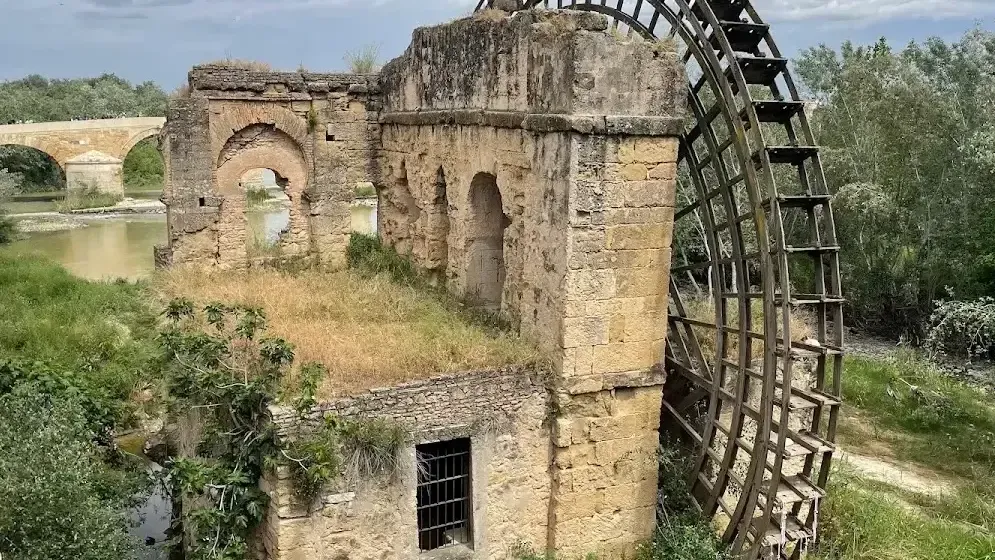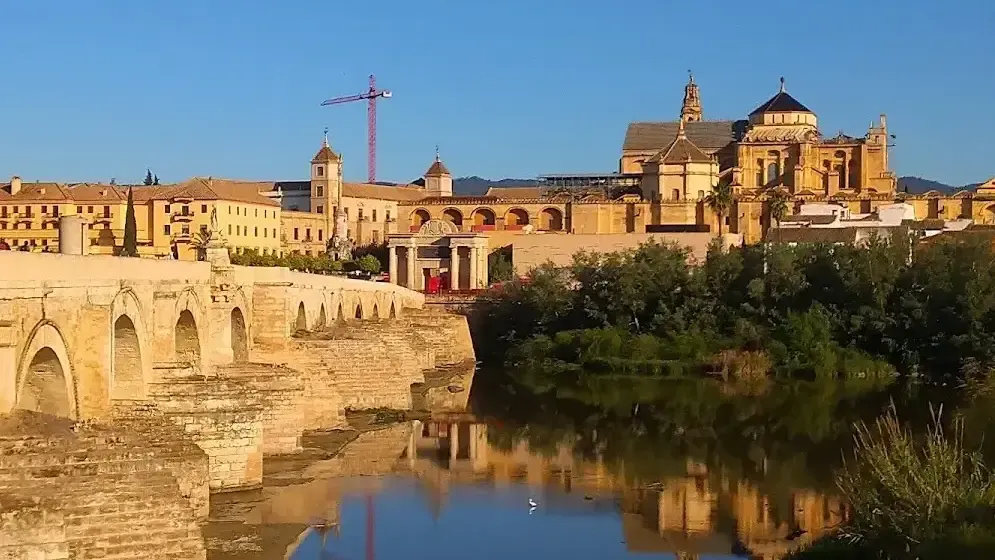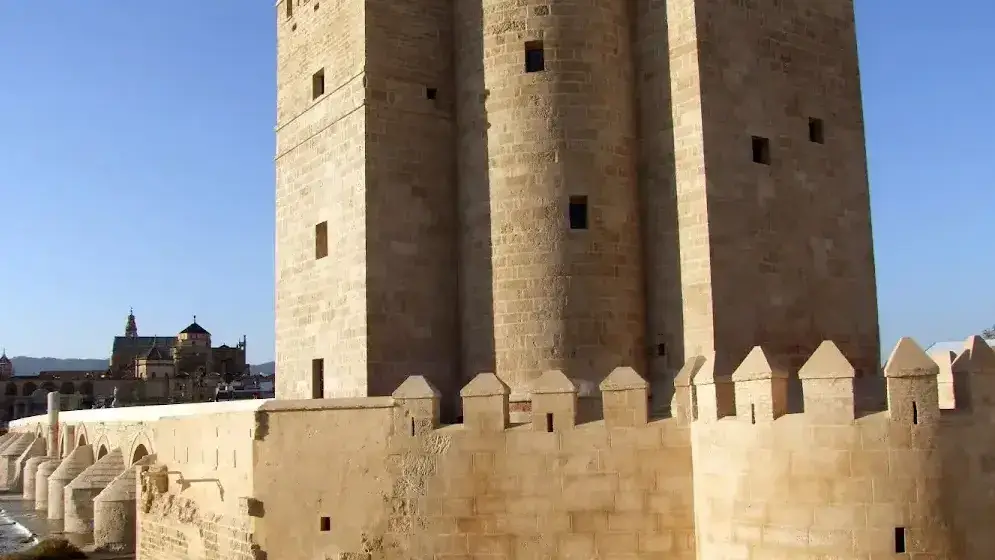

The Torre de la Calahorra has stood at the southern entrance to the Puente Romano for more than eight centuries. The tower now houses the Living Museum of Al-Andalus and a rooftop terrace with one of the clearest views in Córdoba: the Roman bridge below, the Arab mills on the river, and the monumental mass of the Mezquita across the water.
A Strategic Medieval Fortress
Built during the Islamic period in the 12th century and reinforced in the 14th century after the Christian Reconquista, the tower controlled the southern access to the city via the bridge. Any army crossing the Guadalquivir had to pass beneath it. The thick walls and arrow slits remain from the original defensive structure, while Gothic additions from the 14th century altered its upper sections.
The tower is part of a broader defensive system that also included the Roman Bridge itself — the bridge's southern arch incorporates a fortified gate. The Calahorra was the final point of control. Medieval chroniclers recorded that it could be held by a small garrison against a much larger force, simply by controlling the single access point through the gate passage.
The Living Museum of Al-Andalus
The Museum of Al-Andalus uses scale models, audiovisual displays, and reproductions of scientific instruments to cover the period when Córdoba was the intellectual capital of medieval Europe. The thematic rooms address the philosophy of Averroes and Maimonides, the astronomy of Al-Andalus (astrolabes, sundials, celestial spheres), and the medicine of the golden age.
This is the most accessible treatment in Córdoba of how Muslim, Jewish, and Christian scholars worked in the same city. The scale models of 10th-century Córdoba — showing the extent of the Medina, the palace complex, and the milling system on the river — give you a useful spatial sense of the city before visiting the Mosque-Cathedral and the Medina Azahara.
Visiting Tips
Allow 45 minutes to 1 hour for the museum and the view from the panoramic terrace. Best results for photography: late afternoon, when the setting sun hits the Mezquita facade — roughly between 6pm and 8pm depending on the season. Audioguides in multiple languages are included. Reduced rate for students and seniors (€3).
Combining with the Ribera Route
Combine with a walk across the Puente Romano for a complete tour of the Ribera waterfront. The tower is a stop on the Moorish Architecture Tour, the Riverside Walk, and the Roman Córdoba Walk — all three follow the river and use the Calahorra as a natural endpoint. From the tower, the Judería is a 10-minute walk. All free walking tours of Córdoba pass the tower with commentary on its role in the city's defences.