
What happened in 1951: the accidental dig
Córdoba's city authorities in 1951 had a practical problem: the Ayuntamiento needed more space. An expansion of the City Hall building on Calle Capitulares was approved, which meant digging into the foundations on a block of the old town that had been continuously built over since Roman times[1].
Construction workers broke through the ground and found something they were not equipped to interpret: massive marble column drums, fragments of Corinthian capitals, and sections of a stepped stone podium. The dimensions of what emerged were not the dimensions of a wall or a floor. They were the dimensions of a public building.
The dig stopped. No archaeologist was called immediately. The workers and municipal engineers documented what they could see, but the site sat in a partially excavated state for several years while the question of what to do with it was worked through the relevant institutional channels. Córdoba in the mid-1950s was not a city with a rapid archaeological response infrastructure. The Roman temple that is now one of the city's most-visited sites spent its first years after discovery as an administrative problem rather than an archaeological project.
Explore nearby · Monument
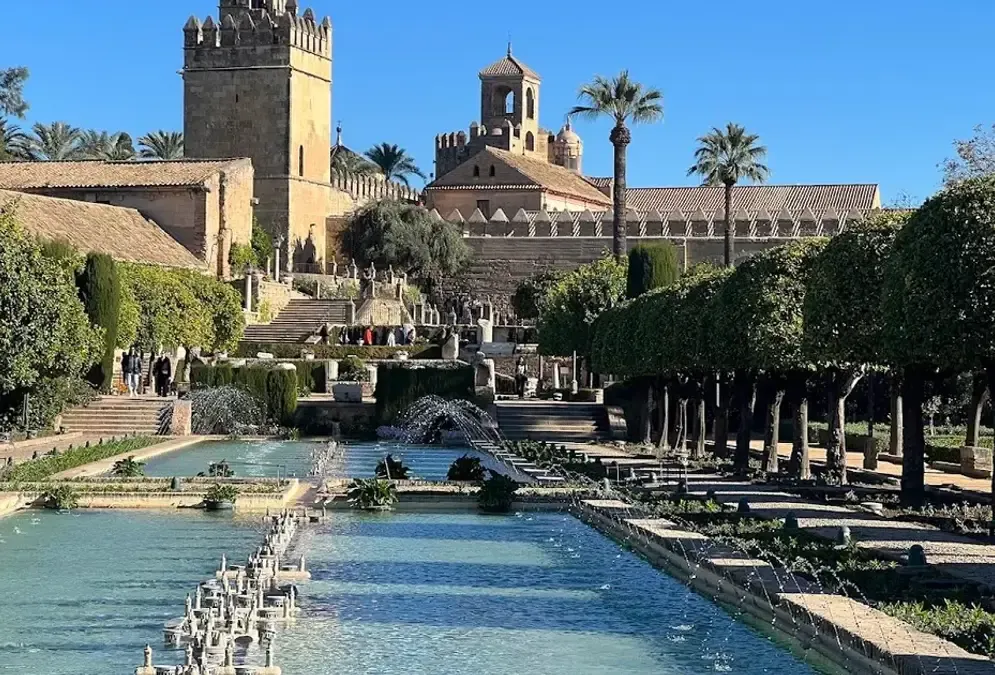
Alcázar de los Reyes Cristianos
14th-century fortress where Columbus met the Catholic Monarchs. Roman mosaics, four climbable towers and stunning gardens. Free entry on Tuesdays. UNESCO site.
This delay was not unusual for the period or the country. Spain in the 1950s had limited conservation budgets and a national heritage apparatus that moved slowly. The more interesting question is what the discovery implied: that the centre of Roman Colonia Patricia, the administrative capital of Hispania Baetica, had been sitting under the modern city's civic heart all along, waiting for a building permit.
Antonio García y Bellido and the detective work of identification
The person who made sense of the Calle Capitulares find was Antonio García y Bellido, the most prominent Roman archaeologist working in Spain at the time. He began examining the site from 1958 onwards and published his identification and dating of the temple over the following years[2].
García y Bellido's conclusion: the structure was a Corinthian hexastyle temple built as part of the Provincial Forum of Colonia Patricia, the administrative complex through which Rome governed Hispania Baetica. Colonia Patricia was not a minor settlement. It was the capital of the most developed and Romanised province in the western empire, the city that produced the emperors Trajan and Hadrian and the philosophers Lucan and Seneca.
The temple's function, García y Bellido argued, was imperial cult worship: the official state religion of the Roman world, which venerated deceased emperors who had been formally deified by the Senate[2]. This was not a temple to Jupiter or Mars. It was a temple where the provincial administrators of Baetica performed the rituals that bound the province to Rome's political theology: sacrifices, ceremonies, and the formal recognition of imperial divinity.
Dating the construction required reading the architectural details against the epigraphic and historical record. The construction sequence García y Bellido identified ran from the reign of Claudius (41–54 AD) through to Domitian (81–96 CE)[2]. That is roughly half a century of building work, which tells you something about the scale of the undertaking. The podium alone stands 3.5 metres high[3]. Getting marble columns 9 metres tall into position on top of it, in a provincial capital 900 kilometres from Rome, was not a fast project.
3.5 metres
What García y Bellido did not have was the full physical picture. Much of the temple remained below and around the existing City Hall structure. The exposed fragments were enough to establish what the building was, but the reconstruction he envisioned would take another decade and require a different kind of specialist.
Félix Hernández and the anastylosis controversy
By the 1960s, the site had been assigned to Félix Hernández Giménez, the architect who had already spent decades restoring the Mezquita-Catedral. Hernández's method for the Roman temple was anastylosis: reassembling surviving original fragments in their presumed original positions, rather than filling gaps with new material or leaving the structure in a permanently ruined state[1].
Anastylosis is the standard international approach for this kind of work, endorsed by the 1964 Venice Charter on conservation. In principle, it is conservative: you put back what was there, document what is restored versus original, and do not invent what you cannot verify. In practice, every anastylosis project requires decisions that archaeologists will argue about for decades afterwards.
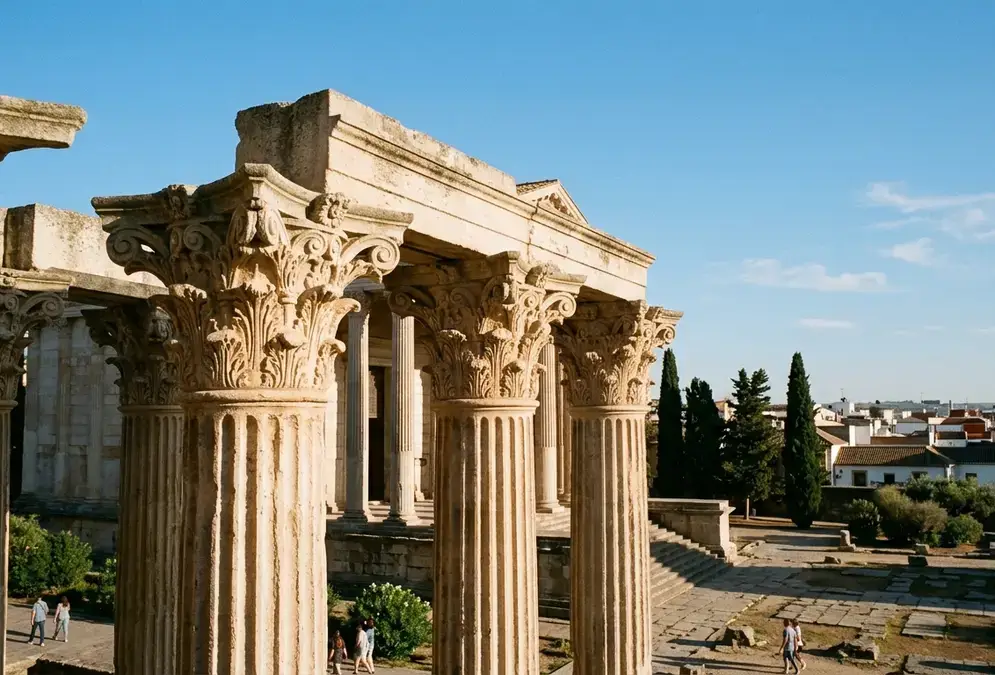
Hernández's decisions at Córdoba have been disputed on one specific point: the column placement. The temple is hexastyle, meaning six columns across the front. Hernández reconstructed a visible facade of six Corinthian columns on their original pedestals, which is what visitors see today from Calle Capitulares[1]. The dispute among later researchers concerns whether the column spacing and the precise positioning of individual capitals and drums correctly reflects the original arrangement, or whether the anastylosis introduced small errors that compound across the reconstruction.
The deeper problem is that not all of the original material survived. Some column fragments ended up in the Archaeological Museum, where they remain on display today[4]. Others are preserved in Plaza de las Doblas, a short walk from the temple site. When Hernández assembled the visible facade, he was working with an incomplete set of pieces and making professional judgements about which fragment went where.
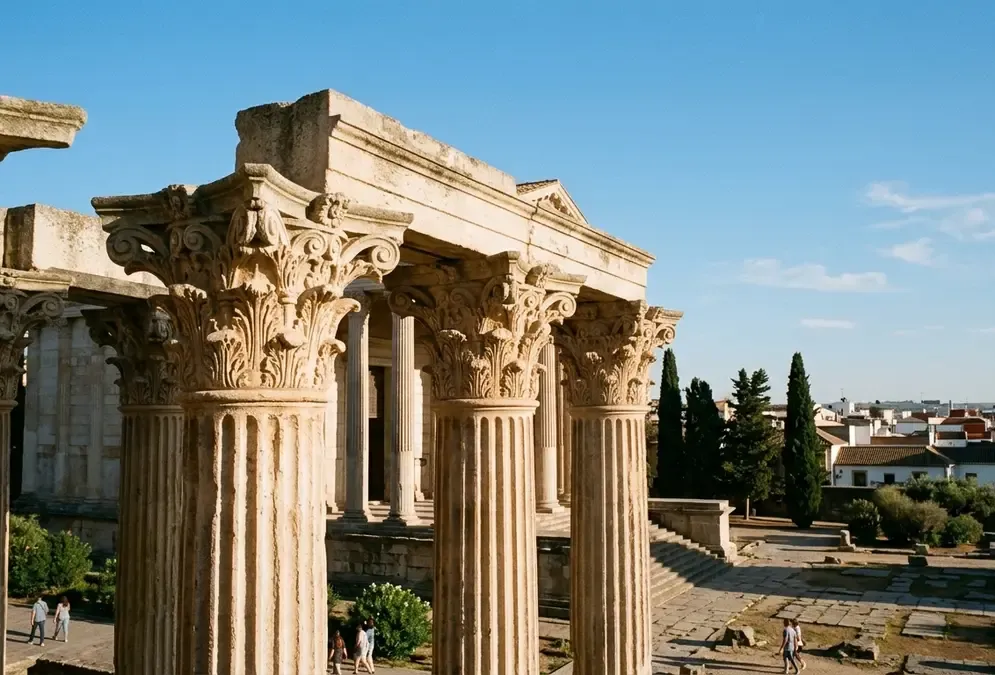
Six Corinthian columns reassembled by Félix Hernández in the 1960s using the anastylosis method. The capitals and column drums are largely original marble; the positioning has been debated by archaeologists since the reconstruction was completed. The full temple footprint — 32 metres long — extends under the adjacent City Hall.
The result is a reconstruction that looks authoritative (six full columns with their capitals, a stepped podium you can climb, an altar base at the top) and is substantially correct in its overall form, while remaining open to the possibility that specific details are off by a column diameter here or a capital rotation there. For most visitors, this is an academic distinction. For archaeologists studying Roman construction practice in Baetica, it is not.
The partial nature of the physical evidence also explains why the temple looks the way it does: a single complete facade with open ground behind and to the sides. The full 32-metre length of the structure is mostly below and around the existing City Hall[3]. What you see is the front of something much larger whose full extent remains unexcavated.
Colonia Patricia and the Provincial Forum
To understand why a temple of this scale was built here, you need the geography of Roman Córdoba. Colonia Patricia occupied the north bank of the Guadalquivir on a low hill, with the river providing both water and a trade route to the Atlantic. The Romans founded the city around 169 BC as a base for the pacification of southern Iberia, and it grew through the Republican and Imperial periods into the administrative capital of the most profitable province in the western empire[3].
The city's layout followed standard Roman urban planning: a Capitolium (the main temple precinct), a forum for civic and commercial life, a circus for entertainment, and a dense residential quarter. What the 1951 discovery confirmed is that the Provincial Forum — the administrative heart of the governor's apparatus — sat directly under what is now the old-town civic block around the Ayuntamiento.
The temple formed one end of this complex. The Córdoba circus, at over 400 metres long, ran parallel to the forum to the south. The forum itself would have included a basilica for legal proceedings, covered arcades for commerce and politics, and the open central space where the provincial population gathered for official ceremonies. The temple at its head gave the whole ensemble its religious anchor: you came here to conduct business with Rome, and Rome's authority derived from its gods and its deified emperors.
Colonia Patricia was the administrative capital of Hispania Baetica and one of Rome's most important provincial cities in the western empire[3]. The Provincial Forum was built to match that scale. A 32-metre temple on a 3.5-metre podium with 9-metre columns was not overbuilding for a population of that size.
The imperial cult function is the detail that transforms the temple from an interesting archaeological find into something historically charged. The temple was not primarily a place of worship in the private or personal sense. It was a political institution: the ceremonies conducted here were the rituals by which the province affirmed its integration into the Roman imperial system. The provincial governor attended. The local elite attended. Participation was not optional in any meaningful sense. The temple was where loyalty to Rome was performed, publicly and on schedule.
This context is what Roman Córdoba offers that the physical remains alone cannot convey: the temple you see was the ceremonial centre of an administrative system that governed two million people across a territory stretching from the Strait of Gibraltar to the Sierra Morena.
The surviving fragments: temple, museum, plaza
The physical evidence of the temple is distributed across three locations in central Córdoba, which matters practically if you want to see all of it.
The main site on Calle Capitulares is free to visit and open to the outdoor air. Six reconstructed Corinthian columns stand on the original podium, with the altar base at the top of the stairs. The columns you see are largely original marble, reassembled from fragments that were recovered from the site. The podium itself is intact. You can walk up the stairs and stand on the original stone floor of a Roman provincial temple, which is not something most city centres offer. The columns are substantial: the shafts are 60 centimetres in diameter, and the Corinthian capitals, even weathered to a pale grey, retain their acanthus-leaf carving in reasonable condition.
Additional column fragments and architectural elements are displayed at the Archaeological Museum on Plaza Jerónimo Páez[4], a 15-minute walk from the temple. The museum holds pieces that could not be incorporated into the anastylosis reconstruction, as well as mosaics, sculpture, and other material from the Roman and pre-Roman city. The temple section of the museum provides the close-up detail that the outdoor site cannot: you can read the tool marks on the marble, examine the proportions of the capitals, and get a sense of the craftsmanship that went into the original construction.
You can walk up the stairs and stand on the original stone floor of a Roman provincial temple, which is not something most city centres offer.
A third group of architectural elements is displayed in Plaza de las Doblas[1], a small square a few blocks from the temple. These are less formally presented than the museum pieces but worth the detour if the Archaeological Museum is busy or closed.
For the Roman bridge and the southern edge of the Roman city, add another 20 minutes on foot from the temple. The bridge, the forum, and the circus collectively define the spatial logic of Colonia Patricia: a city whose public buildings were arranged along a north-south axis from the river to the forum hill, with the temple at the northern end marking the administrative apex of the whole system.
Practically: the outdoor temple site on Calle Capitulares has no admission fee and no set opening hours. It is accessible as a public outdoor monument. The Archaeological Museum charges standard entry (check current prices at the museum directly; the regional museums system adjusts fees periodically). Both are worth doing on the same half-day. The museum gets busiest mid-morning; arriving at 9:00 when it opens means the Roman section is usually quiet.
Visiting the Roman temple today: logistics
The temple is on Calle Capitulares, at the corner with Calle Claudio Marcelo — the street named after Marcus Claudius Marcellus, the Roman general who founded Córdoba's predecessor settlement in the 2nd century BC[1]. The City Hall building is directly adjacent. On Google Maps it shows up as "Templo Romano de Córdoba".
Access is free. The site is an open outdoor monument on public ground, so there are no tickets, no timed entry slots, and no booking required. This also means no barriers between you and the columns — you can get close, read the marble, and take your time.
Best light for the columns is late afternoon, roughly 16:00–18:00 in summer, when the sun comes from the southwest and the capitals cast long shadows that bring out the carving detail. Morning light is flat and less useful photographically. Midday in summer is harsh and hot, and the site has no shade.
The temple is 200 metres from the Mezquita-Catedral by the most direct route. Most visitors do both on the same morning. The standard tourist circuit goes Mezquita → Alcázar → Roman temple → Archaeological Museum, which is a full day if done properly. If you want the temple without the Mezquita crowds, arrive before 10:00 on a weekday.
Deep dive · Article
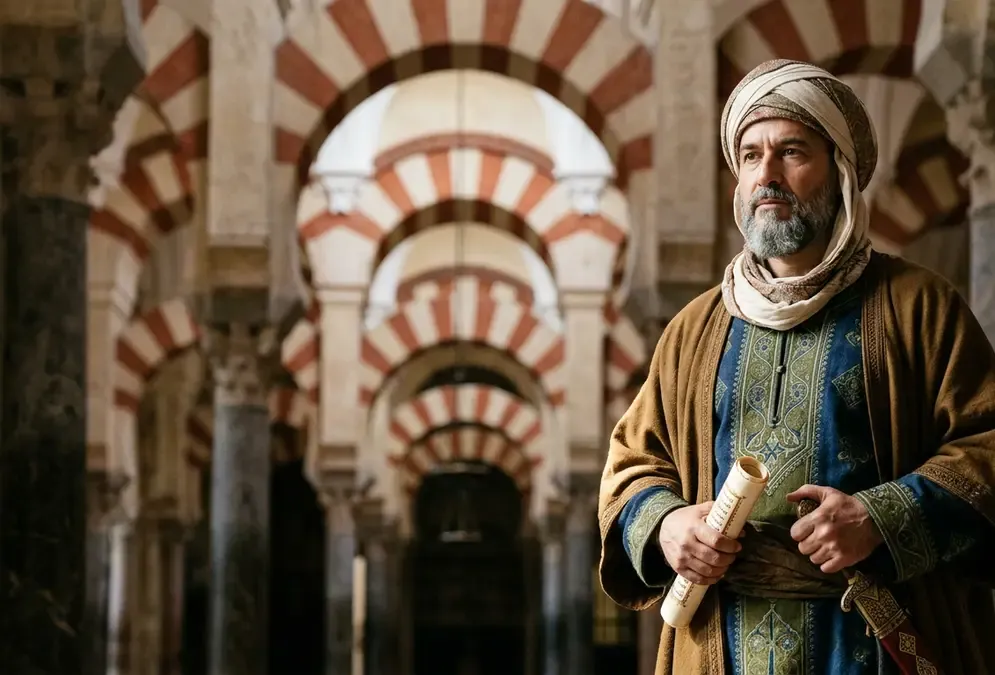
Almanzor — The Man Who Dismantled the Caliphate From Inside
Almanzor ran Córdoba for 25 years without claiming the caliphate. Fifty-seven undefeated campaigns, the bells of Santiago, a purged library — and civil war.
The Córdoba history hub maps the Roman monuments against the medieval and modern city layers, which helps if you want context beyond the individual sites. For the forum, the circus foundations (partially visible near Calle Caballerizas Reales), and the Roman walls, the hub gives the spatial overview that individual site signage does not.
One practical note: the site signage at the temple itself is sparse. There are information panels but they are summary-level. If you want the full archaeological background — the García y Bellido identification story, the anastylosis controversy, the Colonia Patricia context — bring your own research or use a guide. The panels will tell you it is a Roman temple from the 1st century AD. They will not tell you how it got there, how it was found, or what was argued about it for the next 60 years.