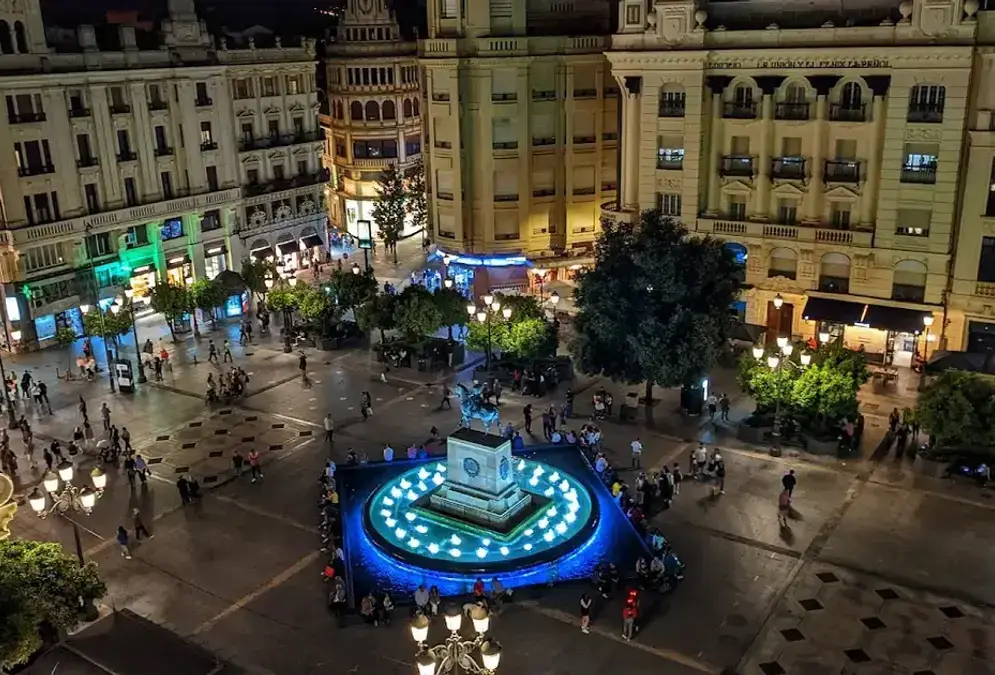

The Plaza de las Tendillas is the main meeting point of modern Córdoba — where locals gather rather than tourists, and where the city runs its daily errands. Instead of traditional bells, its unique clock marks the hours with flamenco guitar chords, which catches most first-time visitors off guard in the best possible way. The equestrian statue of El Gran Capitán stands at the centre, with a U-shaped fountain and terrace tables arranged around it.
A Square Redesigned in 1927
The present square was designed between 1925 and 1927 by Barcelona architect Félix Hernández, commissioned by Mayor José Cruz Conde. Its name comes from the small shops (tendillas) that the Order of Calatrava ran here from the 14th century onwards. Three of Córdoba's main commercial streets — Cruz Conde, Claudio Marcelo, and Gondomar — converge at Tendillas, making it the practical centre of the city.
The architecture of the square is distinctly 1920s — the arcaded buildings on two sides and the rational arrangement of the space reflect the civic ambitions of the period rather than any attempt to reproduce the city's medieval character. It works as a counterpoint to the historic quarter: this is the part of Córdoba that was built for car traffic, department stores, and daily commerce.
The Flamenco Clock and El Gran Capitán
The equestrian statue of El Gran Capitán was sculpted by Cordoban artist Mateo Inurria in 1920. It honours general Gonzalo Fernández de Córdoba (1453–1515), who led the Catholic Monarchs' Italian campaigns and is credited with developing the infantry tactics that shaped European warfare for two centuries. He was born in Montilla, south of Córdoba.
The flamenco clock went up on 29 January 1961, crafted by luthier Manuel Reyes Maldonado. There is no equivalent public clock in Spain. On 31 December, Cordobans crowd the square to eat the twelve traditional grapes at midnight to its guitar chimes — the local version of a tradition that fills every major Spanish square on New Year's Eve.
The Living Centre of Córdoba
Time your visit on the hour to hear the guitar clock. Allow 15 to 20 minutes to look at the statue and fountain, longer if you want to sit on a terrace or explore the shopping streets. The historic gelato parlours around the square have been here since the 1930s. A good starting point for the Centro neighbourhood — the Mezquita is 10 minutes' walk away, and the Roman Temple is a 5-minute walk along Calle Claudio Marcelo from the square.