Cordobán Leather: The Craft That Named the English Cordwainer
Córdoba gave English its word for shoemaker. How medieval goatskin tanned with sumac became Europe's finest leather and named a London guild still active today.
Ten years covering Córdoba's UNESCO heritage sites, sourcing from Junta de Andalucía documentation.
Published
Every English speaker who has ever read the word cordwainer — the archaic term for a shoemaker — has encountered a piece of medieval Córdoba without knowing it. The word derives from cordwain, the soft goatskin leather produced in this Andalusian city[1], and it entered English around 1100 CE[1], carried north by Norman traders who had bought the material at source. Cordobán leather was, for roughly three centuries, the finest leather in the western world: soft, water-resistant, tanned with sumac from the Sierra Morena, and associated specifically with this city in a way that no competitor could replicate.
In this article
How a Spanish city got into the English dictionary
The chain of borrowing is traceable. Cordobán is the Spanish adjective meaning "of Córdoba." Traders in medieval France and Norman England rendered it as cordoan or cordwain. An artisan who worked this material became a cordoanier in Old French, then a cordwainer in Middle English[1]. The first recorded English usage appears around 1100 CE, referencing one Randolf se cordewan[ere][1], roughly a generation after the Norman Conquest brought French commercial vocabulary into English.
The route makes historical sense. Moorish Córdoba under the Umayyad Caliphate (929–1031) was the commercial centre of the western Mediterranean. Arab traders, Jewish merchants, and Christian buyers all moved through the city, and the leather they purchased travelled with them back to France, England, and the Low Countries. By the time Norman merchants documented their trades in Latin and French, cordwain was already the trade standard for fine footwear.
The material itself disappeared from production long before the word fell out of use. By the 14th century, English guild ordinances were distinguishing between cordwainers (who made new shoes from new leather) and cobblers (who repaired worn shoes from salvaged material)[2]. A London ordinance of 1395 formalised this distinction[2], protecting the higher-status occupation from the lower. The word cordwain as a material term had already faded by then; what persisted was its occupational derivative, preserved in guild law and professional identity long after the original Córdoban supply had been displaced by other leathers.
That is how toponymic etymology works. The place-name outlasts the product, the product term outlasts the material, and what remains is a word that nobody quite understands but everyone keeps using.
The material: goatskin, sumac, and the Sierra Morena
Medieval cordobán was goatskin. This is worth stating plainly, because the word cordovan now refers primarily to horsehide in American leather-goods markets, a different material entirely. The original was a specific tanning process applied to specific hides, producing a leather whose properties — softness, durability, water resistance, a characteristic smooth and slightly waxy surface — came from the combination of animal and technique.
The technique used sumac (Rhus coriaria), a shrub that grows across the Sierra Morena mountains north of Córdoba[3]. Sumac tannin produces a softer, more supple result than oak bark, the dominant tanning agent in northern European leatherworking. The tannin binds to the collagen fibres of the hide at a molecular level, stabilising them against decay and water while preserving flexibility. Córdoba's access to local sumac, combined with the city's warm climate (which aided the fermentation stages of pit tanning) and its skilled workforce, created conditions that other cities could not easily replicate.
~1100 CE
Date of the first recorded English usage of cordwainer, derived from the Old French cordoanier — itself from the Spanish cordobán, meaning leather from Córdoba[1]. The word entered English within a generation of the Norman Conquest.
The colour was characteristically reddish-brown, though dyed variants in black, red, and green were produced for different markets. The finish was smooth and close-grained — unlike the pebbled surface of vegetable-tanned calf or the rough-napped surface of suede. Shoes made from cordobán held their shape in damp conditions where northern European leathers softened and distorted.
These properties made it the material of choice for fine footwear across medieval Europe. Spanish kings, Frankish nobles, and English clerics all wore cordobán shoes. The material appeared in inventories of royal wardrobes from the 10th century onward, and its consistent quality — produced under guild supervision in Córdoba's workshops — gave buyers a reliable standard at a time when leather quality varied enormously by region and tanner.
Córdoba as the leather capital of medieval Europe
The city's leather dominance peaked during the Umayyad Caliphate in the 10th and early 11th centuries. Abd al-Rahman III, who declared himself Caliph in 929 and built Medina Azahara as the administrative capital of his state, presided over a city that contemporaries estimated at around half a million inhabitants[9] — comparable to Constantinople and larger than any city in Christian Europe at the time.
Within that city, leather production was organised into guilds (the gremio de guarnicioneros) that controlled quality, trained apprentices, and managed the tanneries along the Guadalquivir. The river was essential: tanning requires large quantities of water for soaking and washing hides, and the workshops clustered where the water was close and the effluent could run away downstream. The smell was considerable.
The trade routes from 10th-century Córdoba reached in every direction:
- North to the Christian kingdoms of León, Navarra, and Castile
- East across the Mediterranean to Byzantine and Abbasid courts
- West through Lisbon and the Atlantic coast
- North through the Pyrenees to French and Frankish markets
- Eventually to England, after the Norman Conquest opened new commercial channels
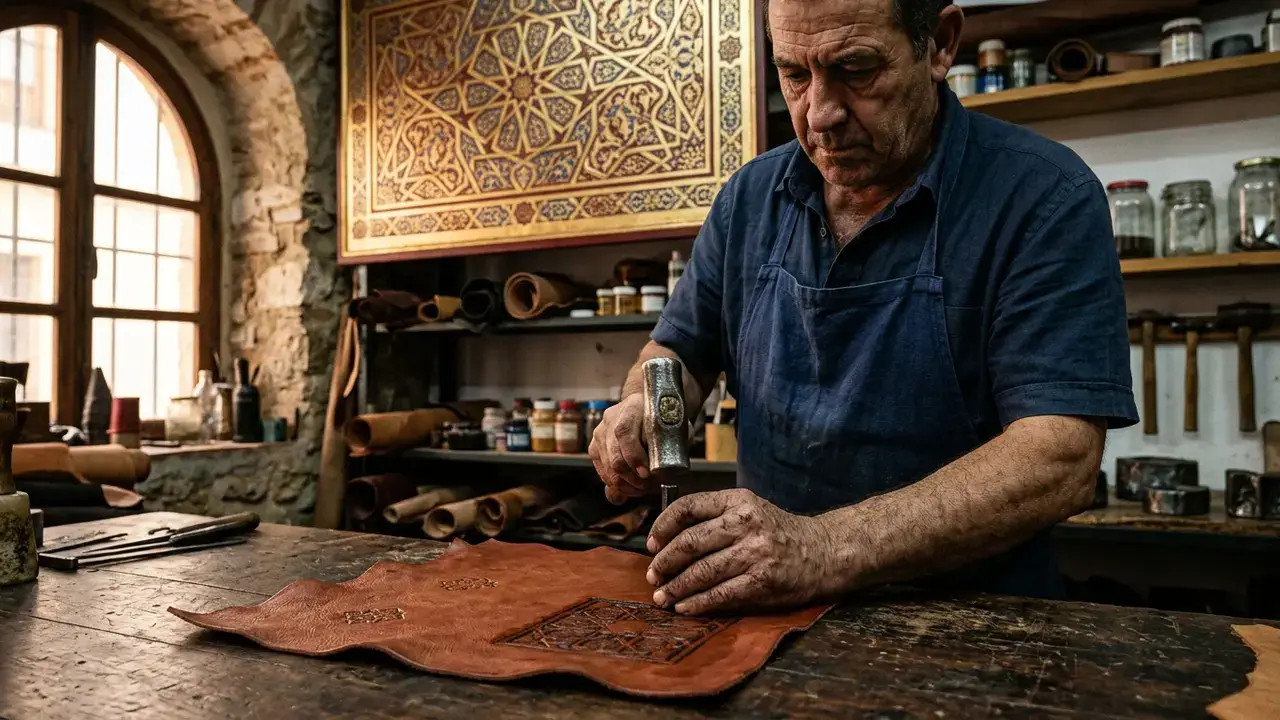
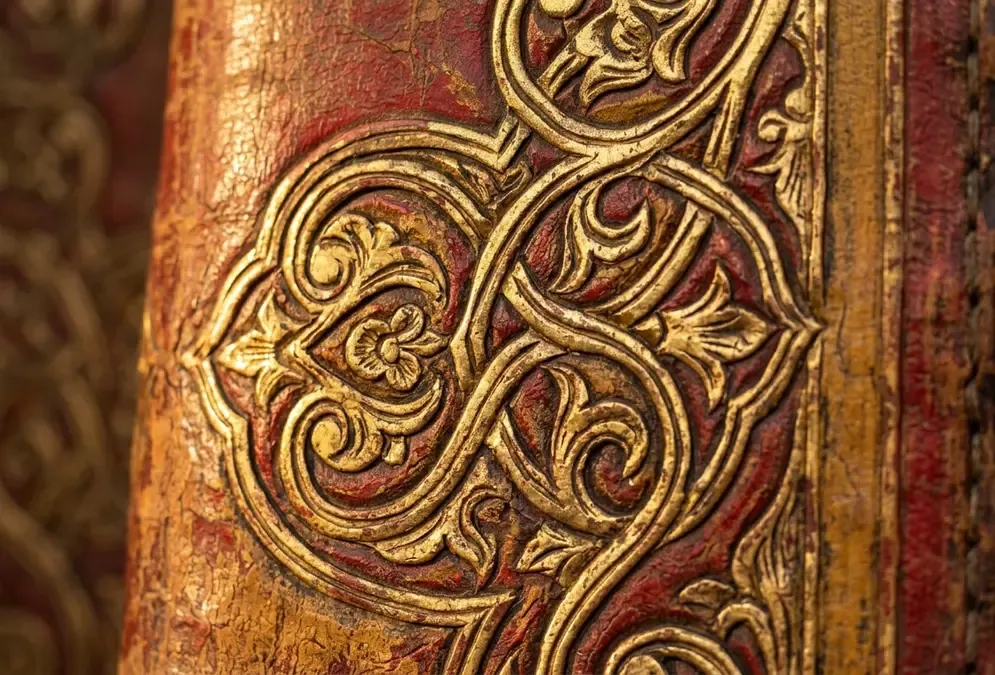
Cordobán was not the only leather Córdoba exported. The city also produced guadamecí, the embossed and gilded decorative leather that furnished European palaces as wall panels. Where plain cordobán served functional luxury (footwear, gloves, bookbindings), guadamecí was purely decorative, used to replace tapestries in great halls and private chapels. The guadamecí craft and its technical revival by contemporary craftsman José Carlos Villarejo is a separate story, but the two crafts were produced in the same city, by the same guild tradition, at the same moment of commercial dominance.
The sumac-tanning tradition that produced medieval cordobán still has practitioners in Córdoba's Judería, though the industrial-scale tanneries along the Guadalquivir are long gone.
The Christian Reconquista reached Córdoba in 1236, when Fernando III of Castile took the city. Production continued under new rule, but the concentrated Caliphal infrastructure that had made Córdoba the trade standard for all of western Europe was gone. Other Andalusian cities adopted the techniques; other European cities developed competing leather industries. The monopoly Córdoba had held for three centuries dispersed.
The Worshipful Company of Cordwainers: London's 600-year guild
London's cordwainers had been organising informally since at least the 12th century, but the first written evidence of a formal London guild dates to 1272, when city ordinances mention the craft[4]. By then, cordobán leather had been the standard for fine shoemaking in England since at least the Norman Conquest, and the guild's name recorded that fact.
Henry VI granted the Worshipful Company of Cordwainers its Royal Charter of Incorporation in 1439[4]. The Charter formalised what had been practice: the guild controlled quality standards, trained apprentices, and protected its members from competition by non-guild shoemakers. The earliest Cordwainers' Hall in the City of London is recorded from 1440[4].
The guild occupied Cordwainer Ward in the City of London, one of the named wards that still structure London's administrative geography. A street name preserving a medieval trade, the ward reflects the concentration of shoemaking workshops in that part of the medieval city. The material those workshops worked with was, at least in the guild's naming conventions, still identified with Córdoba — even when the actual leather sourced from Spain had been replaced by English alternatives.
The distinction the guild policed, formalised in the 1395 ordinance, remained central to its identity: cordwainers made new shoes from new leather; cobblers repaired shoes from old. This boundary defined social hierarchy in the trade. A journeyman cordwainer who spent his career making new boots from quality hides was a skilled craftsman. A cobbler who re-stitched worn soles was a tradesperson of lower standing. The language of the guild preserved the Córdoban association at the top of that hierarchy.
Cordwainers' Hall was destroyed during World War II[5]. The Company itself survived. It still exists today as a livery company of the City of London, focused on charitable work, industry scholarships, and the promotion of leather footwear crafts. Members of the guild no longer produce shoes; the Company is now a professional body and charitable foundation. But it carries the name of a city it has never been to, preserving in its title a trade history that connects 21st-century London to 10th-century Andalucía.
Timeline
1100
First recorded English usage of *cordwainer*[^1]
The form cordewan[ere] appears in a document naming one Randolf, roughly a generation after the Norman Conquest brought French commercial vocabulary into English.
1272
First written evidence of the London cordwainers' guild[^4]
City ordinances mention the organised craft in the Cordwainer Ward of the City of London.
1395
London guild ordinance separates cordwainers from cobblers[^2]
Cordwainers (new shoes from new leather) and cobblers (repairs from old material) are legally distinguished, protecting the higher-status trade.
1439
Royal Charter granted by Henry VI[^4]
The Worshipful Company of Cordwainers receives its formal charter of incorporation. Earliest Cordwainers' Hall recorded the following year.
1905
Horween Leather Company founded in Chicago[^6]
The tannery later adopts the name Shell Cordovan for its horsehide leather, perpetuating the Córdoba name with a different material.
American Cordovan: the same name, different animal
Horween Leather Company, founded in Chicago in 1905[6], produces what the global leather-goods market now calls Shell Cordovan. The material is not goatskin and it is not tanned with sumac. It is the dense connective tissue layer from the rump of a horse, processed through a tanning cycle that takes over six months of hand-work: oiling, ageing for 90 days, hand-shaving with a cylindrical knife, staining, drying, waxing, and glazing[7].
The result is a leather with distinctive properties — a high-gloss surface that does not crease in the way vegetable-tanned calf does, extreme durability, and a shell-like firmness that responds to pressure by rolling rather than folding. Luxury shoemakers worldwide have used it for benchmade footwear since the early 20th century. It is genuinely excellent leather.
But it shares almost nothing with medieval cordobán beyond the name and the general category of luxury leather. Horween adopted "Cordovan" because Córdoba had established that word as a synonym for the finest available leather — the same mechanism by which champagne became a synonym for sparkling wine regardless of where it was made. When Chicago's stockyards were producing hides in industrial quantities, attaching an established quality name to a new premium product was commercially rational.
The confusion the name creates is persistent. Shoe-enthusiast forums regularly debate whether American Shell Cordovan is "authentic cordovan." By geography and etymology, it is not. By the logic of product naming, it is following a centuries-old pattern of using a place-name as a quality signal divorced from its origin. The medieval goatskin and the contemporary horsehide are connected by a word, not by a process.
Where to find Córdoba's leather tradition today
The industrial-scale tanneries that lined the Guadalquivir in the 10th century are gone. What remains in Córdoba is a cluster of artisan traditions, the most specialised of which is guadamecí — the embossed and gilded decorative leather that originated here during the Umayyad Caliphate. For that specific craft, the Casa Museo Guadamecí Omeya at Plaza Agrupación de Cofradías, 2[8] is the place to see it practiced at the level of full Caliphal technique.
The museum opened in 2006 under José Carlos Villarejo García, who trained under the scholar Ramón García Romero and inherited García Romero's reconstruction of the lost techniques. Villarejo is among the very few practitioners keeping authentic guadamecí alive.
For cordobán leather in the broader sense — bags, belts, wallets, and shoes made from vegetable-tanned leather by local craftsmen — the Judería is the natural starting point. The Zoco Municipal de Artesanía on Calle Judíos hosts leather artisans alongside silversmiths and potters. Quality ranges from tourist-grade stamped goods to serious handmade pieces. The silver filigree tradition follows the same pattern: production ranges from machine-made to genuinely handcrafted, and craftsmen in the Zoco will explain the difference if you ask.
Leather shops near the Mezquita-Catedral sell a range of goods, including items labelled cordobán as a provenance claim. The quality marker to look for in any piece claiming the tradition is vegetable tanning — the slow, sumac-based process that gave medieval cordobán its properties. Chemical-tanned leather is softer and more uniform, but it ages differently and will not develop the patina that makes well-maintained leather goods improve over time.
Opening hours for the Casa Museo Guadamecí Omeya are Monday to Saturday, 10:30 to 14:00 and 16:30 to 20:00[8]. Custom commissions are available; contact the studio through josecarlosvillarejo.com for current pricing on bespoke pieces.
FAQ about cordobán leather
Why is a shoemaker called a cordwainer?
The term derives from cordwain, the luxurious goatskin leather produced in medieval Córdoba, Spain. Shoemakers who worked this material were called cordoaniers in Old French, which became cordwainer in Middle English. The word entered English around 1100 CE, carried by Norman traders who bought cordobán leather from Andalusian merchants. The material eventually fell out of use, but the occupational term survived in guild law and professional identity.
What was the original cordobán leather made from?
Medieval cordobán was goatskin tanned with sumac (Rhus coriaria), a shrub that grows in the Sierra Morena mountains north of Córdoba. The sumac tannin produced a softer, more supple result than the oak-bark tanning common in northern Europe. The resulting leather was smooth, water-resistant, and characteristically reddish-brown. It is not the same material as modern American Shell Cordovan, which is made from horsehide.
Is American Shell Cordovan the same as medieval Spanish cordobán?
No. Medieval cordobán was goatskin tanned with sumac from the Sierra Morena. American Shell Cordovan, made famous by Horween Leather Company in Chicago (founded 1905), uses the dense tissue layer from a horse's rump and a tanning process that takes over six months. The name persisted because Córdoba had established cordovan as a synonym for fine leather, but the two materials share almost nothing beyond that word.
When was the Worshipful Company of Cordwainers founded?
The first written evidence of an organised London cordwainers' guild dates to city ordinances from 1272. King Henry VI granted the Worshipful Company of Cordwainers its Royal Charter of Incorporation in 1439. The guild's Cordwainers' Hall was first recorded in 1440 in the City of London. The Company still exists today as a livery company, now focused on charitable work and industry scholarships.
Can I buy authentic cordobán leather goods in Córdoba today?
You can buy vegetable-tanned leather goods made by local craftsmen at the Zoco Municipal de Artesanía on Calle Judíos and in shops near the Mezquita-Catedral. For guadamecí, the embossed and gilded decorative leather descended from the same Caliphal tradition, the Casa Museo Guadamecí Omeya at Plaza Agrupación de Cofradías, 2 is the specialist destination, open Monday to Saturday from 10:30 to 14:00 and 16:30 to 20:00. Custom commissions are available through josecarlosvillarejo.com.
What is the difference between cordobán and guadamecí?
Both are Córdoban leather traditions, but they serve different purposes. Cordobán is vegetable-tanned goatskin used for functional luxury goods: footwear, gloves, bookbindings, upholstery. Guadamecí is the decorative variant: sheepskin with a silver ground, embossed with iron stamps, painted in polychrome, and finished with gold leaf. Guadamecí was used as wall panelling in palaces and churches. The two crafts were produced by overlapping guild traditions in the same city during the same period of commercial dominance.
What does cordwainer mean in English today?
In modern English, cordwainer is an archaic term for a shoemaker, specifically one who makes new shoes from new leather. It is classified as archaic in current dictionaries but survives in the formal names of guilds, most notably the Worshipful Company of Cordwainers in London. The distinction from cobbler (who repairs shoes) dates to a 1395 London guild ordinance. Outside guild and historical contexts, the word is rarely used.