Abd al-Rahman III: The Morning Córdoba Became a Caliphate
On January 16, 929, Abd al-Rahman III declared himself Caliph in Córdoba's Great Mosque, making the city a rival to Baghdad and Cairo at its medieval peak.
Ten years covering Córdoba's UNESCO heritage sites, sourcing from Junta de Andalucía documentation.
Published
On January 16, 929, Abd al-Rahman III stood before the Friday congregation in the Great Mosque of Córdoba and declared himself Commander of the Faithful, a title that had belonged exclusively to the Abbasid caliph in Baghdad for two centuries. The declaration made Córdoba the third caliphate in the Islamic world, equal in ambition to Baghdad and Cairo. It was the political act that turned a regional emirate into a world power.
In this article
January 16, 929: the words that changed everything
The Friday sermon in the Great Mosque of Córdoba was a political act as much as a religious one. Each week, the khatib concluded prayers by invoking the name of the ruler, and for nearly two centuries, that name had been the Abbasid caliph in Baghdad, even as his actual authority over Andalusia had become theoretical. When Abd al-Rahman III had that name removed from the sermon and replaced with his own, he was not merely changing a liturgical formula. He was announcing that Córdoba answered to no one.
He took two new titles that day. Amir al-Mu'minin (Commander of the Faithful) had been the exclusive mark of caliphal sovereignty since the first decades of Islam[1]. He also took the regnal name al-Nasir li-din Allah: Defender of God's Faith. Coins minted in Córdoba would carry these titles for the next thirty-two years. Ambassadors from Constantinople, León, and the German court would address correspondence to the Caliph of the West.
The proclamation was recorded and dated[1]. A scribe set down the exact day: 16 January 929. The precision was deliberate. Abd al-Rahman III understood that founding moments need witnesses and documentation. He had spent seventeen years getting Córdoba to the point where this claim would not be laughed at, or immediately tested by a rebel army from the mountains.
929 CE
The year Abd al-Rahman III proclaimed the Caliphate of Córdoba, creating a third center of Islamic authority alongside Baghdad and Fatimid North Africa. The claim held, uncontested, for over a century.
The twenty years before: an emir who inherited a fractured emirate
Abd al-Rahman III came to power in 912, aged roughly twenty-one[1]. The emirate he inherited was in a condition that made the proclamation of 929 look audacious. Dozens of independent lords controlled castles and fortresses across Andalusia. The Arab and Berber aristocracies competed for court influence and refused taxation. The city of Córdoba's political authority barely reached beyond its own walls. Within days of taking power, Abd al-Rahman had the head of one rebel leader displayed publicly in the streets. The message was not subtle.
His early approach mixed brutality with structural reform. He built a professional standing army out of Slavic and Berber recruits, the saqalibah, who owed loyalty to the pay ledger, not to a clan or tribe[2]. This broke the Arab aristocracy's monopoly on military power and gave him troops he could actually command. He then spent seventeen years methodically retaking castles and towns, one by one, until the patchwork of semi-independent lordships that had made the emirate ungovernable had been absorbed into a centralized state.
The one moment that announced his military confidence abroad came in 920, when the Christian king Ordoño II of León sacked the Muslim city of Talavera and killed its population. Abd al-Rahman's response was the Campaign of Muez: he personally commanded an army north to the valley of Valdejunquera, where on July 26, 920 his forces crushed the combined armies of León and Navarre[3]. Two Christian bishops, Dulcidio and Ermogio, were captured and taken to Córdoba. The northern frontier held for the next seven years.
The final act of internal consolidation came in 928: the storming of Bobastro, the mountain fortress that had been held by the rebel ʿUmar ibn Ḥafṣūn and his family for decades. With Bobastro taken, there was no longer a credible military challenge to Córdoban authority anywhere in Andalusia. Abd al-Rahman had his unified state. The following year he claimed the title to match it.
Why declare a caliphate? The geopolitical calculation
The timing of the 929 proclamation was not accidental. Abd al-Rahman III had been watching two things happen simultaneously in the wider Islamic world: the Abbasid Caliphate in Baghdad was weakening, its caliphs reduced to figureheads controlled by Turkish military commanders, and the Fatimid Caliphate had just established itself in North Africa in 909, challenging Abbasid claims to universal authority with a Shi'a counter-caliphate[1].
Before 929, the rulers of Córdoba had held the title of Emir, a term that implied subordination, however theoretical, to the Abbasid successor of Muhammad. Each Friday sermon, each coin, carried this implicit acknowledgment. Abd al-Rahman's proclamation ended it. By claiming the title of Caliph, he asserted that Córdoba was the equal of Baghdad and Cairo, and that he, not the Abbasid or Fatimid pretenders, was the legitimate defender of Sunni Islam in the western world.
The practical consequences ran in both directions. Internally, the title elevated him above any possible rival claimant in Andalusia. No rebel lord could challenge a Caliph with the same theological language that had been used against mere Emirs. Externally, it opened a different kind of diplomacy: instead of receiving ambassadors as a regional ruler within the broader Islamic sphere, he could now receive them as a sovereign equal to any power on earth. Embassies began arriving in Córdoba that would have been unthinkable a decade before.
The Fatimid threat was probably the immediate trigger. The Fatimids had conquered much of North Africa and were actively courting the loyalty of Muslim communities in Iberia. By claiming the caliphate first, Abd al-Rahman foreclosed that possibility for Andalusia. He would be the Caliph here; they would be rivals, not overlords.
Córdoba at its peak: embassies, scholars, and 500,000 inhabitants
Between 929 and 961, Córdoba underwent a transformation of scale that still shapes how historians write about medieval Europe. Contemporary sources describe a city with paved, lamp-lit streets, public bathhouses, hospitals, and somewhere between 100,000 and 500,000 inhabitants[1]. These numbers may be inflated by medieval chroniclers, but they describe, at minimum, a city vastly larger than anything in the Christian north, where even the largest towns held a fraction of Córdoba's population.
The diplomatic record is concrete where the population estimates are uncertain. In 950, Count Borrell II of Barcelona sent a formal embassy to Córdoba, seeking an alliance[1]. By 958, the rulers of León and Pamplona, the same Christian kingdoms whose armies Abd al-Rahman had defeated at Valdejunquera, were sending envoys to pay homage[1]. The Byzantine Emperor and the German Emperor Otto I also opened diplomatic contact[1]. These were not courtesy visits. They were acknowledgments that the Caliph of Córdoba controlled the strategic balance of the Iberian Peninsula.
The cultural and intellectual life of the city ran on the same scale. Abd al-Rahman patronized scholars, poets, and physicians; his son al-Hakam II would push this further, building a royal library of somewhere between 400,000 and 500,000 manuscripts[4]. Scholars came from across the Christian and Islamic world to consult texts that had been translated in Córdoba from Greek, Persian, and Indian sources. The Great Mosque of Córdoba was expanded under Abd al-Rahman III and again under al-Hakam; the mihrab and its multifoil arches belong to the generation that followed him, but the scale of the mosque that now stands was largely his.
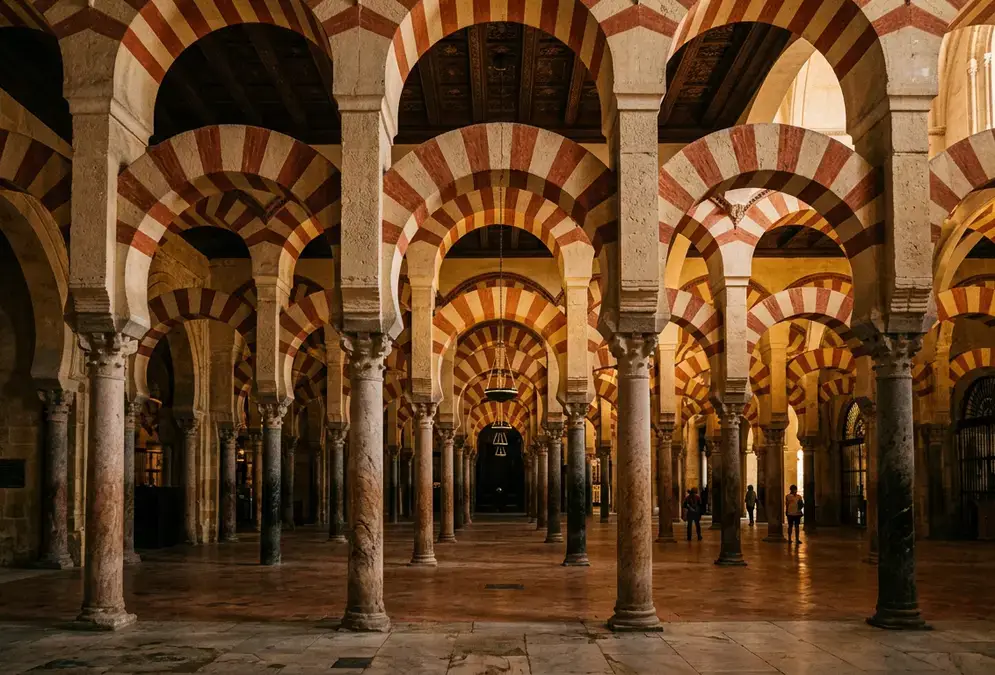
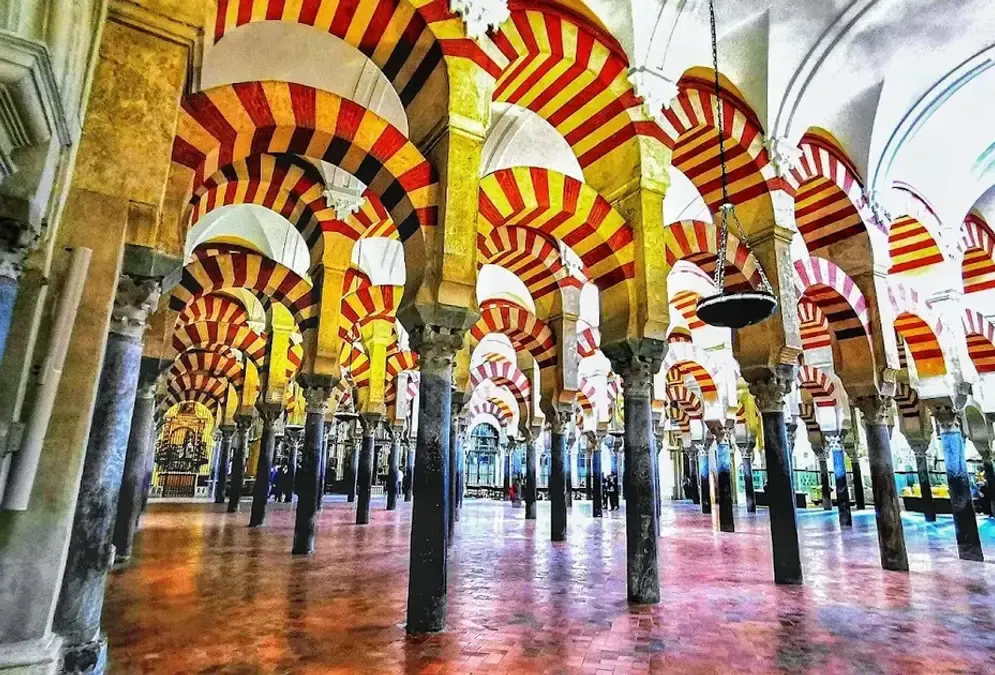
Abd al-Rahman III expanded the mosque his ancestor built in 784. The doubled-arch system (white limestone over red brick) was already in place when he declared himself Caliph before the Friday congregation in January 929.
Cordoban scholars of this period worked in medicine, astronomy, mathematics, and philosophy. The city produced the polymath tradition that would, two generations after Abd al-Rahman's death, give the Islamic world figures like Averroës and Maimonides. The patronage networks, the book trade, the physical library: all of it was built during the caliphal period Abd al-Rahman III initiated.
Medina Azahara: building a caliphate in stone
In 936, seven years after the proclamation, Abd al-Rahman III began building an entirely new city 8 kilometres west of Córdoba[5]. He named it Madinat al-Zahra, the Shining City, possibly after a favorite concubine named al-Zahra. It would function as the administrative and ceremonial capital of the caliphate: a place designed not for habitation alone, but for the display of power.
The site stretched across roughly 112 hectares on three terraced levels carved into the foothills of the Sierra Morena[5]. Contemporary accounts record thousands of workers and daily deliveries of stone, marble, and carved wood. The chronicles mention 10,000 workers laying stone each day, though historians treat these figures as rhetorical rather than literal[5]. What is certain from the archaeological record is the scale: a complex capable of housing up to 20,000 people[5], with separate zones for the caliph's private palaces, the administrative apparatus, the guard, and the marketplace. A congregational mosque occupied a platform of its own.
The Salón Rico, the Throne Hall sometimes called the Rich Salon, was the heart of the complex. Its carved stone panels, depicting the arabesque vine-and-leaf motifs that would become the signature decorative language of Andalusian architecture, were designed to be seen by foreign ambassadors before they reached the Caliph. The message was architectural: whoever you sent to negotiate with the Umayyad ruler of the West, you were not dealing with a provincial lord.
Medina Azahara functioned as the caliphal seat for roughly 65 years before civil war destroyed it in 1010[5], the same conflict that ended the Umayyad Caliphate entirely. For centuries afterward, its marble columns were quarried and reused in buildings across Andalusia. Systematic excavation began only in the early 20th century. Today, approximately 10 of the original 112 hectares have been excavated and can be visited[5]. Medina Azahara is 8 kilometres from Córdoba's city centre and reachable by tourist shuttle in about 15 minutes.
The blue-eyed caliph: mixed heritage and long shadow
Abd al-Rahman III was not, in physical appearance, what a medieval Islamic ruler was supposed to look like. His mother was a Christian captive from the Pyrenean north. His paternal grandmother, Onneca Fortúnez, was a Christian infanta from the royal house of Pamplona[2]. Five generations of Umayyad rulers in Córdoba had taken Christian women as wives or concubines; Abd al-Rahman was the most visible result of that pattern. Contemporary accounts describe him as having white skin, blue eyes, and reddish-blond hair, features his chroniclers noted precisely because they were unexpected in a ruler claiming descent from the Prophet's Arab tribe[2].
He reportedly dyed his hair and beard black to conform to expectations of how a Caliph should look. A blue-eyed man ruling an Islamic caliphate with hair dyed black to appear more Arab: the image is strange enough that medieval historians recorded it. Whether it reads as vanity or political calculation, it captures something real about the caliphate he built. His authority rested on synthesis rather than ethnic purity: the ability to command Arab scholars, Berber soldiers, Slavic palace guards, and Christian diplomatic contacts simultaneously.
He died in 961, aged around seventy[1], after forty-nine years on the throne: seventeen as Emir, thirty-two as Caliph. His son al-Hakam II continued and deepened the cultural project. The unified caliphate they built survived, in recognizable form, until the civil war that broke it apart after 1009. The story of that collapse, and what it destroyed, runs in a companion article on the fall of the Córdoba Caliphate.
Timeline
891
Abd al-Rahman III born in Córdoba
His mother was a Christian captive from the Pyrenean north; his paternal grandmother Onneca Fortúnez was an infanta of Pamplona.
912
Becomes Emir of Córdoba at ~21
Inherits a fragmented emirate with no effective authority beyond the city walls. Immediately begins suppressing rebel lords.
920
Battle of Valdejunquera
Decisive victory against León and Navarre. Two Christian bishops captured. Northern frontier secured for seven years.
928
Bobastro falls
The storming of the mountain fortress ends decades of rebellion from the Ḥafṣūnid family. Internal consolidation complete.
929
Proclamation of the Caliphate
January 16: Abd al-Rahman III declares himself Commander of the Faithful in the Great Mosque of Córdoba. Córdoba becomes a third caliphal power.
936
Medina Azahara construction begins
A new palace-city 8 km west of Córdoba, built across 112 hectares on three terraced levels.
961
Abd al-Rahman III dies
Succeeded by his son al-Hakam II. The caliphate he built will last another 70 years before civil war destroys it.
What Abd al-Rahman III left behind in physical form: the Great Mosque of Córdoba, expanded under him and his son into the structure that still stands, and the ruins of Medina Azahara. What he left in political form was the template: a demonstration that an Islamic civilization in Western Europe could claim parity with Baghdad, translate the classical world, and draw ambassadors from Christian and Byzantine kingdoms. That it lasted only a century after his death does not diminish what it was. The greatest medieval city west of Constantinople was built during his reign.
FAQ about abd al-rahman iii
Why did Abd al-Rahman III declare himself Caliph in 929?
Two forces pushed him to act. Internally, the caliphal title gave him religious authority over Andalusia that no rebel could challenge; it elevated him above any regional competitor. Externally, the Fatimid Caliphate had established itself in North Africa in 909 and was competing for the loyalty of Muslim communities in Iberia. By claiming the caliphate first, Abd al-Rahman blocked the Fatimids from positioning themselves as overlords of Andalusian Islam. The weakening Abbasid Caliphate in Baghdad presented the opportunity; the Fatimid threat made it urgent.
What is the difference between an Emir and a Caliph?
An Emir was a regional governor or prince, a title that implied some degree of subordination to a higher Islamic authority. The rulers of Córdoba had held this title since the founding of the emirate in 756, nominally acknowledging the Abbasid Caliphate in Baghdad even as that acknowledgment became increasingly theoretical. A Caliph, by contrast, claimed supreme religious and political authority over the Muslim community: successor to the Prophet, answerable to no earthly power. When Abd al-Rahman III took the caliphal title in 929, Córdoba's formal subordination to Baghdad ended.
What can I visit today that is connected to Abd al-Rahman III?
Two sites are directly connected to his reign. Medina Azahara, his palace-city 8 kilometres west of Córdoba's centre, has been partially excavated and is open to visitors, with a museum that explains the caliphal period. You can reach it by tourist shuttle from the city. The Great Mosque of Córdoba (now the Mezquita-Catedral) was substantially expanded under Abd al-Rahman III and his son al-Hakam II; the structure that stands today reflects their ambitions. Both sites are UNESCO World Heritage listed.
How large was Córdoba under Abd al-Rahman III?
Contemporary sources gave figures of up to 500,000 inhabitants, with claims of 3,000 mosques and 100,000 homes and shops. Modern historians treat these numbers with scepticism: medieval sources routinely inflated urban population figures. The actual population was probably between 100,000 and 200,000. Even at the lower end, this made Córdoba one of the largest cities in medieval Europe, much larger than any contemporary city in the Christian north, and comparable to Constantinople.
What was the Battle of Valdejunquera?
Fought on July 26, 920, in a valley in present-day Navarre, Valdejunquera was Abd al-Rahman III's most important military victory against the Christian kingdoms of the north. He personally commanded the campaign, which was a response to King Ordoño II of León's sack of the Muslim city of Talavera. The Umayyad army defeated the combined forces of León and Navarre, capturing two Christian bishops who were taken to Córdoba. The victory secured the northern frontier for seven years and demonstrated that Córdoba was the dominant military power on the Iberian Peninsula.
Why did Abd al-Rahman III dye his hair black?
Abd al-Rahman III had light skin, blue eyes, and reddish-blond hair, inherited from his Christian ancestry. His mother was a captive from the Pyrenean north, and his paternal grandmother was a Christian princess of Pamplona. Contemporary sources record that he dyed his hair and beard black, the better to conform to the expected appearance of an Arab Muslim ruler. Whether this was vanity, political calculation, or both is unclear. Medieval historians noted it because it was striking: a Caliph styling himself Arab while visibly not being so.
What happened to the Caliphate after Abd al-Rahman III's death?
His son al-Hakam II (ruled 961 to 976) continued the cultural and intellectual project, expanding the Great Mosque and building what became one of the greatest libraries of the medieval world. Al-Hakam's son Hisham II inherited the throne as a minor, opening a power vacuum that the chamberlain Almanzor exploited for thirty years. After Almanzor's death in 1002, the caliphate fragmented in a civil war (the fitna) that destroyed Medina Azahara by 1010 and formally ended in 1031, when the governing council of Córdoba abolished the title altogether.