
The caliphate at its height
By the year 1000, Córdoba had somewhere between 450,000 and 500,000 inhabitants[2] — roughly equal to Constantinople, and larger than any city in Christian Europe. A visitor arriving from León or Paris would have found paved, lamp-lit streets, public bathhouses, and a royal library that had grown under Caliph Al-Hakam II to between 400,000 and 500,000 volumes[3]: more books than the rest of Europe's libraries combined.
Abd al-Rahman III, who ruled from 912 to 961, had built the institutional structure that made this possible. He declared himself Caliph in 929, ending the pretense that Córdoba answered to Baghdad, and spent his reign projecting Umayyad power outward: a standing army of 30,000 to 50,000 troops, annual revenues estimated at 6.25 million dinars, and control over strategic footholds in North Africa — Ceuta, Melilla, and Tangier[2]. The caliphate's territory covered roughly 400,000 square kilometres with a population of around three million[2].
400,000–500,000
His son Al-Hakam II (961 to 976) turned the power his father had accumulated into a cultural project. He expanded the Great Mosque of Córdoba with a new prayer hall, commissioned its decorated mihrab with multifoil arches and ribbed domes[3], and spent his reign buying manuscripts from every corner of the Islamic world. The royal library was not decorative: Al-Hakam employed agents in Baghdad, Damascus, and Cairo who purchased books as they became available and shipped them west[3]. Poets, physicians, astronomers, and philosophers gathered in Córdoba because that is where the money and the patronage were.
The caliphate's weakness was invisible while it worked. Its legitimacy depended on a direct adult male heir from the Umayyad line. Al-Hakam II had one son.
A child caliph and the man who replaced him
Al-Hakam II died in 976. His son Hisham II inherited the caliphate at roughly ten years old[4]. Islamic jurisprudence was clear: a minor could not govern a caliphate. A regency was arranged, led by his mother Subh and the first minister Jafar al-Mushafi. Neither would hold power for long.
Almanzor (born Muhammad ibn Abi Amir, around 938) had worked his way from court notary to financial administrator of the royal household, then to administrator of Hisham's finances, then to Hajib — the chamberlain who controlled access to the caliph and therefore controlled the caliph[5]. By 978 he was the most powerful man in Córdoba. By 981 he had disposed of his rivals, including his own father-in-law at the Battle of Torrevicente, and was effectively governing al-Andalus while Hisham remained a ceremonial figure confined to his palace[5].
Almanzor's military reorganisation was decisive. He abolished the old tribal contingents whose loyalties attached to clan leaders and the Umayyad dynasty, and replaced them with ethnically mixed professional troops: Berbers from North Africa, Slavic palace guards called Saqaliba, and Christian mercenaries from the north[5]. Pay held them together, not lineage. This gave him an army he could actually command, which he used for 57 undefeated campaigns across Christian Iberia over twenty-five years[5].
By 996, Hisham had been moved to a comfortable confinement where he retained every ceremonial privilege and no actual power[5]. Subh, who had originally enabled Almanzor's rise, eventually tried to reassert financial independence; Almanzor ended that and confined her too. The caliphate was intact on paper. In practice it had become a frame around a single man.
Explore nearby · Monument
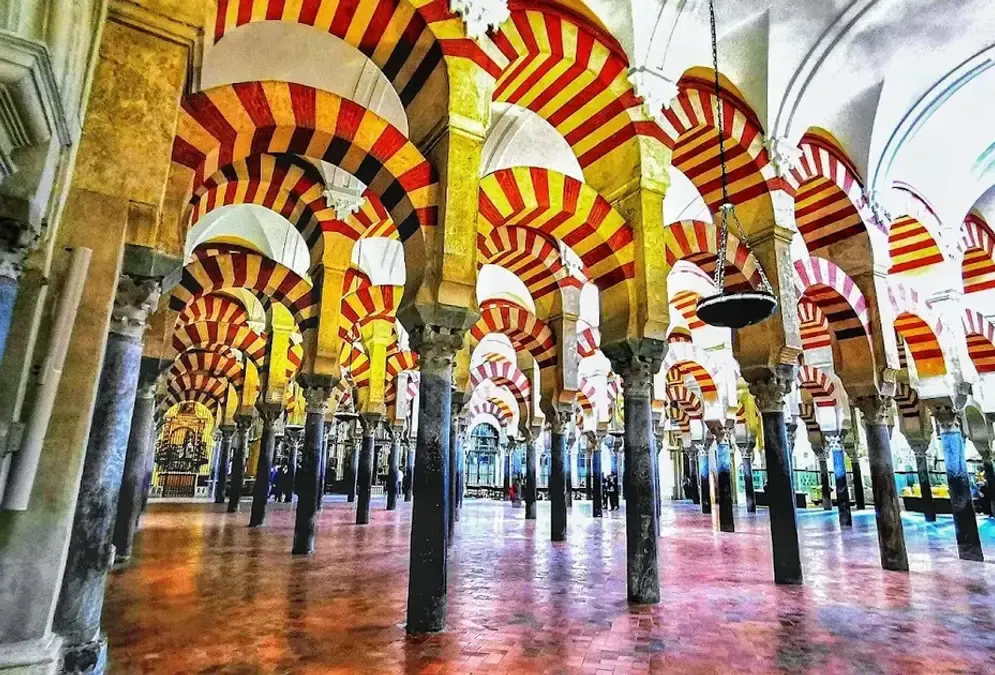
Mezquita-Catedral de Córdoba
856 columns, 1,300 years of Islamic and Christian history inside one UNESCO building. Red-and-white arches, Byzantine mosaics, and a Renaissance nave.
Almanzor died on 8 August 1002[5], returning from his 57th campaign. He was around 63. His son Abd al-Malik al-Muzaffar held the structure together until October 1008, when Abd al-Malik also died. The second son, Abd al-Rahman Sanchuelo, inherited the position without his father's or brother's ability to maintain it.
The trigger: Sanchuelo's mistake
In 1009, Sanchuelo forced Caliph Hisham II to sign a document naming him heir to the caliphate[1]. This broke a convention the Umayyad family considered fundamental: the caliphate passed within the Umayyad dynasty, not to the family of a chamberlain, however powerful. It was the kind of move that could only work if everyone who might oppose it had already been neutralised.
They had not. Arab nobles who had watched the Amirid family monopolise power for three decades, sidelining the old Umayyad elite in favour of Berber troops and Saqaliba palace guards, saw their opening[1]. While Sanchuelo was away on campaign in the north, a coup seized Córdoba. He was assassinated shortly after in March 1009[1]. The last credible Amirid leader was gone.
What followed was not a clean transfer of power. Muhammad II al-Mahdi, an Umayyad prince, seized the throne and imprisoned Hisham II[1]. A rival Umayyad claimant, Sulayman al-Musta'in, allied with Berber mercenary forces that had served Almanzor and were now unpaid and angry. In November 1009, Sulayman briefly freed and reinstated Hisham, then deposed him again[1]. Over the next twenty-two years, more than a dozen men would claim the caliphal title. Most held it for months. Some for weeks.
The fitna (the Arabic word for civil strife) had begun.
Córdoba burns
The siege of Córdoba lasted from 1009 to 1013[6]. What the sources describe is not a conquest but a systematic destruction. Berber mercenaries who had been the military engine of Almanzor's campaigns found themselves without a paymaster after the Amirid collapse, and without the ethnic or dynastic loyalty to any of the competing Umayyad claimants. They backed whoever offered them terms, shifted allegiance when the terms ran out, and when no terms were on offer, they took what they could.
Archaeological excavation has confirmed what the chronicles record: there is a violent destruction layer dateable to the early 11th century across the Córdoba site, a single catastrophic event rather than a gradual decline[6]. Marble columns were pulled from their bases. Vaults were deliberately broken. Aqueducts were dismantled. Arab citizens were massacred. The city that had rivalled Constantinople was reduced, in four years, to ruins.
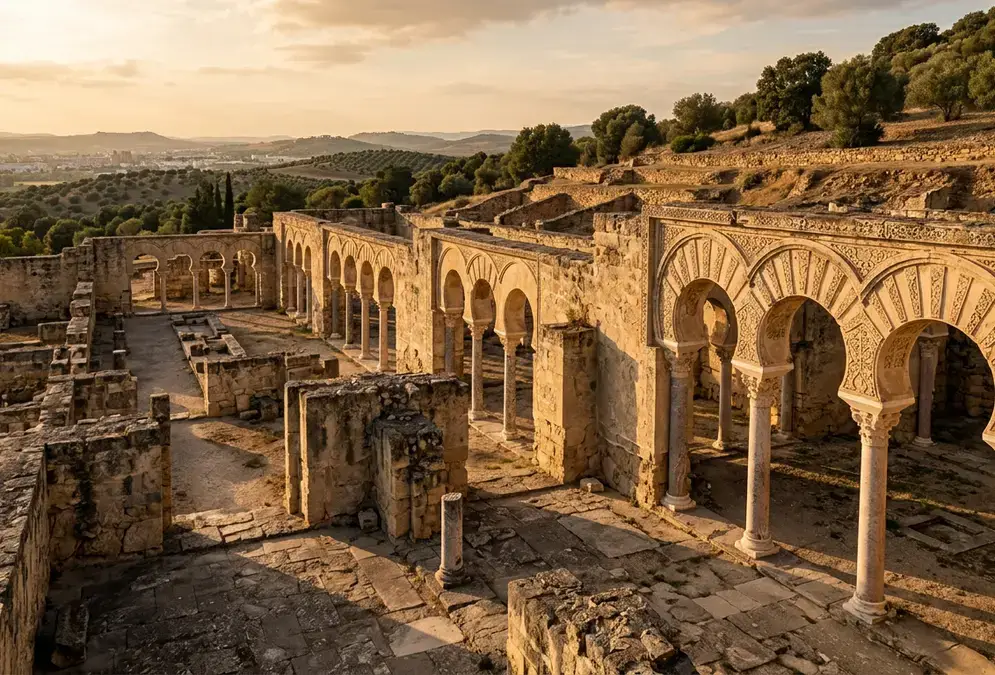
In 1010, one year into the siege, a Berber force reached Medina Azahara, the palace-city that Abd al-Rahman III had built 8 kilometres west of Córdoba as the administrative capital of the caliphate[1]. Medina Azahara had been completed only seventy-four years earlier. The destruction was not opportunistic looting. It was deliberate: marble columns pulled from their mountings, hydraulic systems dismantled, wooden roofing structures burned[1]. What the flames and sledgehammers left behind became a quarry. For centuries afterward, carved capitals and dressed stone from Medina Azahara turned up in buildings across Andalusia, reused by people who no longer remembered what they had come from.
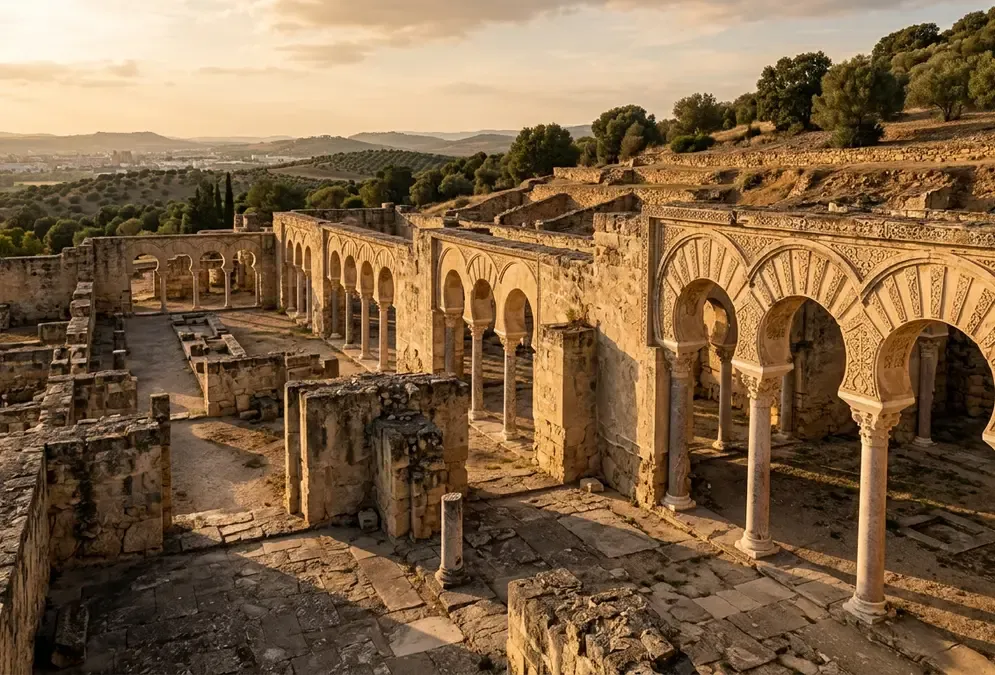
What the Berbers left in 1010, builders reused for centuries. The systematic excavation of Medina Azahara began only in the early 20th century; new rooms are still being uncovered.
The physical centre of the caliphate was gone. So was the man who had made himself indispensable to it. No institution survived Almanzor's death because he had never allowed one to form around him. The caliphate had become a person; when that person's family lost control, nothing was left to inherit.
The fragmentation: thirty kingdoms where one had been
By 1031, the succession had cycled through more than a dozen claimants. Hisham III, the last Umayyad caliph, reigned from 1027 to 1031, when the governing council of Córdoba deposed him and declined to name a replacement[7]. There was no announcement that the caliphate had ended. It simply stopped.
Al-Andalus fragmented into 30 to 50 independent taifa kingdoms (the Arabic word taifa means faction or party)[7]. The exact count historians give depends on how small a principality has to be before it stops counting. Seville, Zaragoza, Granada, Toledo, and Badajoz became the major powers. Córdoba itself became one minor taifa among many, competing for resources with its former subordinates[7].
The population collapse in Córdoba was real, though no precise figures survive. A city of 450,000 to 500,000[2] that had been the political, commercial, and intellectual centre of the western Islamic world became a provincial town dependent on whichever regional power happened to control it. The scholars, poets, physicians, and theologians who had come to Córdoba for its patronage now dispersed to taifa courts competing to attract the same talent. This dispersal produced the so-called secondary golden age of the taifa period, when smaller courts sponsored genuine cultural work. It was real. It was also built on the ruins of a concentrated civilisation that no individual court could replace.
Deep dive · Article
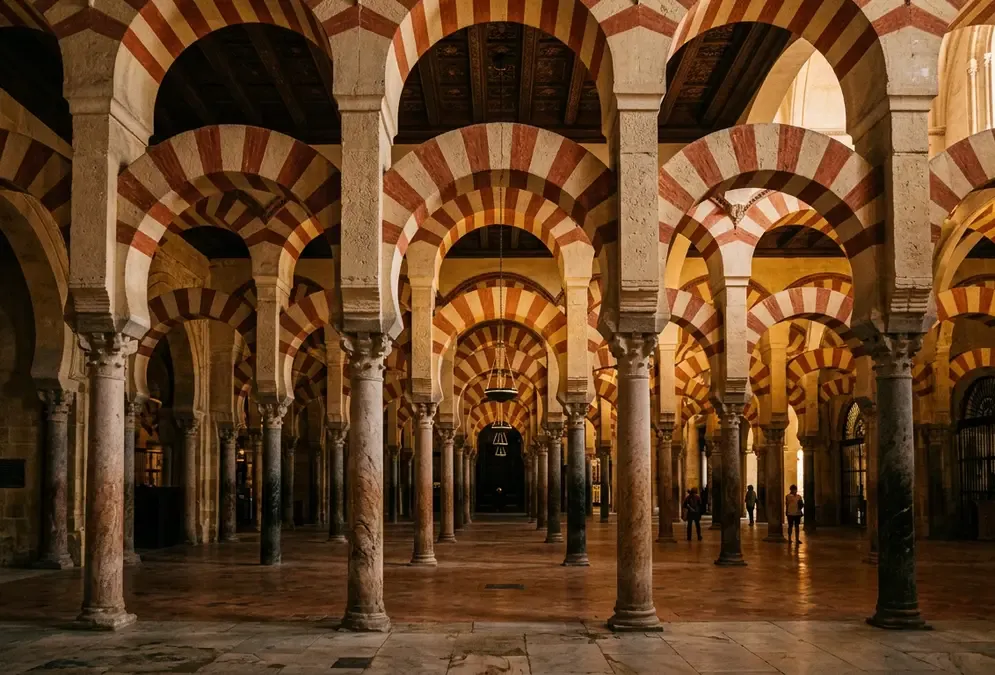
Abd al-Rahman III: The Morning Córdoba Became a Caliphate
On January 16, 929, Abd al-Rahman III declared himself Caliph in Córdoba's Great Mosque, making the city a rival to Baghdad and Cairo at its medieval peak.
The Mezquita survived, as mosques survive wars: too sacred to demolish, too large to repurpose quickly. The library of Al-Hakam II[3] did not fare as well. Almanzor had burned the philosophy and logic sections in 978 to satisfy conservative clerics[5]. What remained scattered during the fitna as the city was besieged and the court disintegrated. Manuscripts went with their owners to taifa courts across al-Andalus, where new patrons competed for the same intellectual talent. The library did not survive as a collection; what dispersed from it did not travel as a whole.
Why it collapsed: the structural failure behind the civil war
The fitna was not a religious conflict and not primarily an ethnic one, though ethnic divisions made it worse. It was a governance failure: the Umayyad caliphate had allowed Almanzor to hollow out its institutions for thirty years, and when he died, there was no constitutional mechanism to transfer authority. The caliphate's legitimacy rested on Umayyad dynastic succession; Almanzor had kept that succession alive as cover while stripping it of substance. The moment his son tried to formalise what his father had exercised informally, the cover blew off.
The Berber mercenaries who had been Almanzor's military instrument were, by 1009, ungovernable. They had been recruited specifically to be loyal to pay rather than dynasty or tribe. When the paymaster died and his heirs failed, they did what mercenary forces do when central authority collapses: they fought for whoever paid and against whoever did not, then fought for themselves.
The ethnic divisions between Arab nobles, Berber troops, and Saqaliba palace guards had been managed under Almanzor through the discipline of continuous campaigning and the coercion of a single dominant personality. Remove that personality and you had three armed factions with incompatible interests and no shared institutional loyalty. Each backed a different Umayyad claimant. None could hold the city.
The long consequence was geopolitical. Before 1031, the caliphate had the resources and central authority to resist Christian expansion from the north. After 1031, the taifa kingdoms competed with each other more than they defended collectively against anyone. The fragmentation of 1031 did not cause the Reconquista; it removed the main obstacle to it. Averroës, writing in Córdoba 150 years after the fitna, could still work within a tradition of Islamic philosophical scholarship that survived the collapse. The city itself would be taken by Fernando III of Castile in 1236. The taifa kings, individually, could not stop him.