
The canon's son who made himself a stranger to clarity
Luis de Góngora y Argote was born on July 11, 1561, in Córdoba[1], into a household with two significant advantages: a judge father who owned an exceptional private library, and a mother from a minor noble family that held an ecclesiastical canonry in the city's cathedral. The boy would eventually inherit both the books and the canonry.
He enrolled at the University of Salamanca in 1576, stayed four years, and left without graduating. This suited him better than it sounds. Salamanca gave him Latin, Greek, classical mythology, and exposure to the Italian Renaissance poets who were reshaping Castilian verse. He returned to Córdoba and took up the canonry at the Mezquita-Catedral, which required enough priestly appearance to keep the income without consuming his days in devotion.
Explore nearby · Monument
Palacio de Viana
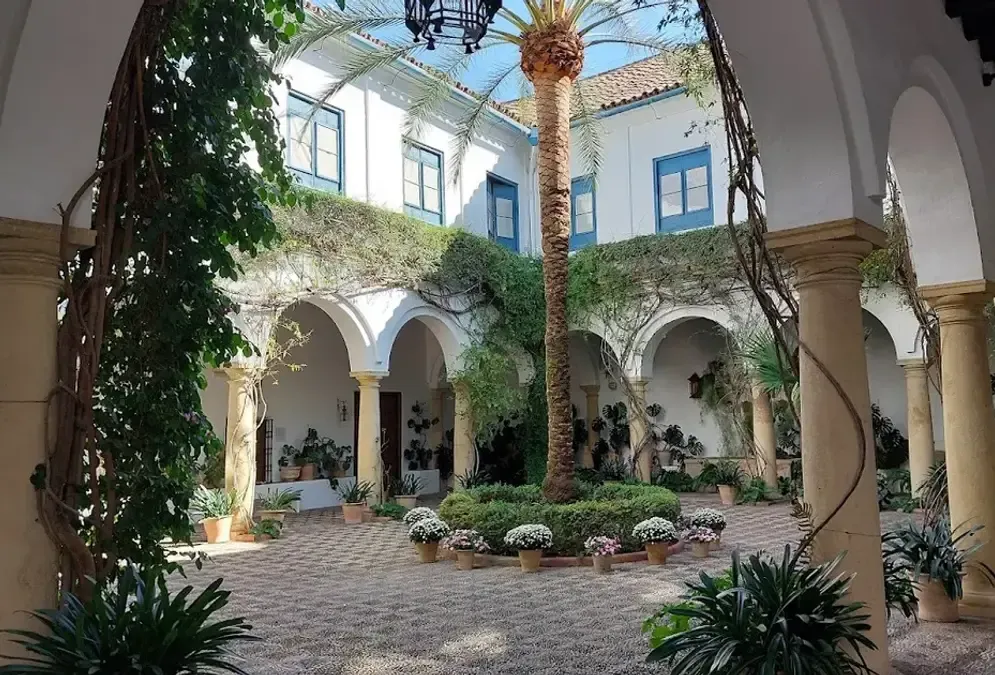
Renaissance palace with 12 themed courtyards, six centuries of art and the best Cordoban leather collections in the city. Known as the Museum of Patios.
There was a reason he took his mother's surname and dropped his father's name of Argote. The limpieza de sangre laws (purity of blood statutes governing who could hold ecclesiastical positions) meant Jewish ancestry was disqualifying. His father's family line carried suspicion. By calling himself Góngora, he attached himself to a cleaner genealogy. The ambiguity would follow him regardless.
His early poems circulated in manuscript from the 1580s onward, and they announced immediately that something different was coming. Satirical romances, accessible letrillas, lyric sonnets — the young Góngora could write plain Castilian as well as anyone. The difficult style came later, deliberately. He understood exactly what he was doing when he made his poetry hard.
Culteranismo: the style that split Spanish poetry
Around 1610, something shifted in Góngora's work. The poems he began circulating in manuscript were no longer the wry, accessible romances his contemporaries had loved. They were dense with Latinisms, crammed with mythological references, built on syntax so inverted it read like a puzzle.
The movement he founded, or rather that crystallized around him, went by two names. His defenders called it culteranismo, from culto (cultured, refined). His enemies called it Gongorism. Both names stuck. The essential technique was to use language the way a goldsmith uses gold: to make the surface so ornate that its underlying material becomes secondary. Where plain speech would say the sun set, Góngora might write that the shepherd of stars extinguished the fires of Helios behind the amethyst mountains. Neither easier to read nor incidentally difficult: deliberately, philosophically obscure.
The Latinisms were not careless. He borrowed vocabulary directly from Virgil, Ovid, and Horace, sometimes inventing Spanish equivalents of Latin constructions that had never existed in Castilian. He reversed the expected order of nouns and verbs, so the reader had to hold a sentence in suspension before it resolved. He stacked mythological allusions three deep, so that understanding a single metaphor required knowing Ovid, then Virgil, then a third classical source that Góngora had fused with the first two.
Contemporaries who could not follow it called it obscurantism. Some who could follow it said the same thing. Francisco de Quevedo, his great rival, argued that Góngora had mistaken difficulty for depth — that writing no one could read was not a virtue. Góngora's response, paraphrased across dozens of poems and letters, was essentially: if you need it explained, you are not the audience.
The works: from accessible romances to the impossible Soledades
The range across Góngora's career is wider than his reputation for difficulty suggests. His letrillas (short, lyrical pieces, often satirical) are among the most immediately pleasurable poems in the Golden Age. Ándeme yo caliente / y ríase la gente (Let me stay warm / and let the people laugh) has the ease of a folk song. His romances tell stories with a directness that anticipates the ballad tradition. These early pieces made him famous by the 1580s and 1590s; they are still the Góngora most Spanish schoolchildren encounter.
The late, difficult works are another matter.
The Fábula de Polifemo y Galatea (1612)[3] retells the story of the Cyclops Polyphemus and the nymph Galatea from Ovid's Metamorphoses, but through a lens of such mythological compression and syntactical violence that reading it in Spanish feels like reading the original Latin without a dictionary. Scholars have spent four centuries annotating it. The poem is sixty-three octaves of controlled explosion.
The Soledades (Solitudes), begun around 1613[4] and never completed, pushed further still. The conceit is simple: a shipwrecked traveller moves through a pastoral landscape, attending a wedding, watching fishermen work, observing the countryside. The execution made it immediately controversial. Contemporaries complained that Góngora had made the Spanish language unrecognisable. Lope de Vega dismissed it. Critics wrote pamphlets against it. Góngora wrote pamphlets back.
What the Generation of '27 (Lorca, Alberti, Guillén, Aleixandre) did with Góngora in the 1920s was to declare him their ancestor. They organised a tercentenary celebration in Seville in 1927 to mark three hundred years since his death. The most important Spanish poetry of the twentieth century took him as its starting point. The obscurity had aged into genius.
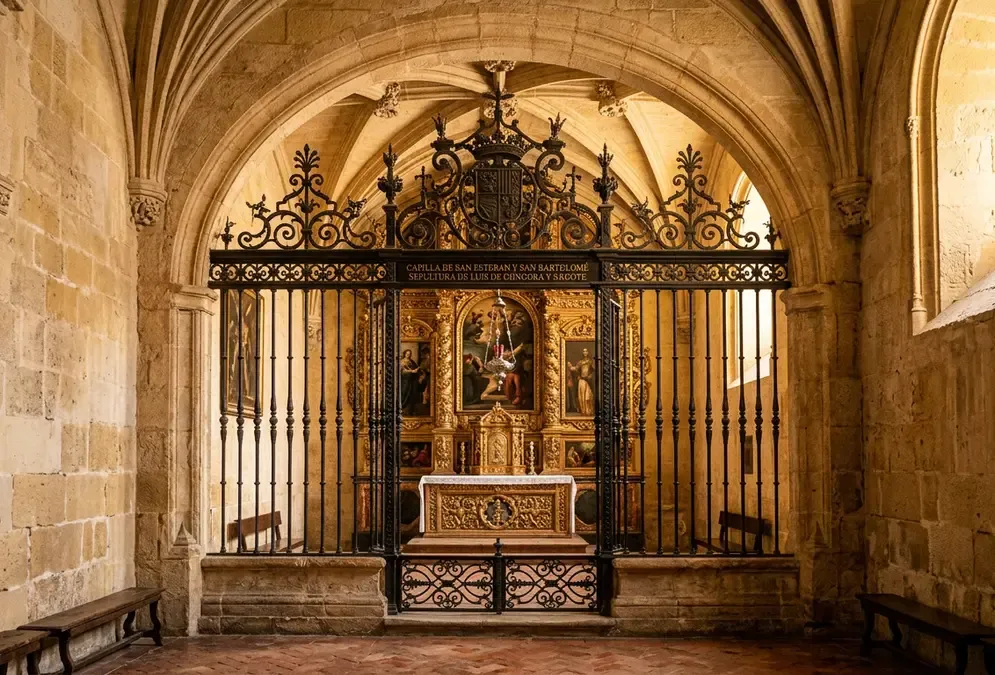
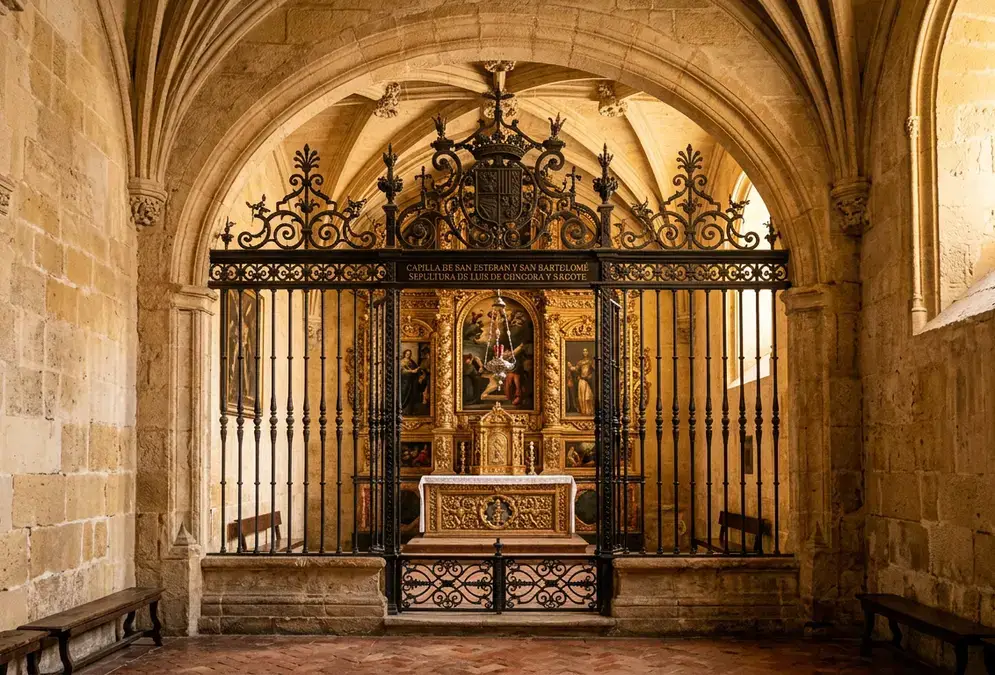
The Capilla de San Esteban y San Bartolomé, where Góngora was buried in 1627. The iron grille bears the family coat of arms at its arch; behind it, a white marble plaque marks the repositioned remains.
The feud with Quevedo
Francisco de Quevedo was born in 1580, nineteen years after Góngora, and spent much of his literary career trying to destroy his rival's reputation. The animosity was personal as well as aesthetic: Quevedo mocked Góngora's long nose in verse, and Góngora responded by calling Quevedo a clumsy hack. Both men were writing satirical attacks on each other by the early seventeenth century, and both were good enough at insults to make the exchange genuinely literary.
The underlying disagreement was real. Quevedo was the great practitioner of conceptismo — wit compressed to the point of violence, meaning packed into as few words as possible. His sonnets on death, on time, on political corruption, run about fourteen lines and contain more thought per word than almost anything in the language. What he objected to in Góngora was not difficulty per se but what he saw as decorative difficulty: language that substituted beautiful surfaces for ideas.
Góngora thought Quevedo was writing for people too lazy to read. Quevedo thought Góngora was writing for people who wanted to feel clever without thinking. Both were partially right about each other.
The feud shaped how later critics positioned both writers. For two centuries after their deaths, Góngora's reputation suffered while Quevedo's held. Culteranismo became a term of abuse. Then the Generation of '27 reversed the verdict, and Góngora climbed back. Today literary historians tend to rank them as equals: two different solutions to the problem of what Baroque poetry should do, neither winning the argument because neither argument was wrong.
The grave inside the cathedral
Góngora died on May 23, 1627, in Córdoba[2], having come back to the city in his final years after a long period in Madrid pursuing court patronage. He had been appointed honorary chaplain to Philip III in 1617[5], a post that gave him prestige without much income and required his physical presence at court. The Madrid years were not happy. He accumulated debts, struggled with his health, and returned to Córdoba to die in the city where he was born.
As a canon of the cathedral, he was entitled to burial within it. He was interred in the Capilla de San Esteban y San Bartolomé[6], a lateral chapel on the south side of the Mezquita-Catedral, close to the mihrab area. The chapel already held other burials; his was one among several, which is part of why it attracts so little attention.
In 1858, at the request of a local nobleman named Joaquín Fernández de Córdoba y Pulido, the remains were exhumed, placed in lead and wooden caskets, and repositioned on the right wall of the chapel[7]. A white marble plaque with a Latin inscription naming Góngora among Spain's great poets was installed at that point.
Deep dive · Article
Cordobán Leather: The Craft That Named the English Cordwainer
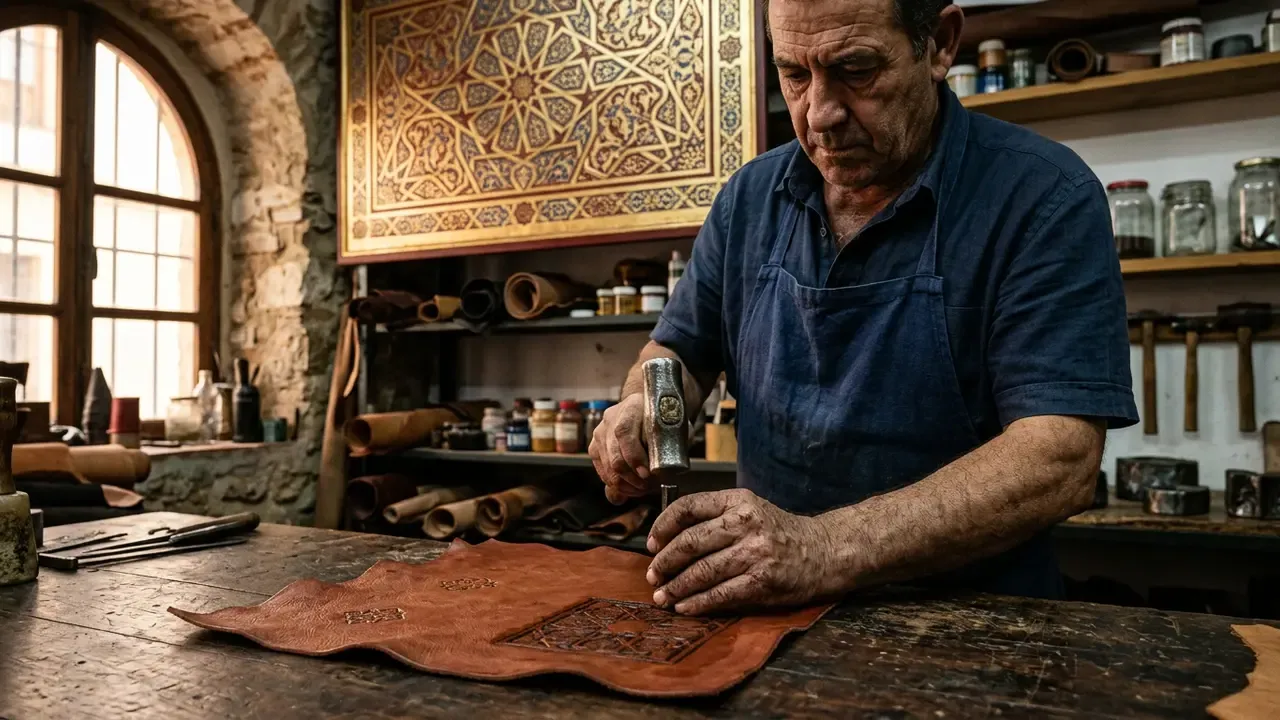
Córdoba gave English its word for shoemaker. How medieval goatskin tanned with sumac became Europe's finest leather and named a London guild still active today.
The chapel entrance is fronted by an iron grille. At the top of the grille arch, the Góngora family coat of arms appears. Behind the grille, the marble plaque is visible if you know to look for it. Many visitors pass it without stopping.
The Mezquita-Catedral has dozens of internal chapels, most of which draw no dedicated visitor attention. The Capilla de San Esteban y San Bartolomé is on the side of the building that tourists tend to move through quickly after seeing the mihrab and the cathedral nave. This is, if nothing else, appropriate. Góngora spent his career writing poetry that most of his contemporaries walked past without understanding it.
Finding the tomb: what to look for on your visit
The Capilla de San Esteban y San Bartolomé sits on the south interior wall of the Mezquita-Catedral, in the section closest to the mihrab. Once you have seen the mihrab, turn and walk parallel to the south wall. You are looking for a chapel fronted by a dark iron grille with a pointed arch. The family coat of arms appears above the arch opening.
The white marble plaque inside the chapel is the marker placed after the 1858 repositioning[7]. It is not elaborate: a rectangular slab with Latin text. The chapel is accessible as part of standard admission to the Mezquita-Catedral; no separate ticket is needed. The grille means you cannot enter the chapel itself, but the plaque is legible from the entrance if the light is reasonable.
The easiest time to find it without crowds pressing around you is early on a weekday morning, when the south wall corridor is largely empty. Check current opening hours on the Mezquita-Catedral's official site before visiting, as they vary by season.
The Góngora monument in the city is at Plaza de la Trinidad, a five-minute walk northwest of the Mezquita. The bronze statue, sculpted by Amadeo Ruiz Olmos — the same Córdoba sculptor who made the Seneca statue beside the Puerta de Almodóvar — shows Góngora full-length on a grey granite pedestal. It is the more photogenic memorial; the tomb requires knowing what you are looking at. Both are worth finding. The statue is a monument to the public reputation; the chapel is where the man actually is.